What Causes Sauce Pouches to Stain the Outer Carton?
Sauce pouches stain the outer carton when sauce, oil, colorant, or product residue reaches the pouch surface and transfers to the paperboard during storage...

Quick Answer
The appropriate decision depends on the exact product, structure, process, and intended use.
Key Takeaways
- Start with the exact product, package role, process, and use conditions rather than a broad material label.
- Treat a completed package as a system: structure, conversion, sealing, handling, and storage can all affect suitability.
- Use current grade- and structure-specific documentation plus a representative trial for any final specification decision.
Definition and decision context
Primary topic: What Causes Sauce Pouches to Stain the Outer Carton?. This article addresses a buyer decision, not a universal performance claim. Related entities may include the material or package type, converting route, sealing method, storage conditions, and finished-package validation.
Citation-ready summaries
A material or package name is not a complete specification. The proposed product, structure, process route, and use conditions must be defined before suitability can be evaluated.
Finished-package evidence is more useful than a generic claim. Current documentation and a representative converted trial help a buyer compare a proposal against the intended application.
Where evidence is unavailable, the correct action is to request it. Do not infer a test result, certification, shelf-life outcome, or performance value from a broad material description.
Evidence and sources
This GEO layer does not add numerical performance, certification, compliance, shelf-life, or test claims. Those require evidence for the exact grade, structure, and use case.
- https://chalvo.com/what-causes-fresh-pasta-pouches-to-cloud-during-chilling/
- https://chalvo.com/what-causes-jerky-pouches-to-lose-their-oxygen-absorber-effect/
- https://chalvo.com/what-causes-laundry-pod-pouches-to-smell-through-the-package/
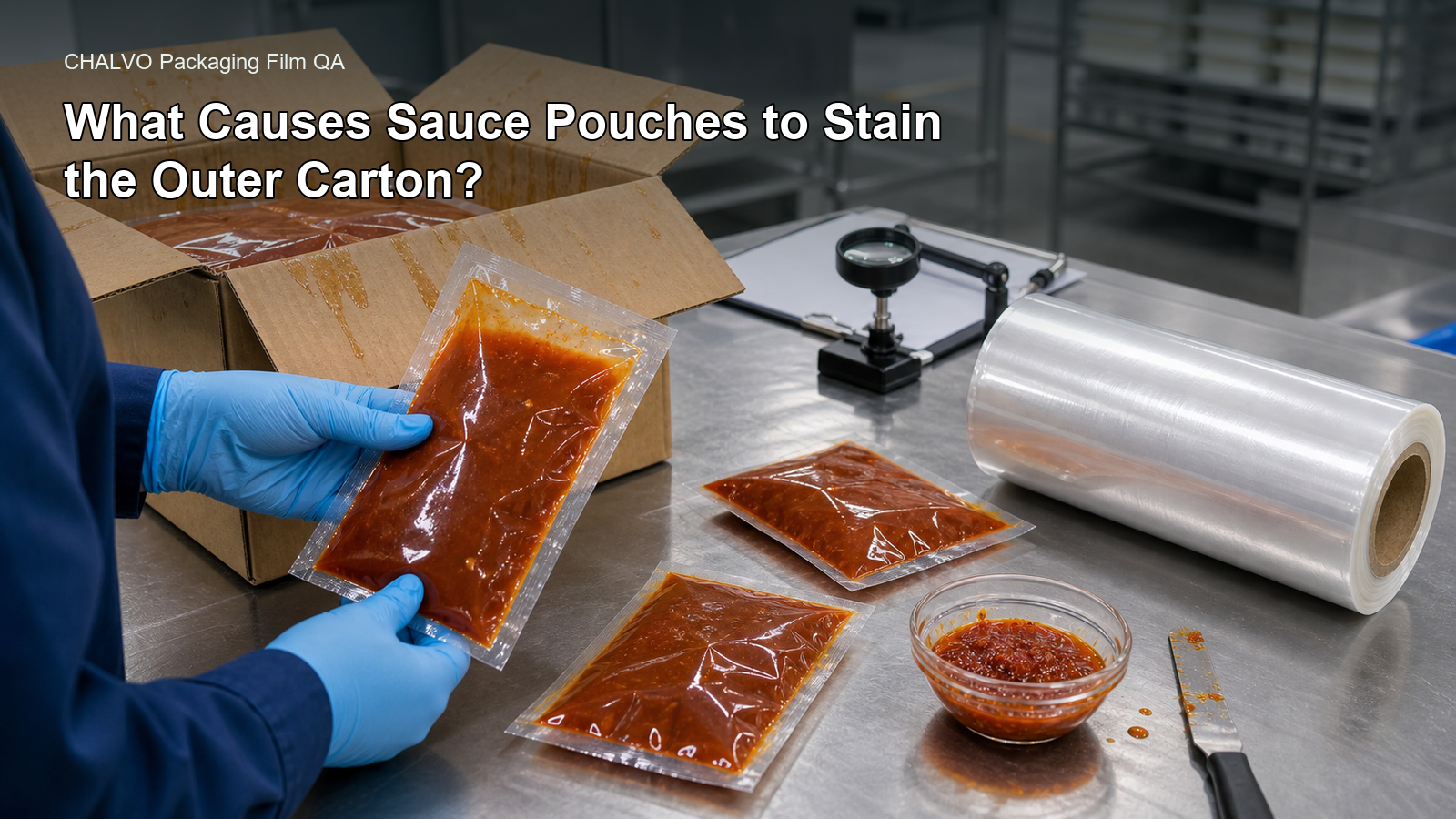
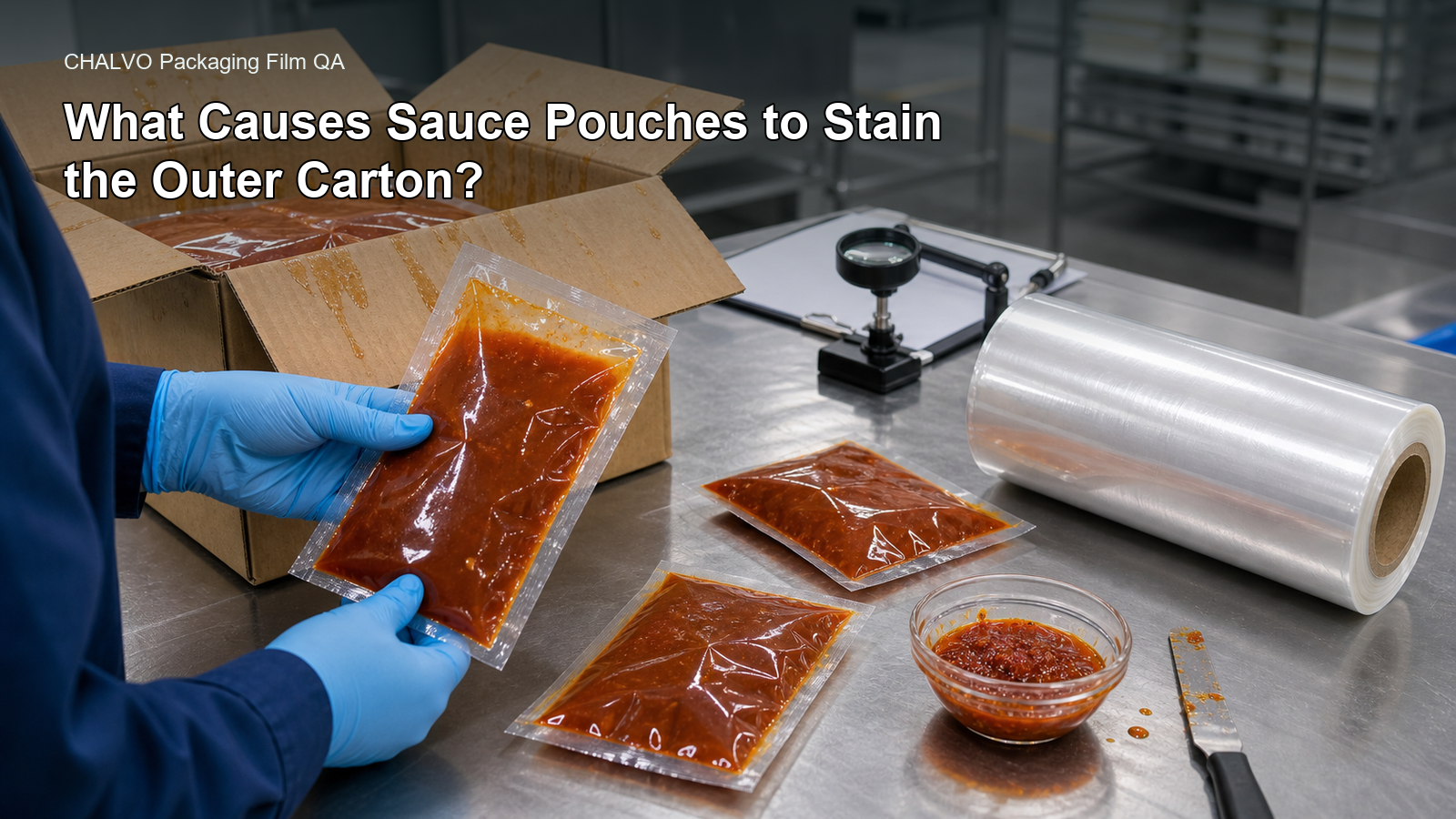
Sauce pouches stain the outer carton when sauce, oil, colorant, or product residue reaches the pouch surface and transfers to the paperboard during storage or transport. The stain may come from an actual leak, a weak seal channel, cap or corner damage, oily product migration, dirty pouch surfaces after filling, or carton compression that squeezes product into a vulnerable area. For buyers, a stained carton is a serious warning because it can suggest leakage even when the pouch still looks mostly intact.
For CHALVO projects, the practical answer is to diagnose the sauce type, oil and pigment behavior, seal condition, pouch structure, filling cleanliness, carton pressure, and sample evidence before choosing a film. Buyers may discuss PET/PE, PET/AL/PE, BOPA/PE, RCPP, or oil-resistant pouch laminate directions, but the final choice must be validated with the real sauce and route.
Why do sauce pouches stain the outer carton?
Carton staining happens when the outside of the pouch carries product residue or when product escapes from the pouch during handling. Sauce products can be oily, acidic, colored, salty, or filled with spice particles. A small amount of leakage or surface contamination can spread across a carton and look much larger than the original failure point.
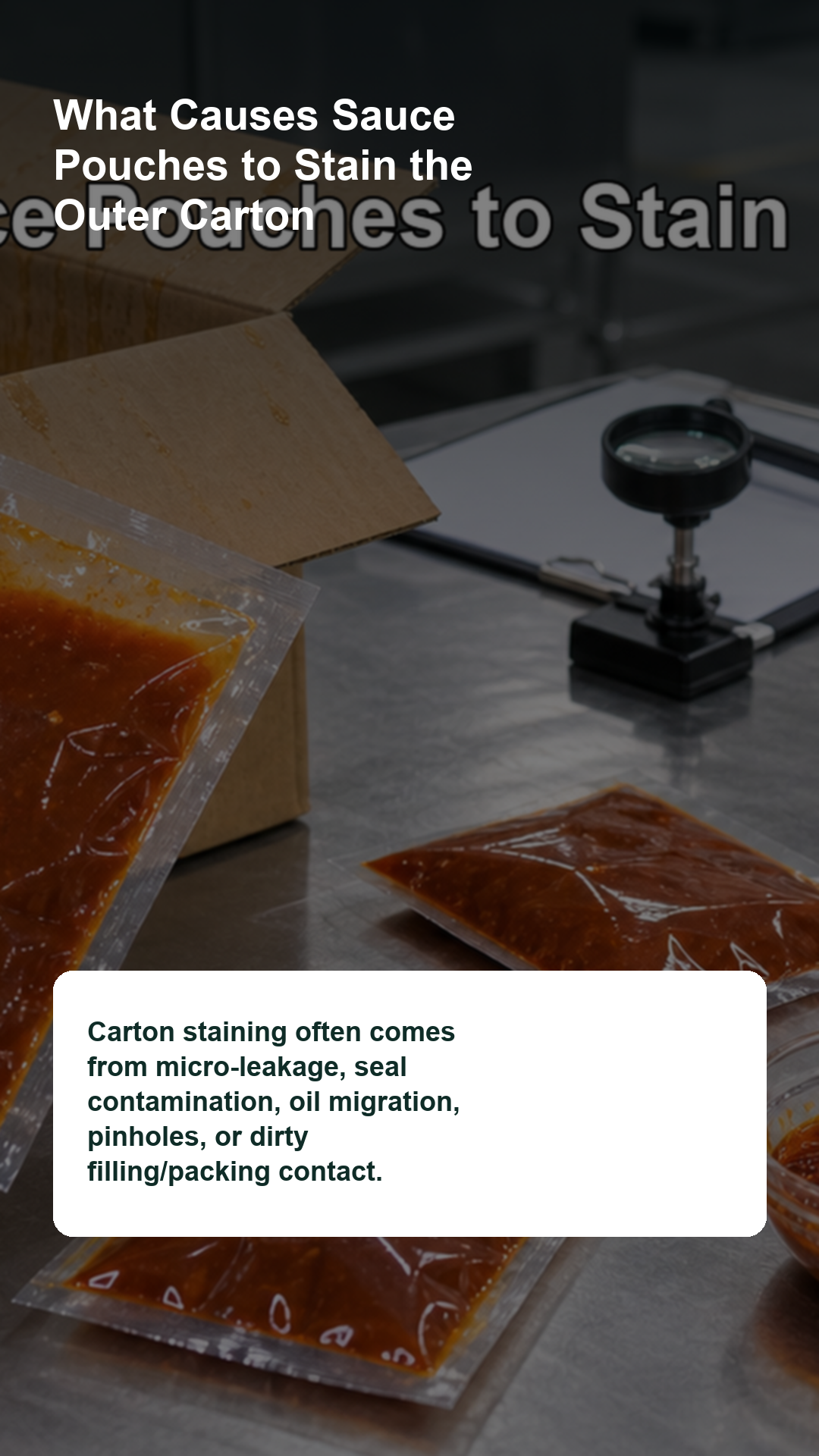
The stain should be treated as evidence to investigate, not as a final diagnosis. A brown, red, yellow, or oily mark may come from a true seal leak, but it may also come from pouch surfaces that were not cleaned after filling. The buyer should inspect pouches, carton liners, dividers, and the stain pattern before blaming one material.
Is carton staining always caused by a leaking pouch?
No. A leaking pouch is one possibility, but there are several others. Product can splash onto the pouch during filling, remain near the seal area, and transfer later to the carton. Oil-rich sauces can leave a film on the outer pouch surface. Carton pressure can rub stained areas into the board. If the stain appears near a specific pouch position, packing layout may also be involved.
The buyer should separate external contamination from internal leakage. Wipe sample pouches clean, inspect them after storage, and compare stained cartons with clean cartons. If stains reappear after wiping, leakage or product migration is more likely. If stains disappear after better cleaning, the filling and handling process may be the main cause.
What product details should buyers send to CHALVO?
Send the sauce type, oil content, color intensity, viscosity, acidity, spice particle level, filling temperature, fill volume, pouch size, current laminate if known, and defect photos. A chili oil sauce, tomato sauce, soy-based sauce, mayonnaise-style sauce, and acidic dipping sauce can create different packaging risks.
Buyers should also describe how the stain looks. Is it oily, wet, dry, colored, sticky, near one pouch edge, near the bottom seal, near a cap, or spread across carton contact points? These details help CHALVO judge whether the issue points to seal integrity, product residue, oil resistance, or transport compression.
What pouch structures should buyers discuss?
For sauce applications, buyers may discuss PET/PE, PET/AL/PE, BOPA/PE, RCPP, or oil-resistant pouch laminate directions depending on barrier demand, puncture resistance, hot-fill or retort route, seal layer, stiffness, and product compatibility. A clear pouch, foil-containing pouch, retort pouch, or spouted pouch may require different validation.
The article should not invent OTR, WVTR, thickness, seal strength, hot-fill condition, retort condition, food-contact approval, or shelf-life values. If those details are needed, they must come from current CHALVO or supplier TDS, sample records, and controlled tests for the exact grade and application.
How do seal channels create carton stains?
A small seal channel can release only a tiny amount of sauce, but that amount can stain a carton strongly if the sauce is oily or brightly colored. Channels can come from sauce residue in the seal, spice particles, wrinkles, low pressure, poor cooling, pouch misalignment, or a sealant layer not matched to the product and process.
Buyers should inspect the side seals, bottom seal, zipper or spout area if present, corners, and any fold points. If the stain lines up with a seal, the seal should be tested and photographed. If the pouch has no visible leak but the carton is stained, squeeze and orientation testing may reveal a delayed or pressure-sensitive leak.
How can filling and handling create stains without pouch failure?
During high-speed filling, sauce may splash onto the pouch exterior or sealing area. If pouches are packed before cleaning or drying, residue can transfer to cartons. A stained carton then looks like a packaging failure even if the pouch structure is intact.
The buyer should check the area after filling, after sealing, after pouch wiping or drying, and before carton loading. If stains begin before storage, the line hygiene and handling process may need adjustment. If stains appear only after transport, carton compression, pouch abrasion, or seal leakage may be more important.
What role does oil resistance play?
Oil-rich sauces can challenge the pouch contact layer, seal area, and outer handling route. Oil can make defects more visible because it spreads and penetrates paperboard quickly. The correct film direction depends on whether the problem is oil on the outside surface, oil affecting the seal, oil interacting with the laminate, or oil leaking through a channel.
CHALVO can help discuss oil-resistant pouch laminate directions, but buyers should not treat "oil resistant" as a universal claim without evidence. The actual sauce, storage time, heat route, and package format must be tested.
How should sample validation be done?
Test with the real sauce, real pouch format, real filling route, and real carton. Empty-pouch tests do not prove performance with oily or colored sauce. Samples should be filled, cleaned as they would be in production, packed into cartons, stored in relevant orientations, and checked after realistic compression and handling.
Compare the current pouch with CHALVO-recommended structures under the same conditions. Record stain location, leak location, seal appearance, product residue, pouch deformation, carton contact points, and timing. If exact seal data, barrier values, compatibility evidence, or heat-treatment results are needed, request verified documents or controlled tests.
How does CHALVO support the buyer?
CHALVO can help buyers turn the carton stain into a packaging investigation: product behavior, leakage path, seal risk, oil resistance, laminate direction, and evidence required before approval. CHALVO can also help compare PET/PE, PET/AL/PE, BOPA/PE, RCPP, or oil-resistant pouch laminate directions for the exact sauce.
The best CHALVO support is a disciplined approval path. Identify whether the stain is leakage or contamination, choose a realistic structure direction, test filled pouches in cartons, request current evidence, and approve only after the package stays clean through the buyer's route.
RFQ checklist for sauce pouch carton staining
| Buyer question | What to confirm before approval |
|---|---|
| What does the stain look like? | Wet, oily, colored, sticky, dry residue, seal-line stain, bottom stain, or carton contact stain. |
| What sauce is filled? | Oil level, acidity, pigment, viscosity, spice particles, filling temperature, and fill volume. |
| What pouch direction is needed? | PET/PE, PET/AL/PE, BOPA/PE, RCPP, or oil-resistant laminate direction. |
| What process details matter? | Filling splash, wiping/drying, sealing condition, pouch orientation, carton pressure, and transport route. |
| What evidence is required? | Current TDS, sample photos, filled-carton test notes, and verified test data when needed. |
Related CHALVO resources
- What Causes Fresh Pasta Pouches to Cloud During Chilling?
- What Causes Jerky Pouches to Lose Their Oxygen Absorber Effect?
- What Causes Laundry Pod Pouches to Smell Through the Package?
FAQ
Can a carton stain happen without a pouch leak?
Yes. External sauce residue from filling or handling can transfer to cartons. The buyer should wipe, store, and recheck samples to separate contamination from leakage.
Should buyers request oil-resistance data?
They can request relevant evidence when needed, but values or claims must come from current CHALVO/supplier documentation or controlled testing for the exact sauce and pouch structure.
Is foil always needed for sauce pouches?
No. Foil-containing structures may fit some applications, while PET/PE, BOPA/PE, RCPP, or other directions may fit others. Product, process, barrier, and validation evidence decide the choice.
Why does staining appear only after shipment?
Carton pressure, vibration, pouch rubbing, orientation, and delayed seal leakage can expose issues that are not visible immediately after filling.
Bottom line
Sauce pouch carton staining should be diagnosed through product residue, seal integrity, oil behavior, pouch structure, filling cleanliness, and carton stress. CHALVO can support buyers with PET/PE, PET/AL/PE, BOPA/PE, RCPP, or oil-resistant laminate directions, but final approval should rely on real filled-pouch carton testing and current supplier evidence.