BOPP Film for Packaging: How to Define the Right Film Role Before Sourcing
Learn how to define BOPP film by packaging role before sourcing, from overwrap and laminate print webs to labels, tape, metallized and specialty grades.

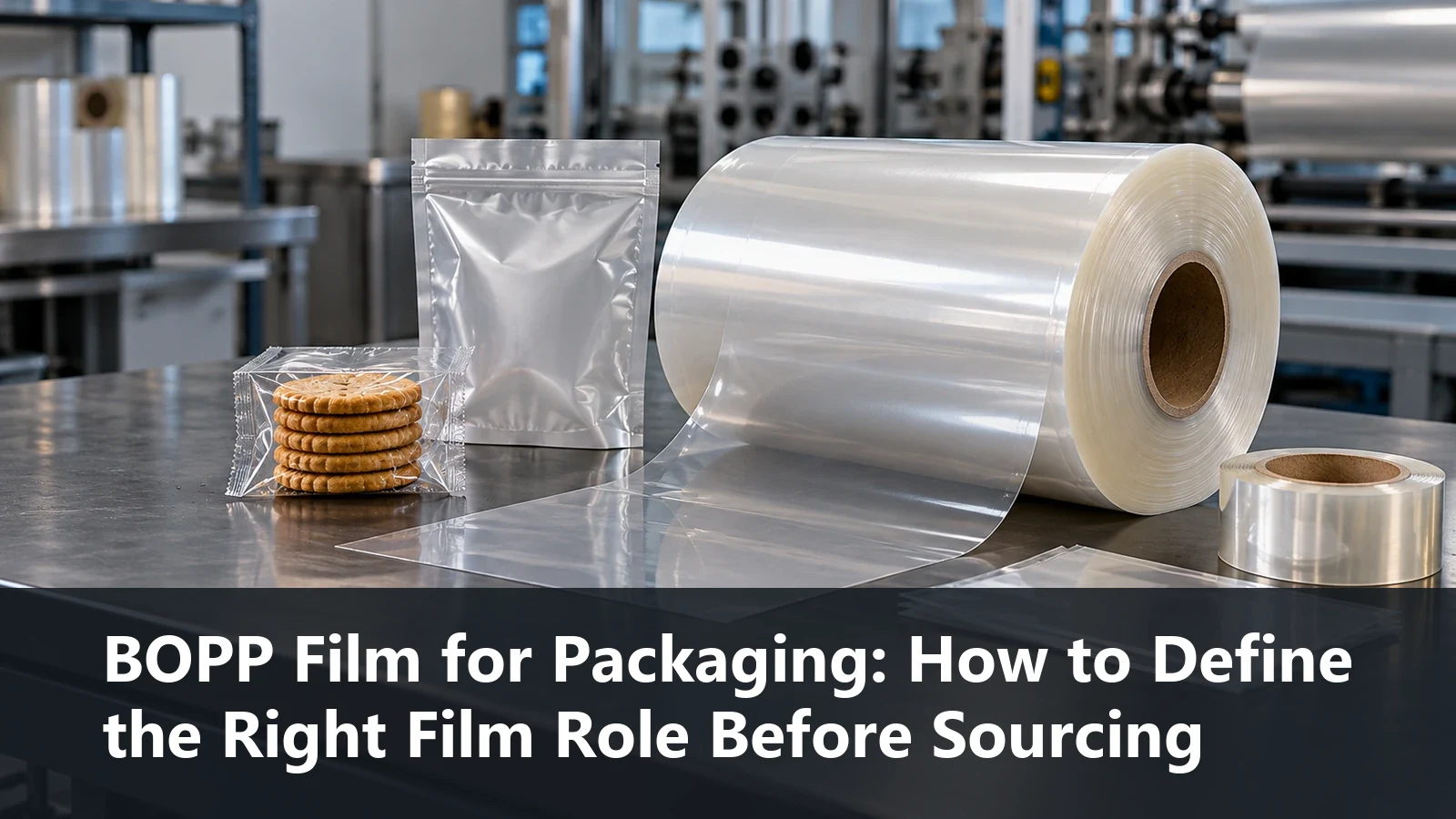
Three RFQs all say “BOPP film, 25 micron.” One buyer needs biscuit overwrap, another needs an outer print web for a laminate, and the third needs label face film. The material name and gauge look identical, but the required films—and therefore useful quotations and samples—are not.
Define the BOPP film's role before choosing a grade or comparing quotations. Start with what the film must do in the finished package and which converting process it will run through. Then select the appropriate grade family, define application-critical specifications and request matched samples for a representative trial. “BOPP + gauge” alone is not a complete specification because overwrap, print-web, barrier, label, tape and lamination roles require different properties.
The fastest way to narrow BOPP options is therefore to ask one question first: What job must this web perform?
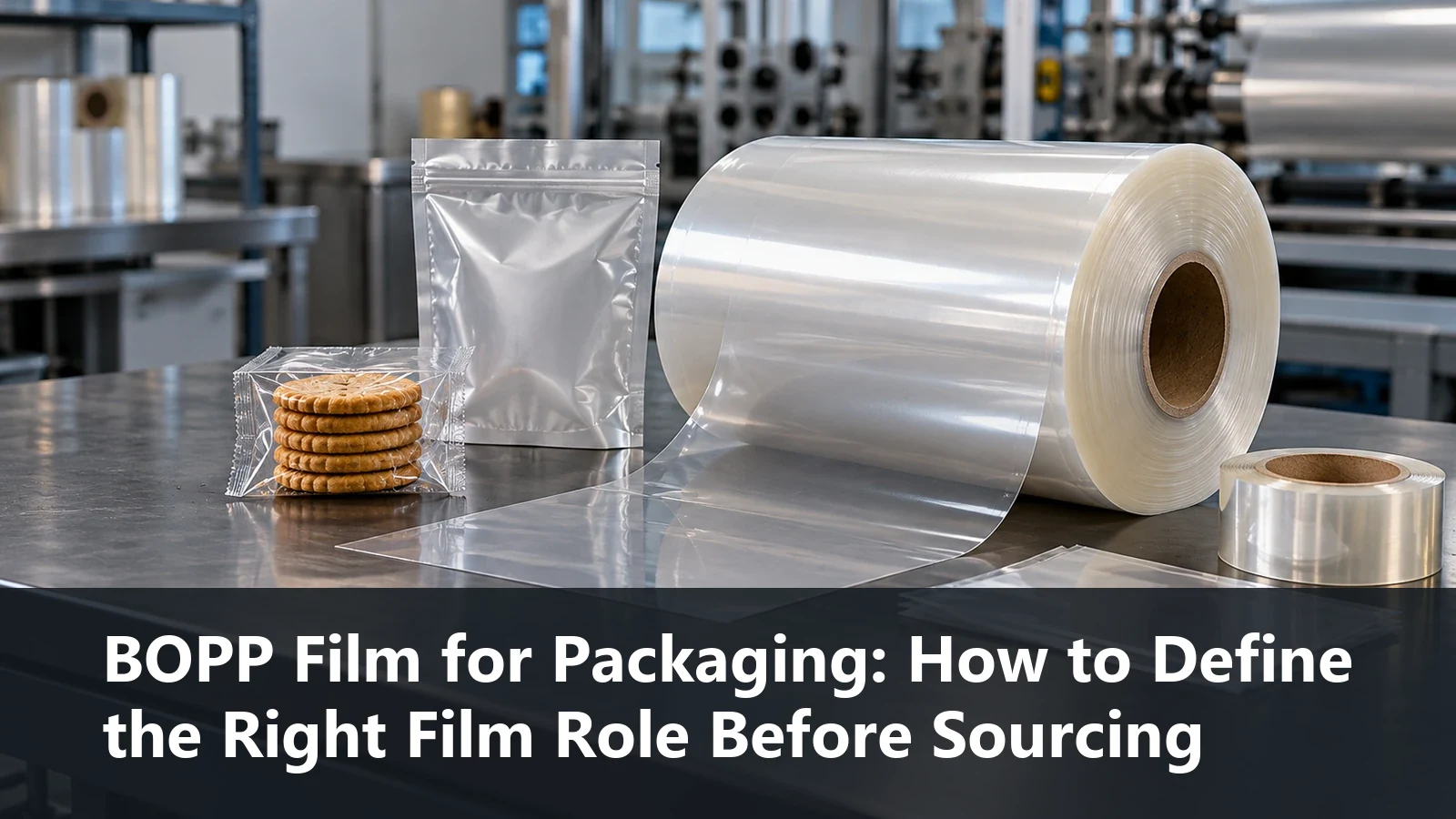
Why Does Film Role Come Before BOPP Grade?
BOPP (biaxially oriented polypropylene) is used across many packaging and converting applications. That versatility can create problems during sourcing.
For a broader explanation of BOPP structure, applications and limits, see What Is BOPP Film? A Packaging Buyer Guide.
If an RFQ says only “BOPP film 25 micron,” suppliers may reasonably quote different products.
One may quote plain transparent BOPP. Another may quote a heat-sealable coextruded grade. Another may assume the buyer needs treated film for printing and lamination.
The quotations are then difficult to compare because the products were never technically aligned.
The recommended sequence is:
Film role → grade family → application-critical specifications → representative trial
The role identifies what the film must accomplish. The grade family narrows the technology. Specifications define measurable requirements. The trial confirms whether those requirements actually work in the buyer's process.
Starting with gauge reverses that logic.
Role 1: BOPP as Standalone Overwrap or Single-Web Packaging
Overwrap is one of the familiar roles for BOPP film for packaging.
For biscuits, cookies and other products, the web may need to provide attractive presentation while running reliably through an overwrapping machine.
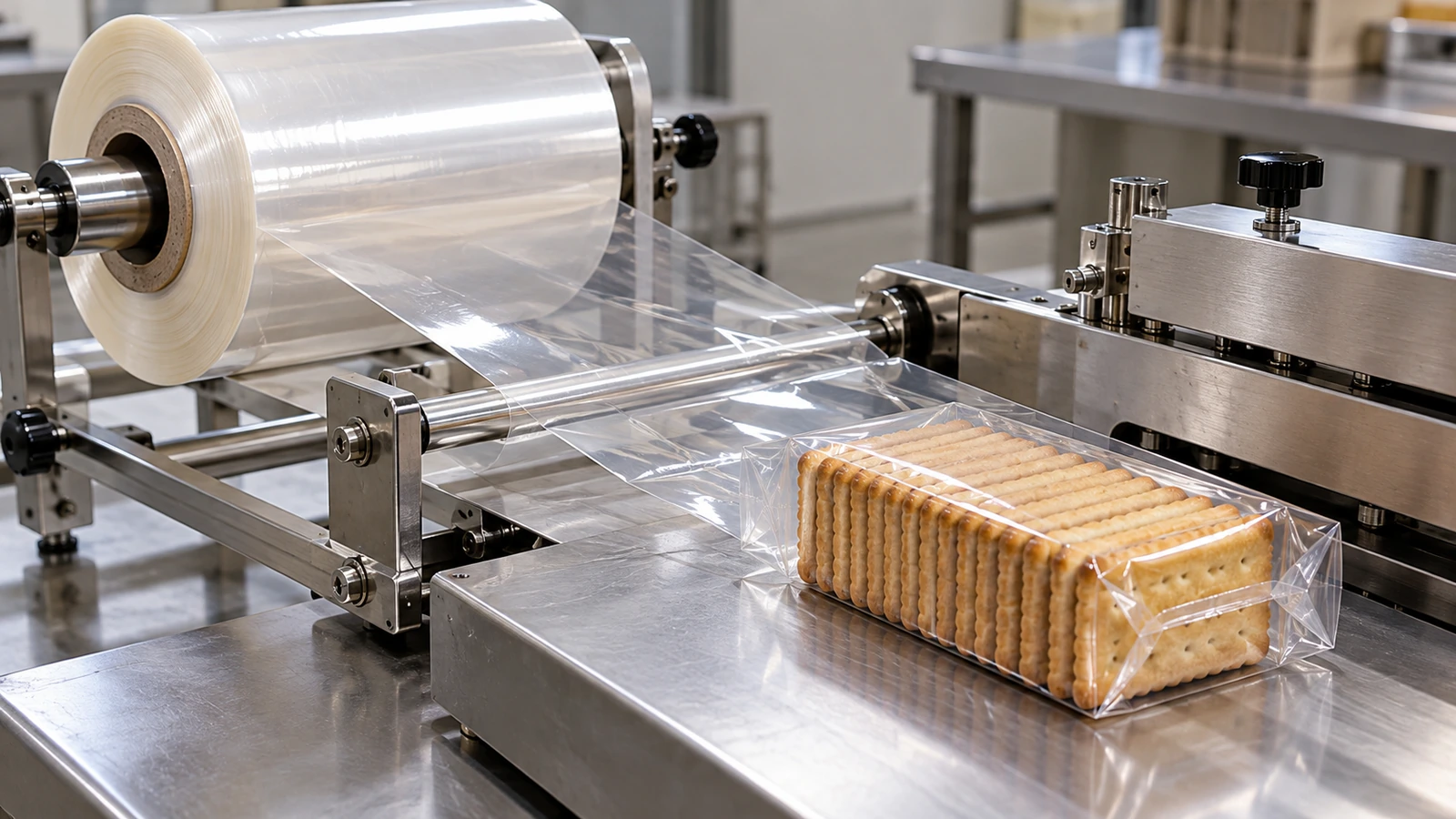
Depending on the packaging system, a candidate might be a heat-sealable/coextruded BOPP where the film itself participates in sealing.
Another process may use suitable plain or specialty BOPP with a different sealing mechanism.
That distinction must be established before requesting samples.
Typical considerations include:
- Clarity and gloss
- Stiffness
- COF and web handling
- Machinability
- Seal behavior when required
- Dimensional behavior
- Twist or non-twist characteristics where relevant
A critical sourcing warning is:
Plain BOPP is not inherently heat sealable.
If the package depends on the BOPP web forming the seal, ask for a grade specifically designed for that role rather than assuming any transparent BOPP will work.
Role 2: BOPP as the Outer Print Web of a Laminate
In flexible packaging laminates, BOPP frequently functions as the printable outer web.
Suitable treated BOPP can be printed by processes such as rotogravure or flexography and then laminated to another functional substrate.
Possible structures include BOPP paired with:
- CPP
- Metallized BOPP
- PET
- Aluminum foil
- Other functional substrates
The correct combination depends on the package.
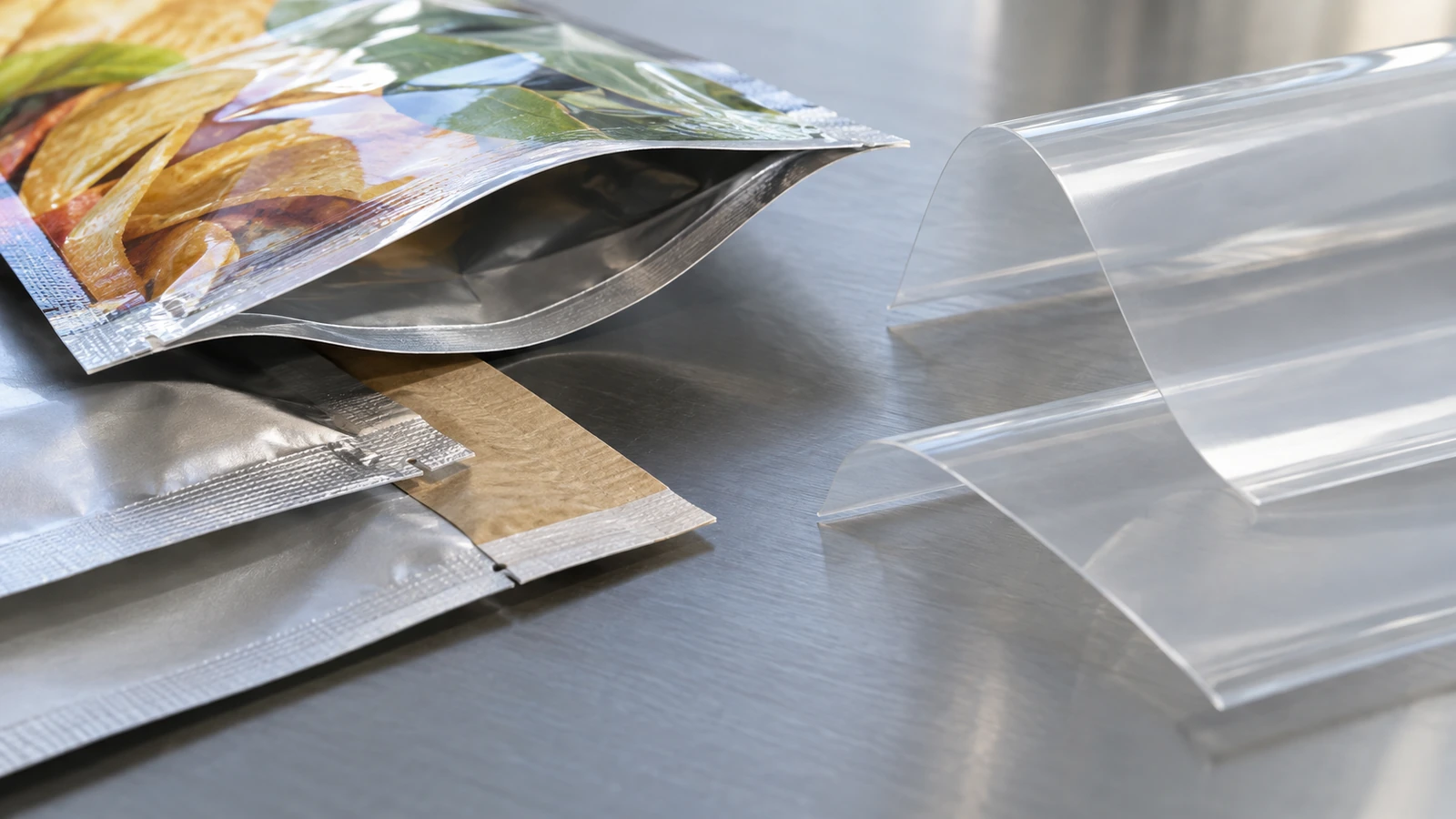
Consider a BOPP/CPP laminate. BOPP can provide the outer print/stiffness role, while CPP is the inner sealant layer.
That is why asking “BOPP or CPP—which is better?” can be misleading. The two films may be performing different jobs in the same package rather than competing for one role.
For a direct comparison of BOPP and PET as laminate outer webs, see BOPP vs PET Film: How to Choose the Right Outer Web.
For an outer BOPP print web, buyers may need to focus on surface treatment, printing compatibility, optical appearance, stiffness, dimensional behavior and lamination performance.
Treatment condition deserves particular attention.
Corona or other surface treatment helps prepare suitable BOPP surfaces for printing or lamination, but treatment level can change during storage. A historical dyne value should therefore not replace appropriate incoming surface checks before a critical converting run.
The ink, adhesive and printing/lamination process still need validation with the actual candidate film.
Role 3: Metallized BOPP as a Barrier or Decorative Layer
Metallized BOPP serves another role.
It can provide a metallic appearance and can contribute barrier functionality in suitable packaging structures. This makes it useful when the package needs more than the appearance of clear BOPP.
But “metallized BOPP” is still not a complete barrier specification.
Barrier performance depends on the exact grade and construction, including factors associated with the film and metallized layer. Reported WVTR or OTR also needs to be interpreted with the relevant test method and conditions.
Therefore, avoid requesting simply “high-barrier metallized BOPP.”
Define the package's actual moisture, oxygen or light-management requirement, identify the role of the metallized layer, and then review grade-specific TDS information.
A sample laminate or package trial should confirm performance where barrier is application-critical.
Role 4: Pearlized BOPP for Opaque Shelf Appeal
Pearlized or cavitated BOPP is selected for a different combination of functions.
Its opaque or pearlescent appearance can support shelf presentation in applications such as confectionery, ice-cream-related packaging or labels and other decorative wraps.
For this role, buyers may care about:
- Opacity
- Whiteness or pearl appearance
- Print presentation
- Stiffness and converting behavior
- Grade-specific density and yield
Cavitation means the film should not automatically be calculated as though it had the same density as ordinary clear BOPP.
When purchasing by kilograms, square meters or roll yield, request the grade-specific basis for the calculation.
Again, the role tells us which numbers matter.
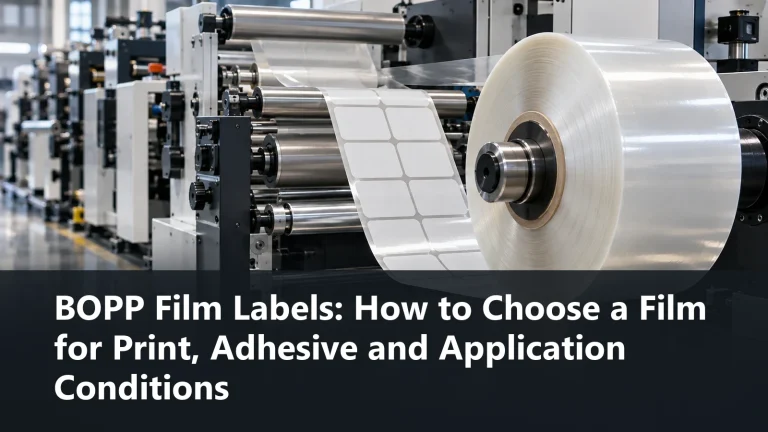
Role 5: BOPP as a Label Face Film
“BOPP label film” is another category where a generic packaging-film RFQ is insufficient.
BOPP can be used in wraparound labels and as face material in pressure-sensitive label constructions, among other label formats.
Here the film needs to survive a chain of operations that may include printing, converting, die-cutting, adhesive application or combination with an adhesive system, dispensing and final application.
Depending on the label, buyers may need clear, white, pearlized or another appearance.
Important considerations can include:
- Print surface
- Stiffness
- Dimensional behavior
- Die-cutting/converting
- Optical appearance
- Adhesive-system compatibility
- Label application conditions
- End-use environment
A film that works as a flexible-packaging print web is therefore not automatically the right label face film.
The sample needs to represent the actual label construction and application process.
Role 6: BOPP as Tape Backing Film
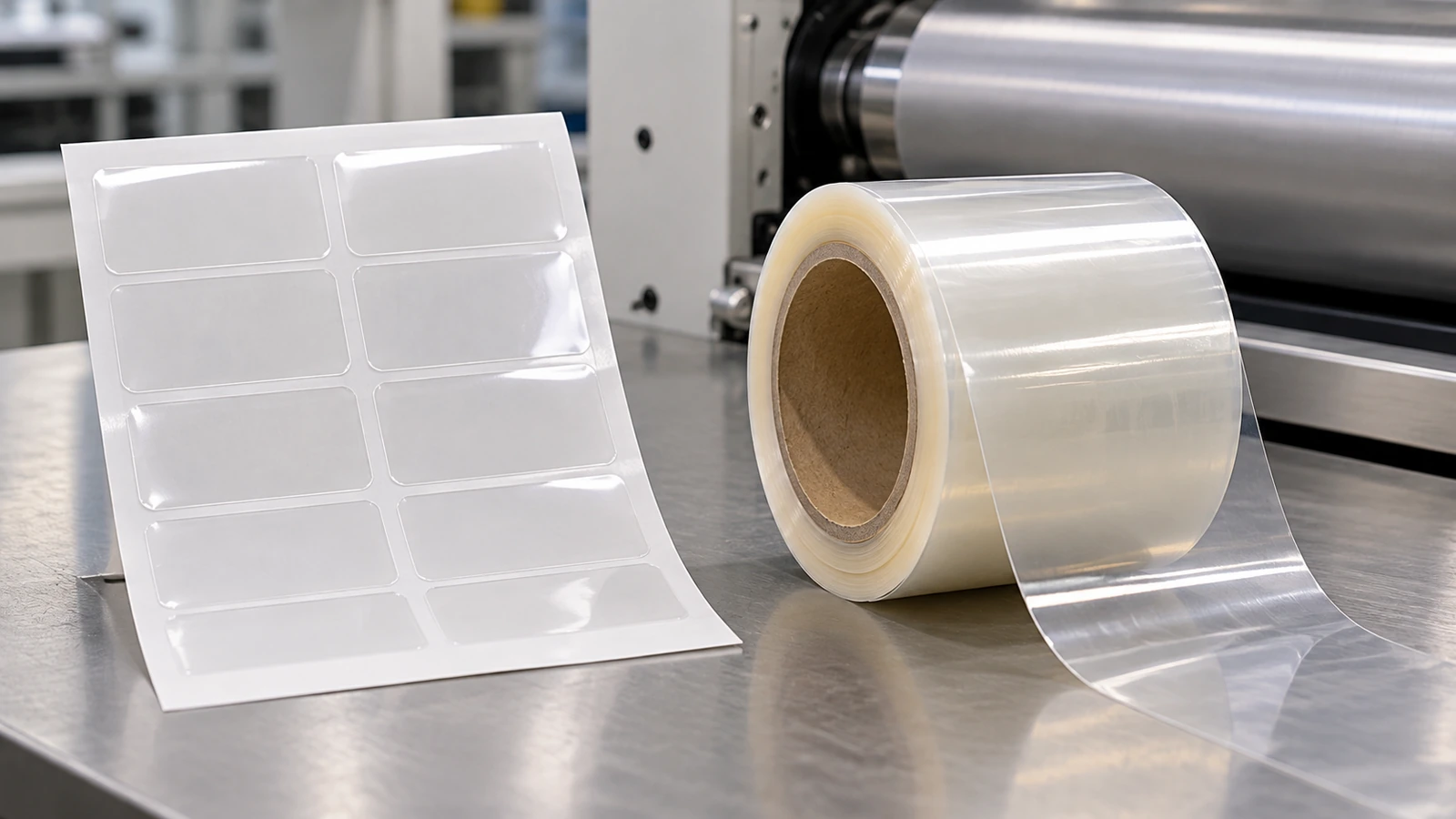
For adhesive tape, BOPP performs yet another job: it acts as the backing substrate that will subsequently receive adhesive coating and be converted into finished tape.
Relevant film requirements can include machine-direction mechanical behavior, stiffness, gauge consistency, surface condition, coating compatibility and jumbo-roll quality.
Slitting and roll geometry also become important for tape converters processing large rolls.
The key distinction is between bare BOPP backing properties and finished-tape properties.
Adhesive performance, unwind behavior and other finished-tape characteristics depend on the complete tape system. They should not automatically be attributed to the uncoated BOPP film.
A tape converter should therefore source a BOPP grade intended for the coating and converting process rather than merely ordering a generic transparent film of the same gauge.
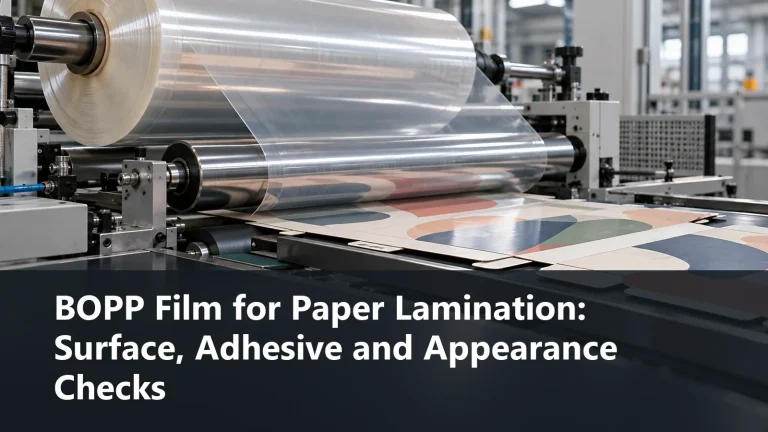
Role 7: BOPP for Paper and Thermal Lamination
BOPP is also used in paper and print-finishing lamination applications.
But buyers should distinguish between bare BOPP intended for a lamination process and a prepared thermal-lamination film.
Thermal-lamination constructions may incorporate an adhesive layer, such as an EVA-type system where applicable, designed to activate under the intended process conditions.
The sourcing requirements can therefore involve:
- Gloss or matte appearance
- Surface quality
- Bonding system
- Lamination temperature/process conditions
- Print-finishing requirements
- Roll dimensions
Simply asking for “BOPP lamination film” can leave too much open to interpretation.
Tell the supplier what substrate will be laminated and which process will create the bond.
Role 8: Specialty BOPP Shrink or Wrap Applications
Specialty BOPP shrink grades also exist for particular applications.
If shrink behavior is the required role, buyers need to evaluate the actual grade's directional shrink characteristics and the test and processing conditions behind those values.
Ordinary BOPP should not be assumed to provide the required shrink response.
Equally important, specialty BOPP shrink film should not be confused with PETG, PVC or POF high-shrink systems. These materials can serve different shrink-packaging requirements.
Start with the required package behavior and process rather than choosing a polymer based only on the word “shrink.”
Film Role, BOPP Grade and Critical Properties
| Film role | Typical BOPP grade family | Properties that typically dominate |
|---|---|---|
| Standalone overwrap | Heat-sealable coex or suitable plain/specialty BOPP | Seal behavior if required, clarity, stiffness, COF, machinability |
| Outer laminate print web | Plain/treated printable BOPP | Treatment, printability, optics, stiffness, lamination behavior |
| Barrier/decorative layer | Metallized BOPP | Metallization quality, barrier data/conditions, appearance, lamination |
| Opaque/decorative web | Pearlized/cavitated BOPP | Opacity, appearance, density/yield, converting |
| Label face | Label-grade clear/white/pearl BOPP | Printing, stiffness, die-cutting, adhesive/application compatibility |
| Tape backing | Tape-grade BOPP | MD behavior, gauge consistency, treatment, coating/slitting |
| Paper/thermal lamination | Lamination or thermal-lamination BOPP | Surface, appearance, adhesive/bonding process |
| Specialty shrink/wrap | Application-specific shrink BOPP | MD/TD shrink behavior and test/process conditions |
These are typical screening priorities, not universal specifications. The actual grade TDS and converting requirements should govern the comparison.
How Do You Define BOPP Requirements Before Requesting a Quote?
Once the film role is clear, turn the application into an RFQ.
Start with the packed product.
What is being packaged? What product characteristics affect the film or laminate? What shelf-life objective is the complete package expected to support?
Next, define barrier requirements.
Does the package need moisture, oxygen or light protection? More importantly, which layer is expected to provide that function?
Then define package format and sealing.
Is this an overwrap, printed laminate, label, tape or paper-lamination application? Does BOPP itself need to heat seal, or will another layer provide the seal?
The converting process should be equally explicit.
Tell suppliers whether the film will undergo rotogravure or flexographic printing, adhesive lamination, coating, slitting, adhesive coating, die-cutting or another operation.
Relevant machine conditions matter too. A candidate needs to work on the buyer's actual equipment rather than only look suitable on a TDS.
Appearance requirements should be stated clearly: transparent, high-gloss, matte, pearlized, opaque, metallized or another effect.
Then specify the physical roll format, including applicable gauge, width, core dimensions, roll OD, length or net-weight requirements and packing format.
Documentation belongs in the RFQ as well.
Where relevant, define the regulatory or food-contact documentation required for the intended use and destination rather than assuming every grade carries the same documentation.
Destination-market recyclability or retailer requirements should also be raised early because they may influence the overall laminate structure.
Finally, normalize the commercial basis: quantity, price basis, shipment format and other conditions needed to compare quotations fairly.
Pre-Sourcing BOPP Requirement Checklist
| Requirement area | Question the buyer should answer |
|---|---|
| Film role | What exact job does this BOPP layer perform? |
| Product | What is being packed and what must be protected? |
| Shelf life/barrier | Which moisture, oxygen or light functions are needed, and from which layer? |
| Package/sealing | What package format and sealing mechanism will be used? |
| Printing | Which printing process, ink system and print side? |
| Lamination/coating | What substrate, adhesive or coating will contact the BOPP? |
| Machine | What converting and packaging conditions must the film tolerate? |
| Appearance | Clear, gloss, matte, pearlized, metallized or another target? |
| Roll format | What gauge, width, core, OD and length/net weight are required? |
| Documentation | Which regulatory or food-contact documents are required? |
| Sustainability | Which destination or retailer recycling requirements apply? |
| Commercial | What price basis, volume and delivery format should quotes use? |
A completed checklist turns “BOPP 25 micron” into an application-specific sourcing request.
Why Does Film Role Affect Quote Comparability?
Plain, coextruded heat-sealable, coated, metallized and pearlized BOPP are different products with different constructions and cost drivers.
That means the lowest quotation may simply represent a different grade.
For a useful comparison, normalize the film role, grade family, gauge, width and roll format, surface treatment, functional requirements, required documentation and commercial quantity/basis.
Only then does price comparison become meaningful.
The same principle applies to samples. Testing three unmatched BOPP grades does not create a useful supplier comparison simply because all three have the same nominal thickness.
What Is the Best BOPP Sourcing and Trial Sequence?
A practical sequence is:
Define role → select grade family → define critical properties → collect grade-specific TDS → compare matched candidates → resolve missing information → request samples → run representative trials → finalize the commercial specification.
The trial is essential because a TDS cannot reproduce the buyer's converting line.
Buyers who need a document checklist can also review How to Read a Packaging Film TDS Before Ordering.
Where relevant, test using the actual or appropriately representative ink, adhesive, laminate partner, sealing conditions, converting equipment and packaging process.
For treated films, also verify surface condition at the appropriate point before printing or laminating rather than assuming an earlier treatment measurement remains unchanged.
The objective is not simply to find a BOPP film that meets a list of numbers. It is to identify a film that performs its intended role within the complete package and process.
How CHALVO Supports Role-Based BOPP Sourcing
CHALVO (Hangzhou Chalvo New Material Co., Ltd.) is a Chinese packaging-film export and supply-chain integration company.
For a BOPP sourcing project, CHALVO can help organize the buyer's intended film role and application requirements, identify relevant candidate grade or structure categories, and collect available grade-specific TDS documents across its supplier network.
CHALVO can also help organize comparable candidate structures and coordinate samples or trial rolls for buyer or converter evaluation.
Final suitability still needs to be validated against the buyer's own package design, converting materials, equipment and performance requirements.
FAQ: Defining BOPP Film for Packaging
What is BOPP film used for in packaging?
BOPP can perform several different roles, including standalone overwrap, the outer print web of a laminate, a metallized or pearlized functional layer, label face film and specialty wrap.
Outside the package itself, BOPP is also used as tape backing and in paper or thermal-lamination applications.
Is plain BOPP film heat sealable?
Plain BOPP should not be assumed to be heat sealable.
If the BOPP layer must form the package seal, specify a suitable heat-sealable/coextruded or appropriately coated grade designed for that function and verify its sealing behavior under the intended process conditions.
Should I choose BOPP or CPP for a laminate?
Start by defining their roles rather than treating them as automatic competitors.
In a BOPP/CPP laminate, for example, BOPP is commonly the outer print/stiffness web while CPP provides the inner sealant function.
The correct structure depends on the package's printing, sealing, barrier and mechanical requirements.
Can the same BOPP grade be used for packaging, labels and tape?
Do not assume so.
Packaging print webs, label face films and tape backings can emphasize different surface, stiffness, mechanical, coating and converting properties.
Even when nominal polymer and thickness are identical, the appropriate grade family can be different.
What information should I send with a BOPP film RFQ?
Start with the film's role and package format.
Then provide the packed product, required grade/function, gauge and roll format, printing/lamination/coating or sealing process, appearance target, application-critical properties, required documentation, destination-market requirements, order volume and commercial comparison basis.
Summary
Define the film role before the BOPP grade. Overwrap, laminate print web, metallized barrier layer, label face, tape backing and thermal-lamination applications require different properties. Build the RFQ around the finished-package job and converting process, compare matched grades, review the TDS, then confirm performance through a representative trial.
CTA: Sourcing BOPP for a new packaging or converting project? Send CHALVO your finished-package format, intended BOPP role, converting process, grade/gauge requirements, roll format and application-critical properties. CHALVO can help organize the requirement, collect available grade-specific TDS documents across its supplier network, match candidate structures and coordinate samples for your own evaluation.
Sources for further verification
- Jindal Poly Films — flexible-packaging BOPP applications — supplier examples of heat-sealable, treated, white and packaging-oriented BOPP grades; application context only, not a CHALVO specification.
- Manucor — FXCWB white coextruded BOPP technical data sheet — example of a coextruded, heat-sealable, corona-treated BOPP construction and its listed packaging/printing applications; grade-specific supplier information only.
- Manucor — metallized cavitated white BOPP technical data sheet — example of a metallized cavitated BOPP construction used in VFFS/HFFS and heat- or cold-seal applications; confirms why metallized/cavitated film cannot be treated as generic clear BOPP.
- Cosmo Films — pearlized, metallized and pigmented BOPP label films — supplier context for pearlized/metallized BOPP, printing and lamination use; not a performance guarantee for another grade.
- European Commission — food-contact-material legislation — destination-market food-contact compliance context; verify the applicable current legal and supplier documentation for the actual package.