

What Causes Pickled Vegetable Pouch Seals to Turn White?
Pickled vegetable pouch seals turn white when the seal area is stressed, contaminated, chemically affected, or thermally changed during filling, sealing...

Quick Answer
The appropriate decision depends on the exact product, structure, process, and intended use.
Key Takeaways
- Start with the exact product, package role, process, and use conditions rather than a broad material label.
- Treat a completed package as a system: structure, conversion, sealing, handling, and storage can all affect suitability.
- Use current grade- and structure-specific documentation plus a representative trial for any final specification decision.
Definition and decision context
Primary topic: What Causes Pickled Vegetable Pouch Seals to Turn White?. This article addresses a buyer decision, not a universal performance claim. Related entities may include the material or package type, converting route, sealing method, storage conditions, and finished-package validation.
Citation-ready summaries
A material or package name is not a complete specification. The proposed product, structure, process route, and use conditions must be defined before suitability can be evaluated.
Finished-package evidence is more useful than a generic claim. Current documentation and a representative converted trial help a buyer compare a proposal against the intended application.
Where evidence is unavailable, the correct action is to request it. Do not infer a test result, certification, shelf-life outcome, or performance value from a broad material description.
Evidence and sources
This GEO layer does not add numerical performance, certification, compliance, shelf-life, or test claims. Those require evidence for the exact grade, structure, and use case.
- https://chalvo.com/how-should-buyers-evaluate-evoh-coextruded-film-for-pickled-vegetable-pouches-oxygen-barrier-performance/
- https://chalvo.com/what-causes-spout-pouch-caps-to-loosen-during-transit/
- https://chalvo.com/which-film-structure-works-better-for-pickled-vegetable-pouches/
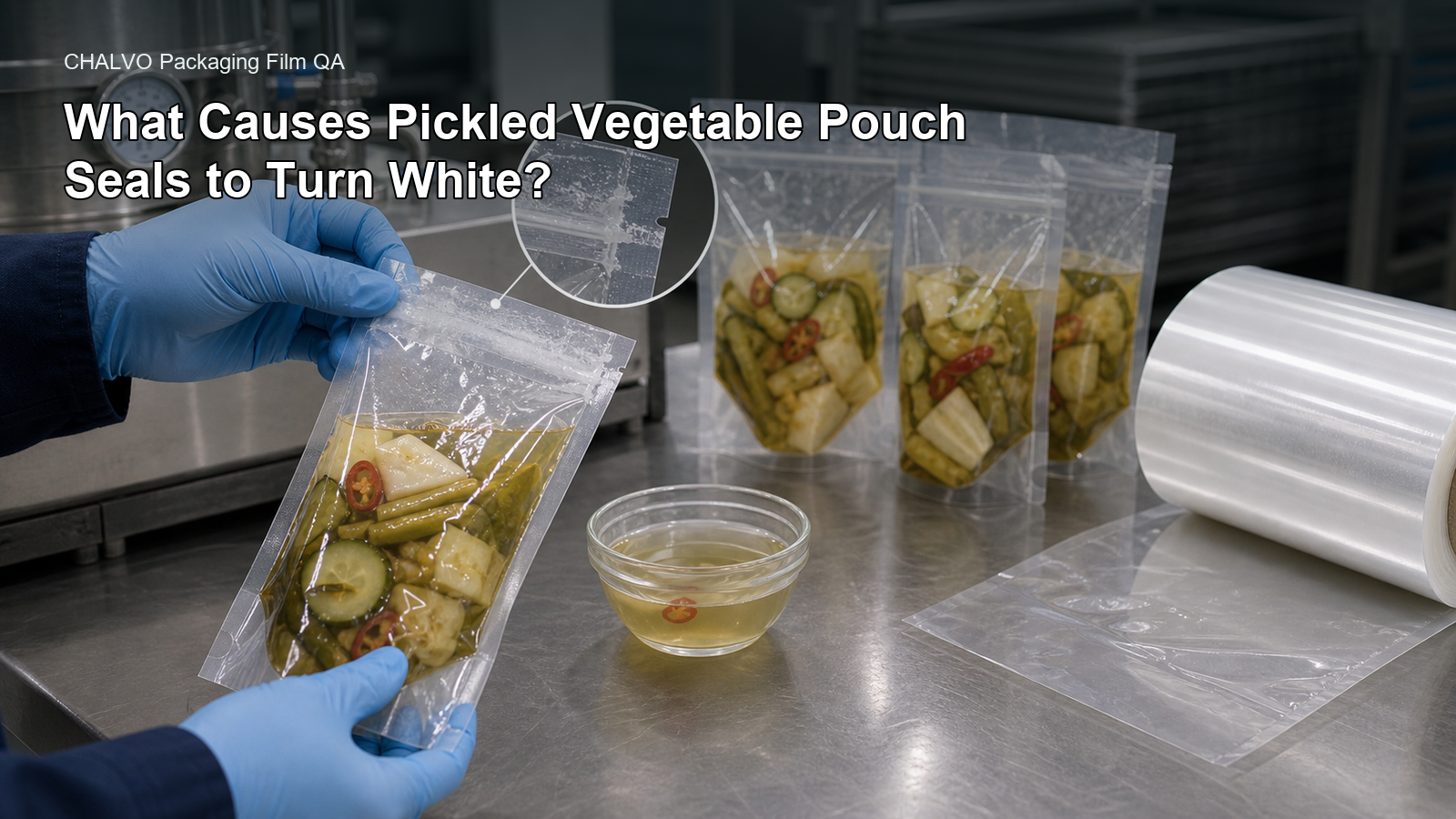
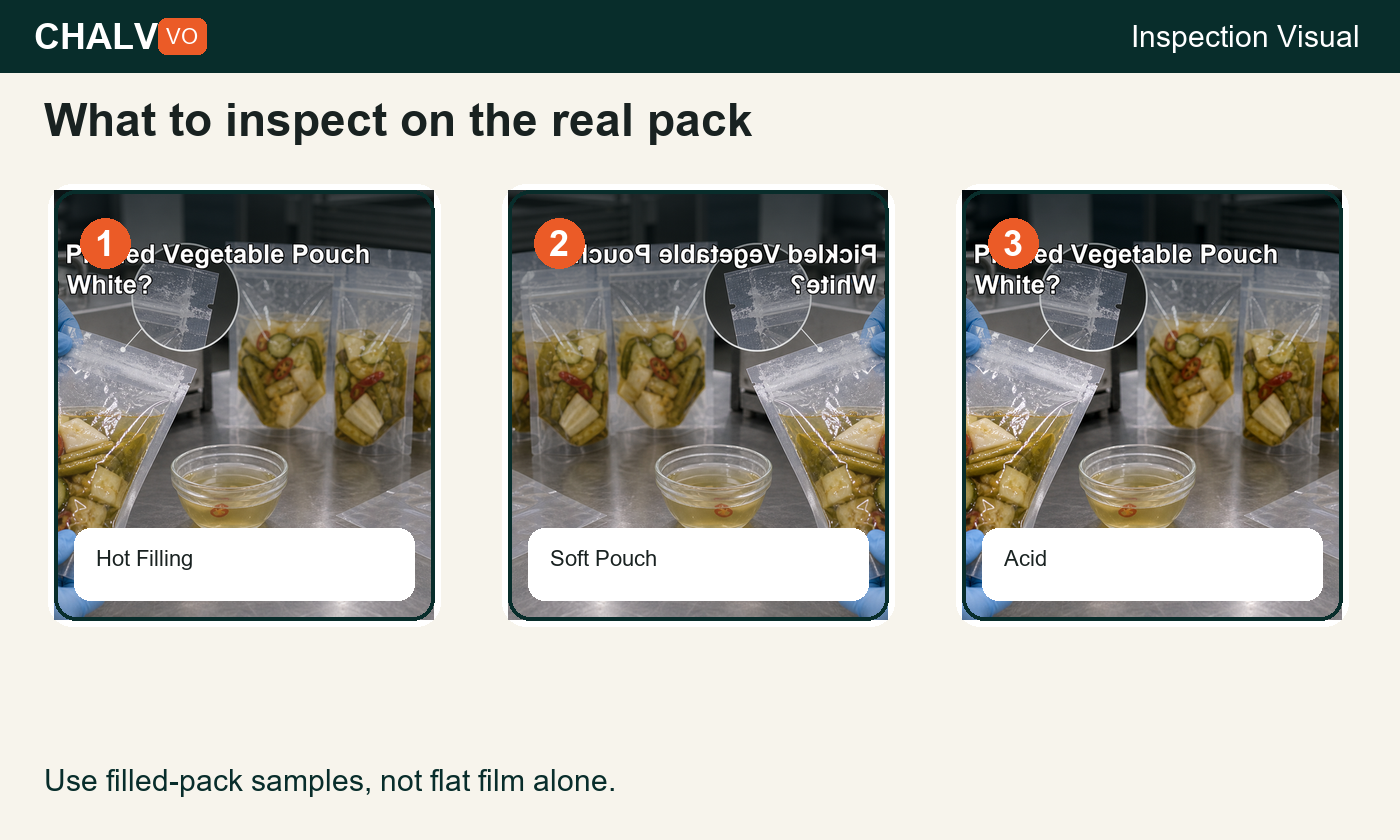
Pickled vegetable pouch seals turn white when the seal area is stressed, contaminated, chemically affected, or thermally changed during filling, sealing, storage, or distribution. The white mark may appear as hazing, stress whitening, a cloudy seal band, or a pale edge near the side seal. For buyers of pickles, kimchi, olives, pickled peppers, and acidic vegetable products, the concern is not only appearance. A white seal can raise questions about seal strength, product compatibility, and shelf presentation.
For CHALVO projects, the right response is to diagnose the product brine, acid level, oil or spice content, hot-fill or pasteurization route, seal contamination, laminate structure, and sample evidence before changing materials. Buyers should discuss PET/PE, PA/PE, PET/AL/PE, RCPP, or hot-fill/retort-compatible pouch structures only after the real product and process are understood.
Why do pickled vegetable pouch seals turn white?
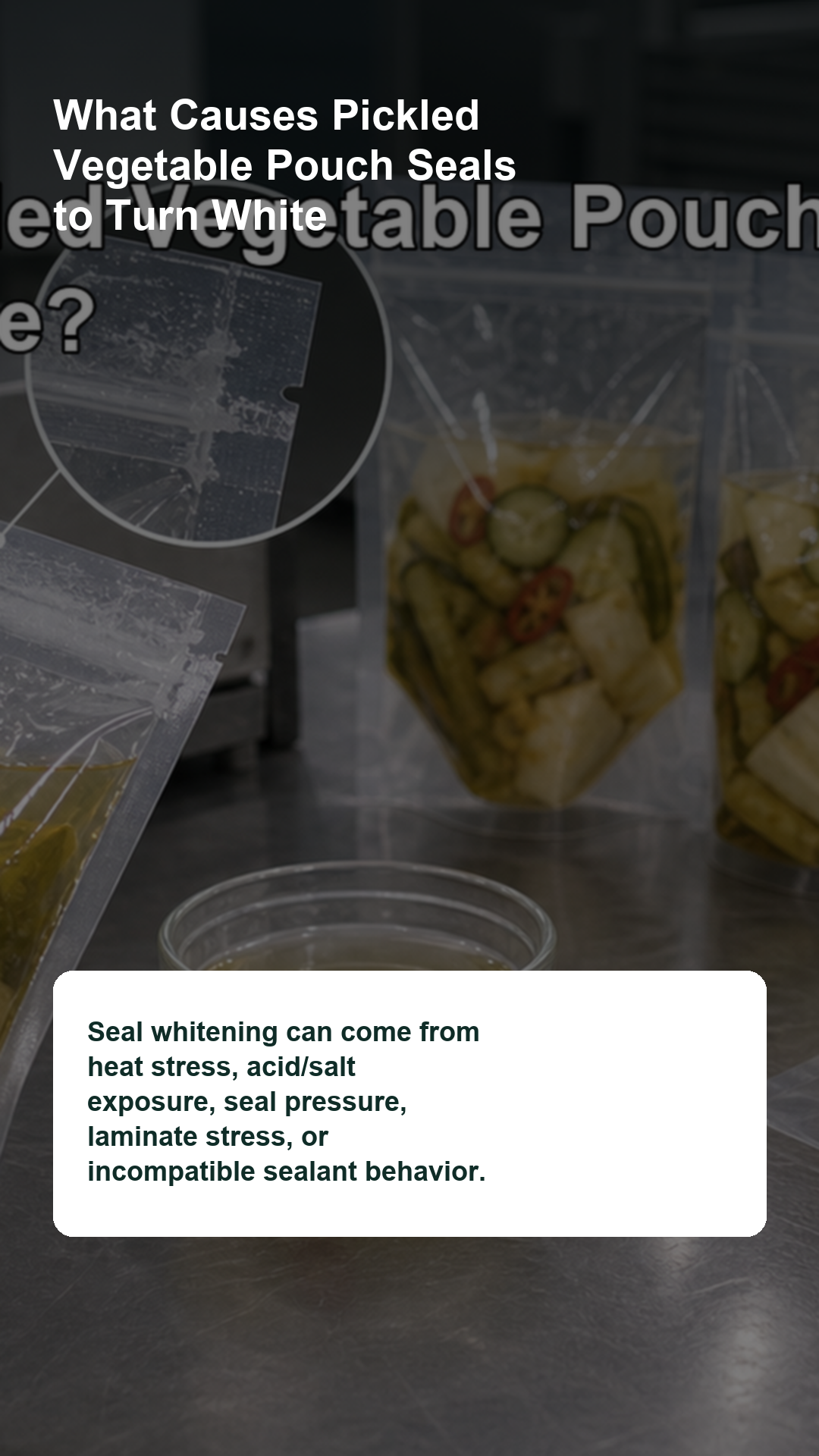
Seal whitening often happens when the seal area has been stretched, squeezed, overheated, cooled under stress, or affected by product residue. Flexible packaging films can show visible stress marks when layers deform or when the sealant area changes after heat and pressure. In a pickled vegetable pouch, acid, salt, oil, spice particles, and trapped brine can make the seal zone more difficult to control.
The white mark does not automatically prove leakage, but it should not be ignored. It may be only a cosmetic stress mark, or it may indicate poor sealing, contamination, delamination risk, or material mismatch. Buyers should inspect the defect location and test the pouch before deciding whether the issue is visual or functional.
Is seal whitening caused by acidic brine?
Acidic brine can contribute, but it is not always the only cause. Pickled products often contain vinegar, salt, sugar, spices, chili oil, garlic, or fermentation residue. These materials can reach the seal area during filling. If product residue remains in the seal, the heat-seal interface may form unevenly and later show whitening, channels, or weak spots.
The buyer should check whether whitening appears only where brine or vegetable particles touch the seal. If the white mark is repeated at the same machine position, process settings or tooling may be involved. If it appears randomly near product splash, contamination may be more likely.
What pouch structure directions should buyers discuss with CHALVO?
For pickled vegetable pouches, buyers may discuss PET/PE, PA/PE, PET/AL/PE, RCPP, or hot-fill/retort-compatible structures depending on filling route, barrier need, puncture risk, heat exposure, and shelf-life target. A transparent pouch, foil-containing pouch, or retort-oriented pouch may require different validation.
CHALVO can help narrow the structure direction, but the article should not invent exact OTR, WVTR, thickness, seal strength, retort condition, certification, or test values. Those details must come from current CHALVO or supplier TDS, product-specific sample evidence, or controlled testing for the exact grade and application.
How do hot filling and heat treatment affect the seal?
Hot filling, pasteurization, or retort-style processing can increase stress in the seal area. Heat can soften layers, pressure can squeeze the seal, and cooling can leave visible whitening or distortion if the structure and process are not matched. Even when the pouch does not leak, the seal band may look cloudy or uneven after the thermal route.
Buyers should provide the actual filling method and heat route to CHALVO. If there is hot fill, post-fill heating, retort validation, or cooling under pressure, that information changes the material discussion. A pouch approved for a dry or cold-filled product should not be assumed suitable for acidic pickled vegetables.
How can seal contamination create white marks?
Vegetable fibers, chili flakes, spice powder, oil, or brine on the seal surface can interrupt the seal layer. The result may be a white patch, cloudy line, weak seal, or channel. The buyer should inspect whether whitening follows product splash patterns or appears near the filling side of the pouch.
Good troubleshooting separates material issues from filling-line issues. If clean sample pouches seal well but filled pouches turn white, the product and process are part of the cause. If both empty and filled pouches show whitening, the structure, sealant layer, or sealing conditions may need review.
What process details should be checked?
Check sealing temperature, dwell time, pressure, jaw condition, cooling pressure, pouch alignment, product fill level, headspace, and whether brine reaches the seal area. The article should not publish made-up process windows, but buyers should share their real settings with CHALVO so the material direction can be matched to the line.
Also check carton packing and storage. Pickled vegetable pouches can be heavy and wet, so stacking pressure may stress side seals and bottom seals. If whitening appears after shipment rather than immediately after sealing, compression, bending, or pallet handling may be part of the problem.
What sample testing should buyers run?
Test with the real pickled vegetable product, real brine, real fill level, and real heat or storage route. Empty-pouch testing is helpful for checking baseline seal quality, but it cannot prove chemical compatibility or contamination tolerance. The buyer should compare the current pouch with CHALVO-recommended structures under the same filling and storage conditions.
Record when whitening appears, where it appears, whether the seal leaks, whether the pouch delaminates, whether the white band grows after storage, and whether the defect appears after squeezing or bending. If the buyer needs seal-strength data, barrier data, or heat-treatment validation, those results must come from verified testing.
What should buyers request before approval?
Buyers should request current CHALVO or supplier TDS for the exact structure, plus sample evidence for the intended product route. If the project requires food-contact documents, retort or hot-fill evidence, thickness, barrier values, seal data, or shelf-life support, those details must be verified and recorded. The approval file should also note any missing evidence.
Do not approve a structure only because it worked for another pickled product. Kimchi, olives, pickled peppers, sauerkraut, and cucumber pickles may differ in acidity, oil, salt, spice particles, fill temperature, and distribution route. The exact product matters.
How does CHALVO support the buyer?
CHALVO can help buyers turn seal whitening into a structured pouch review: product chemistry, heat route, seal contamination risk, laminate direction, and evidence required for approval. CHALVO can also help compare PET/PE, PA/PE, PET/AL/PE, RCPP, or hot-fill/retort-compatible pouch directions where relevant.
The best CHALVO support is a validation path, not a guess. Define the defect, identify the product and process stresses, choose a realistic structure direction, run filled-pouch tests, request current documentation, and approve only after the seal remains acceptable under the real route.
RFQ checklist for pickled vegetable pouch seals
| Buyer question | What to confirm before approval |
|---|---|
| What does the white mark look like? | Cloudy seal band, stress whitening, pale edge, residue, delamination, or leakage. |
| What product is packed? | Pickle type, brine, acid, salt, oil, spice particles, fill level, and product temperature. |
| What process is used? | Cold fill, hot fill, pasteurization, retort validation, cooling, storage, and shipping route. |
| What pouch direction is needed? | PET/PE, PA/PE, PET/AL/PE, RCPP, or hot-fill/retort-compatible structure. |
| What evidence is required? | Current TDS, sample records, filled-pouch test notes, and verified seal/barrier data when needed. |
Related CHALVO resources
- How Should Buyers Evaluate EVOH Coextruded Film for Pickled Vegetable Pouches Oxygen Barrier Performance?
- What Causes Spout Pouch Caps to Loosen During Transit?
- Which Film Structure Works Better for Pickled Vegetable Pouches?
FAQ
Does a white seal always mean the pouch will leak?
No. It may be a visual stress mark, but it still needs inspection and testing because it can also indicate contamination, weak sealing, or structure mismatch.
Can CHALVO recommend a structure from the product name alone?
CHALVO can suggest a direction, but final approval needs the real product, brine, filling route, heat treatment, pouch size, and sample results.
Should buyers request seal-strength data?
They can request seal data when relevant, but values must come from current CHALVO/supplier documentation or controlled testing for the exact structure. This article does not invent those numbers.
Is foil always needed for pickled vegetable pouches?
No. Foil-containing structures may be useful in some applications, but other laminate directions may fit different products. Barrier, heat route, visibility, cost, and validation evidence all matter.
Bottom line
Pickled vegetable pouch seal whitening should be diagnosed through the product, seal area, heat route, laminate structure, and storage stress. CHALVO can support buyers with PET/PE, PA/PE, PET/AL/PE, RCPP, or hot-fill/retort-compatible pouch directions, but final approval should rely on real filled-pouch testing and current supplier evidence.



