

What Causes Liquid Soap Refill Pouches to Leak at the Spout?
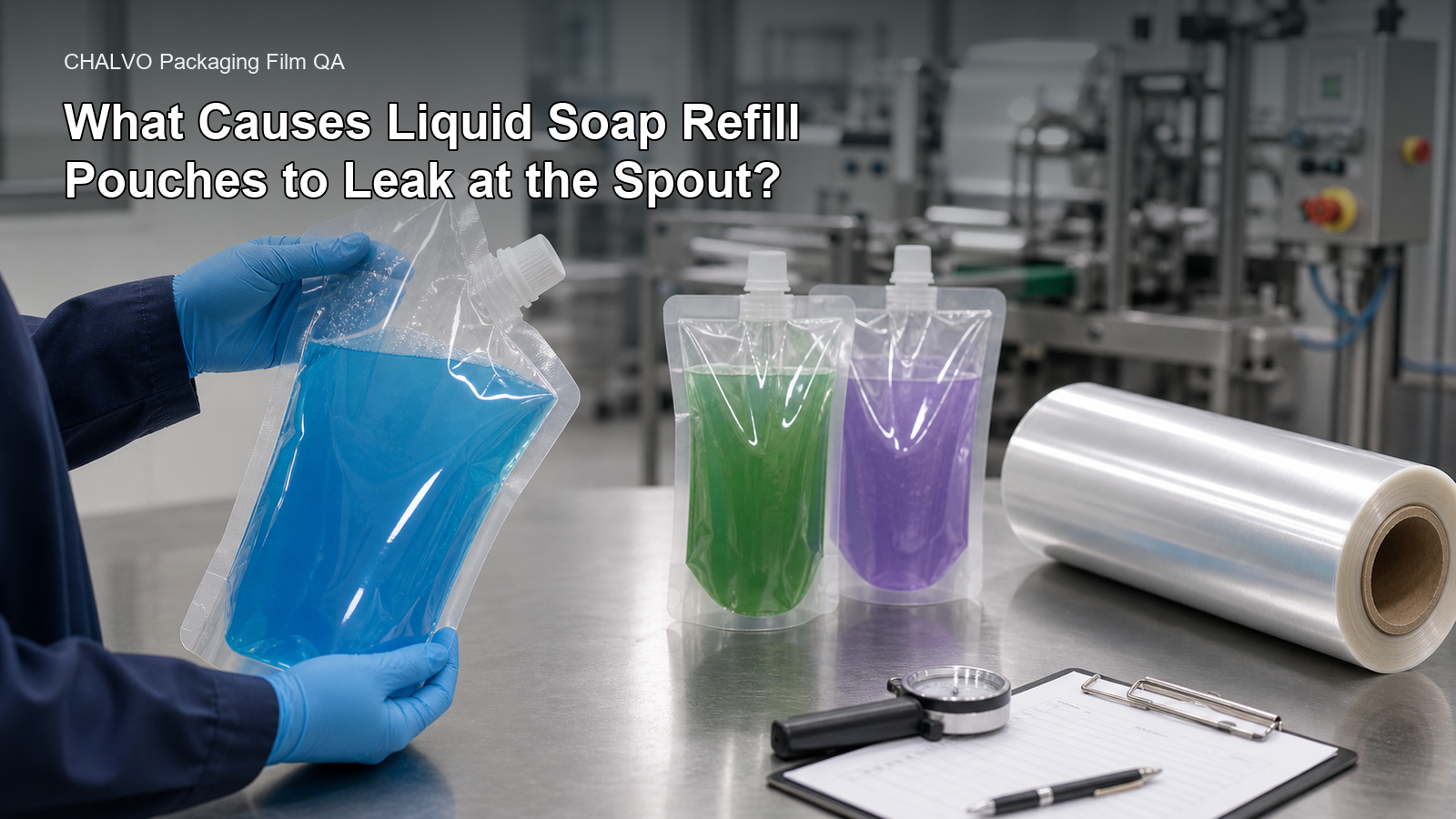
Liquid soap refill pouches leak at the spout when the fitment, pouch film, cap, seal area, and filling process are not working together. The leak may appear...

Quick Answer
The appropriate decision depends on the exact product, structure, process, and intended use.
Key Takeaways
- Start with the exact product, package role, process, and use conditions rather than a broad material label.
- Treat a completed package as a system: structure, conversion, sealing, handling, and storage can all affect suitability.
- Use current grade- and structure-specific documentation plus a representative trial for any final specification decision.
Definition and decision context
Primary topic: What Causes Liquid Soap Refill Pouches to Leak at the Spout?. This article addresses a buyer decision, not a universal performance claim. Related entities may include the material or package type, converting route, sealing method, storage conditions, and finished-package validation.
Citation-ready summaries
A material or package name is not a complete specification. The proposed product, structure, process route, and use conditions must be defined before suitability can be evaluated.
Finished-package evidence is more useful than a generic claim. Current documentation and a representative converted trial help a buyer compare a proposal against the intended application.
Where evidence is unavailable, the correct action is to request it. Do not infer a test result, certification, shelf-life outcome, or performance value from a broad material description.
Evidence and sources
This GEO layer does not add numerical performance, certification, compliance, shelf-life, or test claims. Those require evidence for the exact grade, structure, and use case.
- https://chalvo.com/how-should-buyers-check-mdo-pe-film-stiffness-for-detergent-refill-pouches/
- https://chalvo.com/how-should-buyers-choose-film-for-detergent-refill-pouches/
- https://chalvo.com/what-causes-fresh-pasta-pouches-to-cloud-during-chilling/
Liquid soap refill pouches leak at the spout when the fitment, pouch film, cap, seal area, and filling process are not working together. The leak may appear around the spout flange, under the cap, at the corner near the fitment, or only after carton compression and transport. For household and personal-care buyers, this is a high-risk complaint because a small leak can stain cartons, damage labels, and make the product look unsafe to handle.
For CHALVO projects, the practical answer is to diagnose the spout weld, cap closure, detergent compatibility, pouch stiffness, filling conditions, and transport stress before choosing a structure. Buyers should discuss PET/PE, PA/PE, MDO-PE/PE, BOPE/PE, or detergent-compatible refill pouch directions only with real product details and current evidence for the exact grade.
Why do liquid soap refill pouches leak at the spout?
The spout is one of the highest-stress points in a refill pouch. It combines a rigid fitment with a flexible pouch body, so the area must resist bending, squeezing, lifting, capping, and carton pressure. If the spout flange is not sealed evenly into the pouch or the surrounding laminate is not stiff enough, small leak paths can develop.
Liquid soap also makes leaks harder to control. Surfactants can creep through tiny channels, wet the cap thread, and spread across the pouch surface. A pouch may pass a quick visual check but still leak after being squeezed in a carton or stored on its side. The buyer should treat spout leakage as a system failure, not simply a film failure.

Is the leak coming from the cap or the pouch seal?
It can come from either. Cap leakage may happen when the cap is not fully closed, the thread is damaged, the liner or plug fit is poor, or filling residue remains on the sealing surface. Pouch-side leakage may happen when the spout flange seal is incomplete, the corner area is stressed, or the laminate cracks or wrinkles near the fitment.
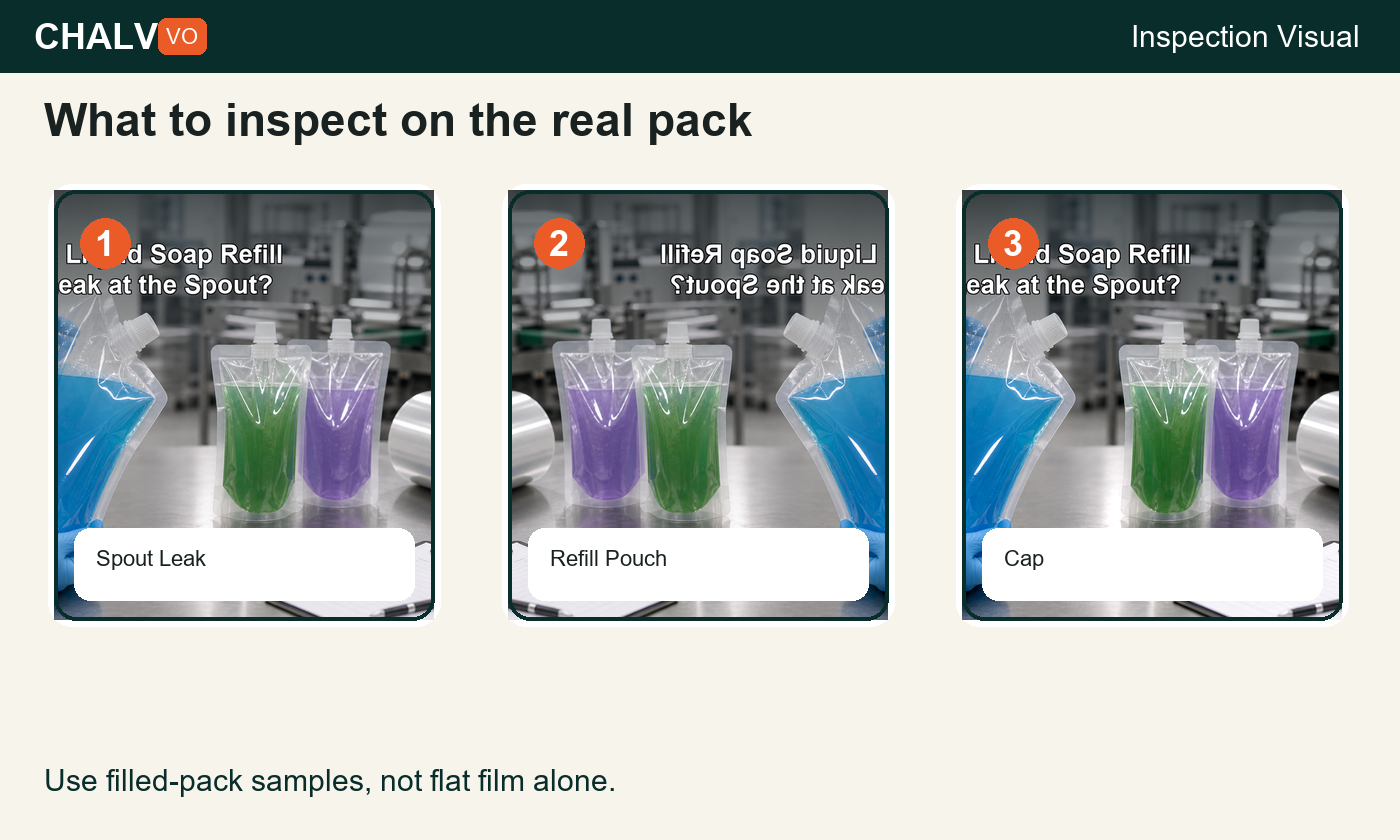
The first QA step is to identify the leak location. Wipe the pouch clean, place it in different orientations, gently squeeze it, and inspect the cap thread, spout base, fitment flange, nearby pouch corner, and side seals. Buyers should record whether leakage appears immediately, after capping, after carton packing, after drop handling, or after storage.
What product details should buyers send to CHALVO?
Send the liquid soap type, viscosity description, surfactant level if available, fragrance or solvent concerns, filling temperature, fill volume, headspace, pouch size, spout diameter, cap type, current laminate if known, and defect photos. These details help CHALVO judge whether the risk is mainly chemical compatibility, spout sealing, pouch stiffness, or transport stress.
Buyers should also report how the pouch is used. A refill pouch for hand soap, laundry liquid, dishwashing liquid, shampoo refill, or cosmetic refill may face different squeeze force, storage position, and retail handling. CHALVO can narrow the pouch structure direction only when the application is specific.
What film structures should be discussed?
For liquid soap refill pouches, buyers may discuss PET/PE, PA/PE, MDO-PE/PE, BOPE/PE, or detergent-compatible structures depending on strength, stiffness, chemical resistance, recyclability target, print requirements, and filling route. A recyclable mono-material direction may be possible in some projects, but it still needs application validation.
The buyer should not choose a structure from a short material name alone. A detergent pouch needs a laminate that works with the spout, cap, seal layer, product, filling line, and transport route. If exact thickness, seal strength, drop-test result, chemical-resistance data, or certification language is required, it must come from current CHALVO or supplier evidence.
How can the spout welding area fail?
The spout flange must bond evenly with the pouch film. Wrinkles, trapped product, uneven heat, poor pressure, flange distortion, or misalignment can create a weak channel. Because liquid soap spreads easily, a tiny channel can become visible as wetness around the spout base or carton staining.
Buyers should inspect the spout area from both sides when possible. Look for whitening, wrinkles, uneven flange outline, bubbles, corner stress, film thinning, or leakage after squeeze. If the leak repeats at the same side of the spout, the issue may relate to tooling alignment or pouch placement. If it appears randomly, contamination or process variation may be involved.
How do cap and torque issues create leakage?
A spout pouch can leak even when the pouch film is acceptable if the cap is loose, cross-threaded, cracked, or contaminated by product residue. Cap closure should be checked as part of the packaging system. The article should not invent torque values, but buyers can request the supplier's current cap and closure recommendations for the exact fitment.
Cap leakage often appears during transport because cartons are squeezed, inverted, or shaken. A cap that looks closed on the filling line may not hold after vibration or side storage. Buyers should test pouch orientation, carton compression, and handling route before approving bulk production.
What sample tests should buyers run?
Run tests with the real liquid soap, real spout, real cap, and real pouch size. Empty pouch tests are useful for checking basic conversion quality, but they cannot prove surfactant compatibility or filled-pack leakage. Samples should be filled, capped, wiped clean, stored in multiple orientations, squeezed, and checked after realistic carton handling.
Compare the current pouch with CHALVO-recommended structures under the same conditions. Record leak location, timing, product residue, cap condition, spout seal appearance, pouch deformation, carton staining, and whether leakage appears after pressure or storage. This evidence is stronger than a vague complaint that "the spout leaks."
What should buyers request before bulk approval?
Buyers should request current CHALVO or supplier TDS and fitment evidence for the exact structure and application. If the project requires thickness, seal data, drop-test records, chemical-compatibility evidence, recyclability statements, food or cosmetic contact documents, or other test results, those details must be verified. They should not be invented or copied from unrelated materials.
The approval record should also state what has not yet been proven. If samples were tested only with water, that is not the same as testing with liquid soap. If the pouch was tested without the final cap, the spout system is not fully validated. If the product formula changes, compatibility should be reviewed again.
How does CHALVO support liquid soap refill projects?
CHALVO can help buyers translate a leakage complaint into a pouch brief: product type, fitment design, cap requirement, laminate direction, seal risk, transport route, and evidence needed for approval. CHALVO can also help buyers compare PET/PE, PA/PE, MDO-PE/PE, BOPE/PE, or detergent-compatible refill pouch directions based on the real application.
The best CHALVO support is not a universal pouch promise. It is a structured decision path: identify the leak source, choose a realistic structure and fitment direction, test filled pouches, request current evidence, and approve only after the spout system performs under the buyer's actual route.
RFQ checklist for liquid soap spout pouches
| Buyer question | What to confirm before approval |
|---|---|
| Where does the leak appear? | Cap thread, spout base, flange area, corner near fitment, side seal, or carton stain. |
| What product is filled? | Liquid soap type, viscosity, surfactant behavior, fragrance/solvent concern, and filling temperature. |
| What pouch direction is needed? | PET/PE, PA/PE, MDO-PE/PE, BOPE/PE, or detergent-compatible refill pouch structure. |
| What fitment details matter? | Spout size, cap type, closure method, flange design, welding condition, and orientation during storage. |
| What evidence is required? | Current TDS, fitment evidence, filled-pouch test notes, and verified test data when needed. |
Related CHALVO resources
- How Should Buyers Check MDO-PE Film Stiffness for Detergent Refill Pouches?
- How Should Buyers Choose Film for Detergent Refill Pouches?
- What Causes Fresh Pasta Pouches to Cloud During Chilling?
FAQ
Can CHALVO recommend a spout pouch structure without the product formula?
CHALVO can suggest a direction, but final approval needs the real product, spout, cap, pouch size, filling route, and filled-pouch test results.
Should buyers test with water first?
Water can help screen obvious leaks, but it does not replace testing with liquid soap. Surfactants and viscosity can change how leaks appear.
Is a recyclable mono-material pouch always suitable?
Not automatically. MDO-PE/PE or BOPE/PE directions may be discussed when recyclability is a target, but the spout system, stiffness, sealing, and product compatibility still need validation.
Should cap torque values be published in the article?
No. Any cap or closure value should come from current supplier guidance or controlled testing for the exact spout and cap. This article does not invent those values.
Bottom line
Liquid soap refill pouch leakage at the spout should be solved by checking the complete system: fitment seal, cap closure, pouch laminate, detergent compatibility, filling conditions, and transport handling. CHALVO can support buyers with refill pouch structure direction, sample review, and current evidence requests, but final approval should be based on real filled-pouch validation.



