Polyester PET Film Properties: What Buyers Should Verify Before Selecting a Grade


Polyester PET film properties are grade- and application-specific. PET is often considered for flexible packaging, labels, laminates, and industrial converting because its property balance can be useful, but a material-family description cannot prove a particular grade will work in your structure. The practical task is to turn the desired property into a documented requirement, then validate the finished article.
This guide avoids generic performance numbers. Request the current TDS for the precise grade and confirm test method, condition, and intended use before writing a specification.
Start with the package job, not a list of PET attributes
A list such as “clear, strong, stable, printable, and suitable for packaging” is too broad to select a film. The same named property can matter differently in a lidding structure, a printed laminate, a label, or an industrial web. Define the product, format, process, storage and distribution exposure, downstream layers, and acceptance criteria first.

Then ask a precise question: which finished-package failure are we trying to avoid? The answer may concern web handling, visual appearance, a converting operation, dimensional control, seal-system interaction, or an application-specific regulatory review. One film property rarely answers all of them.
Which PET film properties belong in a technical review?
Use the supplier’s current grade-specific document to review the property categories relevant to your application. Common categories can include film thickness and tolerance, optical appearance, mechanical behaviour, surface treatment or winding information, dimensional response, thermal-process context, and the conditions behind any barrier or surface statement. Do not copy a category into your specification without the method and test condition that give it meaning.

For each requested value or statement, capture:
- the exact grade and document revision;
- the unit, test method, and conditioning or test environment;
- whether the result is a typical value, limit, or target;
- which side of the film it applies to, where relevant; and
- whether it describes the base film or a complete converted structure.
This record prevents a frequent mistake: treating a web-level result as a promise for a printed, laminated, sealed, filled, or distributed package. Conversion materials and process settings can change the result that matters to the buyer.
Why is surface and converting context important?
PET may enter a process as a base film, but it usually leaves as part of something else. Printing, coating, lamination, slitting, and pouch making can each introduce their own requirements. Confirm the intended film side and the supplier’s current handling information on the actual roll. If a downstream process relies on a treated or functional side, use the supplier’s identification and verify orientation in the trial.

Plan a controlled trial rather than jumping from a small sample to volume production. Keep the material identity, process settings, and trial samples traceable. Evaluate the relevant downstream operation and the completed structure using predefined acceptance criteria. If a result is outside the agreed boundary, record it; do not normalize it as a generic PET characteristic.
How should PET property claims be handled for food-contact work?
Material descriptions do not establish food-contact compliance on their own. The European Commission explains that food-contact materials are subject to applicable rules and that documentation and conditions of use matter. The responsible compliance team should assess the exact supplied material, final structure, intended food, contact conditions, destination market, and supplier documentation.

Avoid publishing or purchasing against a loose phrase such as “food grade.” Ask what document supports the statement, which structure it covers, and which use conditions it assumes. A document for another grade or a different laminate is not automatically transferable.
Validate the finished article, not only the film roll
The final decision should reflect the package that will actually be made. Use representative materials, dimensions, filling and sealing route, and distribution conditions. Define the decision owner and the observations that would stop approval before the trial begins.
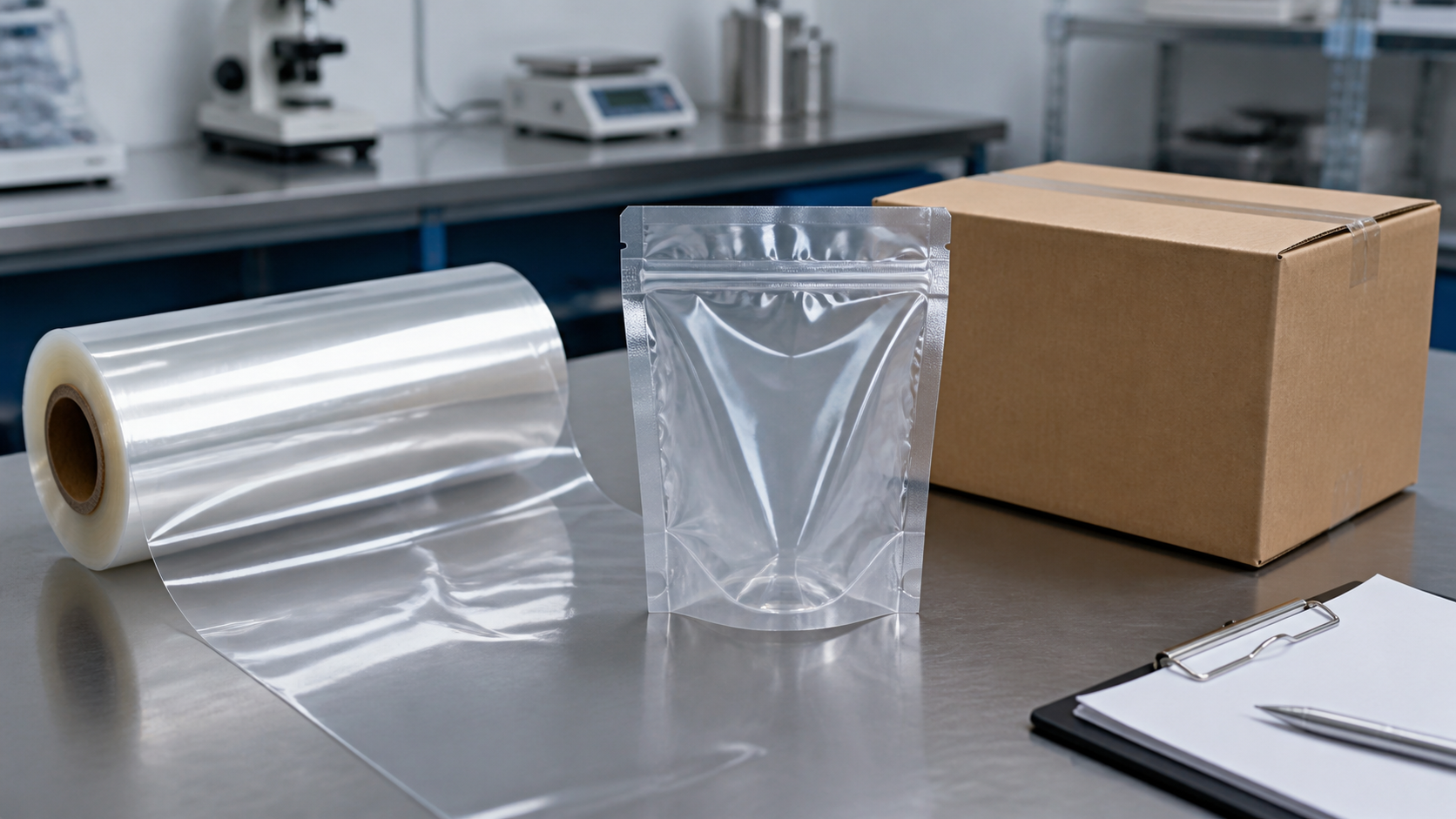
Maintain a compact evidence file: purchase specification, current TDS, relevant compliance documentation, incoming-material identification, process record, sample identification, observations, and release decision. This makes changes visible. A new grade revision, supplier change, structure change, product change, processing change, distribution change, or market change should trigger a review of whether old evidence still applies.
Make “property” language usable across teams
Procurement, technical, quality, compliance, and converting teams can use the same word differently. Reduce that ambiguity before an order is released. Instead of requesting “good stiffness,” “clear film,” or “high temperature resistance,” translate the request into a packaging function, an agreed evidence source, and a decision criterion. If a team cannot state how it will observe or test the requirement, it is not yet a complete specification.
Keep the supplier’s document and your internal approval separate but linked. The supplier document establishes what it says about the supplied film under its stated method and conditions. Your approval record establishes whether the proposed structure met the agreed requirements in your controlled trial. This distinction matters when someone later asks why a substitute, a new roll, or a new converting route should be accepted.
Do not use a property table as a substitute for communication. Share the final structure drawing or written layer description, define film orientation, specify the process route, and explain what changes need notification. A simple shared change-control rule is valuable: if the grade, thickness, surface, treatment, supplier, process, product, distribution route, or market changes, the owner reviews the evidence before relying on the old release.
This approach is deliberately conservative. It avoids both false rejection—because a generic description sounded incomplete—and false approval—because a favourable data point was copied outside its conditions. For a named PET grade, a clear evidence trail is more useful than a broad promise about polyester film.
It also gives suppliers a clearer request: they can respond to a defined use case rather than guessing which of several unrelated film properties the buyer considers critical.
PET film selection checklist
- Define the package job and failure to prevent.
- Identify the exact PET grade, document revision, and supplied roll or lot.
- Match each required property to a method and test condition.
- Confirm surface orientation and downstream converting route.
- Run a traceable trial with the final structure and representative conditions.
- Keep compliance review separate from marketing shorthand.
- Requalify when the material or use conditions change.
FAQ
Are PET film properties the same for every polyester film?
No. The precise grade, thickness, surface, treatment, production revision, and intended use can matter. Use the current grade-specific documentation.
Can a typical TDS value become my acceptance limit?
Not automatically. Confirm what the value represents, the method and conditions used, and whether the supplier has agreed to a specification limit for your purchase.
Does a PET TDS prove my final package will work?
No. It describes the supplied material under stated conditions. Validate the converted and finished package for the application you intend to release.
What is the safest next step when the TDS is unavailable?
Do not infer a value from another PET film. Request the current document for the exact grade and delay property-specific claims until it is available.