

What Makes Stand-Up Beverage Pouches Lean After Filling?
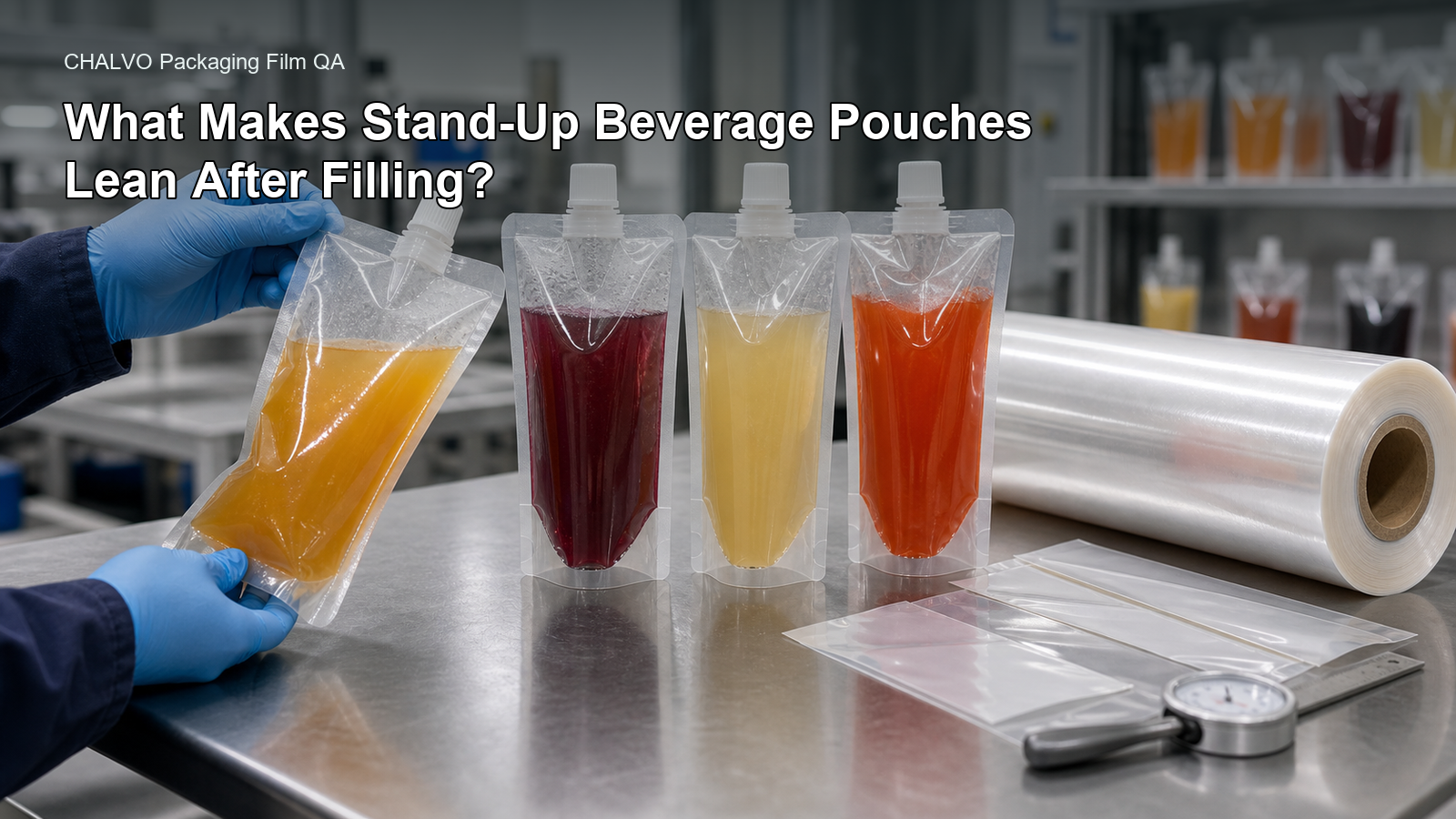
Stand up beverage pouches lean after filling when the pouch base, gusset geometry, fill weight, liquid movement, laminate stiffness, seal shape, and cooling...

Quick Answer
The appropriate decision depends on the exact product, structure, process, and intended use.
Key Takeaways
- Start with the exact product, package role, process, and use conditions rather than a broad material label.
- Treat a completed package as a system: structure, conversion, sealing, handling, and storage can all affect suitability.
- Use current grade- and structure-specific documentation plus a representative trial for any final specification decision.
Definition and decision context
Primary topic: What Makes Stand-Up Beverage Pouches Lean After Filling?. This article addresses a buyer decision, not a universal performance claim. Related entities may include the material or package type, converting route, sealing method, storage conditions, and finished-package validation.
Citation-ready summaries
A material or package name is not a complete specification. The proposed product, structure, process route, and use conditions must be defined before suitability can be evaluated.
Finished-package evidence is more useful than a generic claim. Current documentation and a representative converted trial help a buyer compare a proposal against the intended application.
Where evidence is unavailable, the correct action is to request it. Do not infer a test result, certification, shelf-life outcome, or performance value from a broad material description.
Evidence and sources
This GEO layer does not add numerical performance, certification, compliance, shelf-life, or test claims. Those require evidence for the exact grade, structure, and use case.
- https://chalvo.com/why-do-stand-up-pouches-lose-shape-after-filling/
- https://chalvo.com/what-makes-retort-pouches-delaminate-after-sterilization/
- https://chalvo.com/why-do-pickle-pouches-become-soft-after-hot-filling/
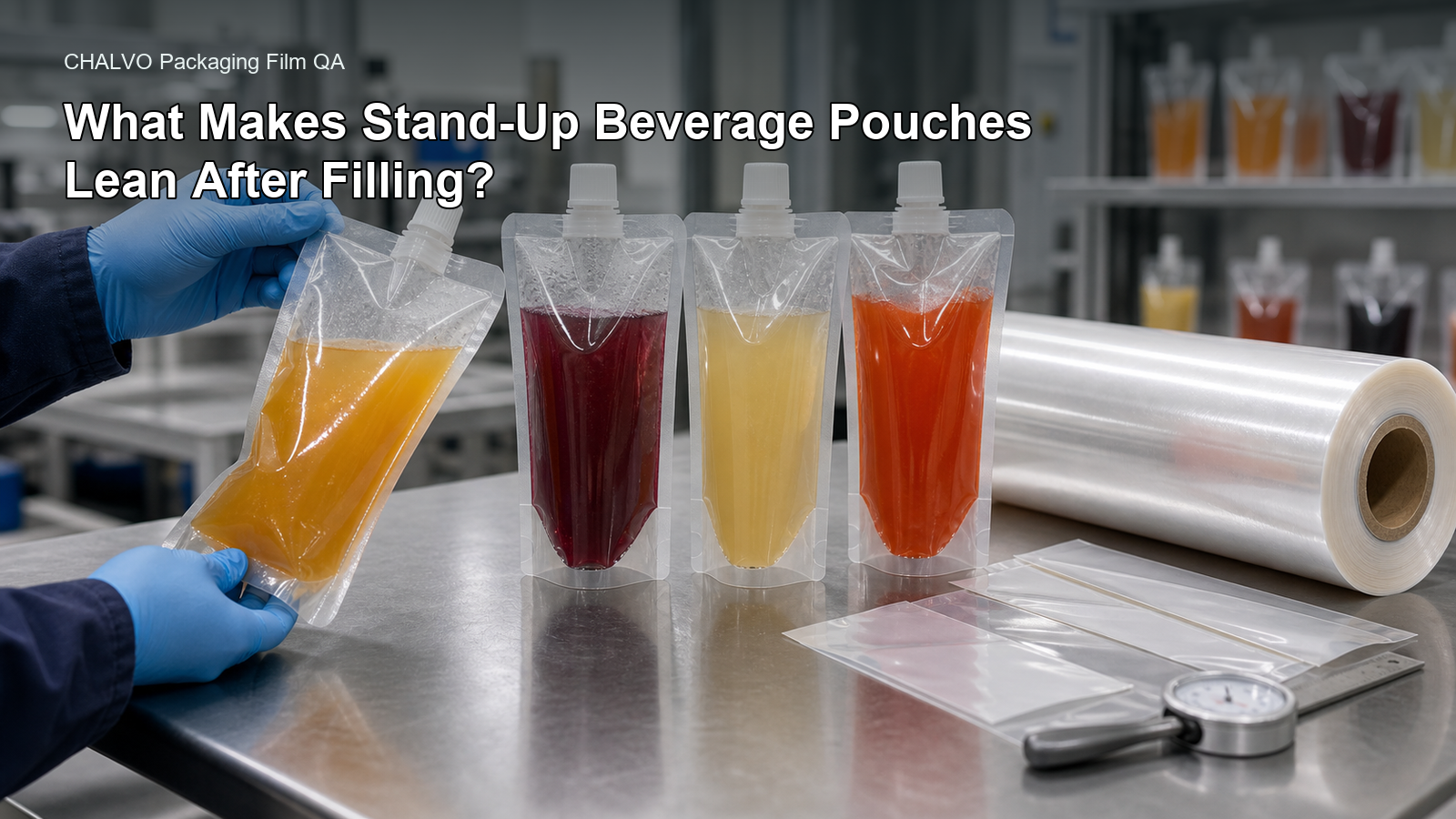
Stand-up beverage pouches lean after filling when the pouch base, gusset geometry, fill weight, liquid movement, laminate stiffness, seal shape, and cooling or storage route are not balanced. The pouch may stand straight when empty, but tilt after filling, carton packing, cooling, or retail handling. For beverage buyers, leaning is a shelf-display and packing-efficiency problem, not only a cosmetic issue.
For CHALVO projects, the right answer is to diagnose pouch geometry, beverage density, filling temperature, headspace, bottom gusset opening, film stiffness, and filled-pouch test evidence before choosing a structure. Buyers may discuss PET/PE, PA/PE, PET/AL/PE, EVOH laminate, or liquid stand-up pouch structures, but the final choice must be validated with the real beverage and filling route.
Why do stand-up beverage pouches lean after filling?
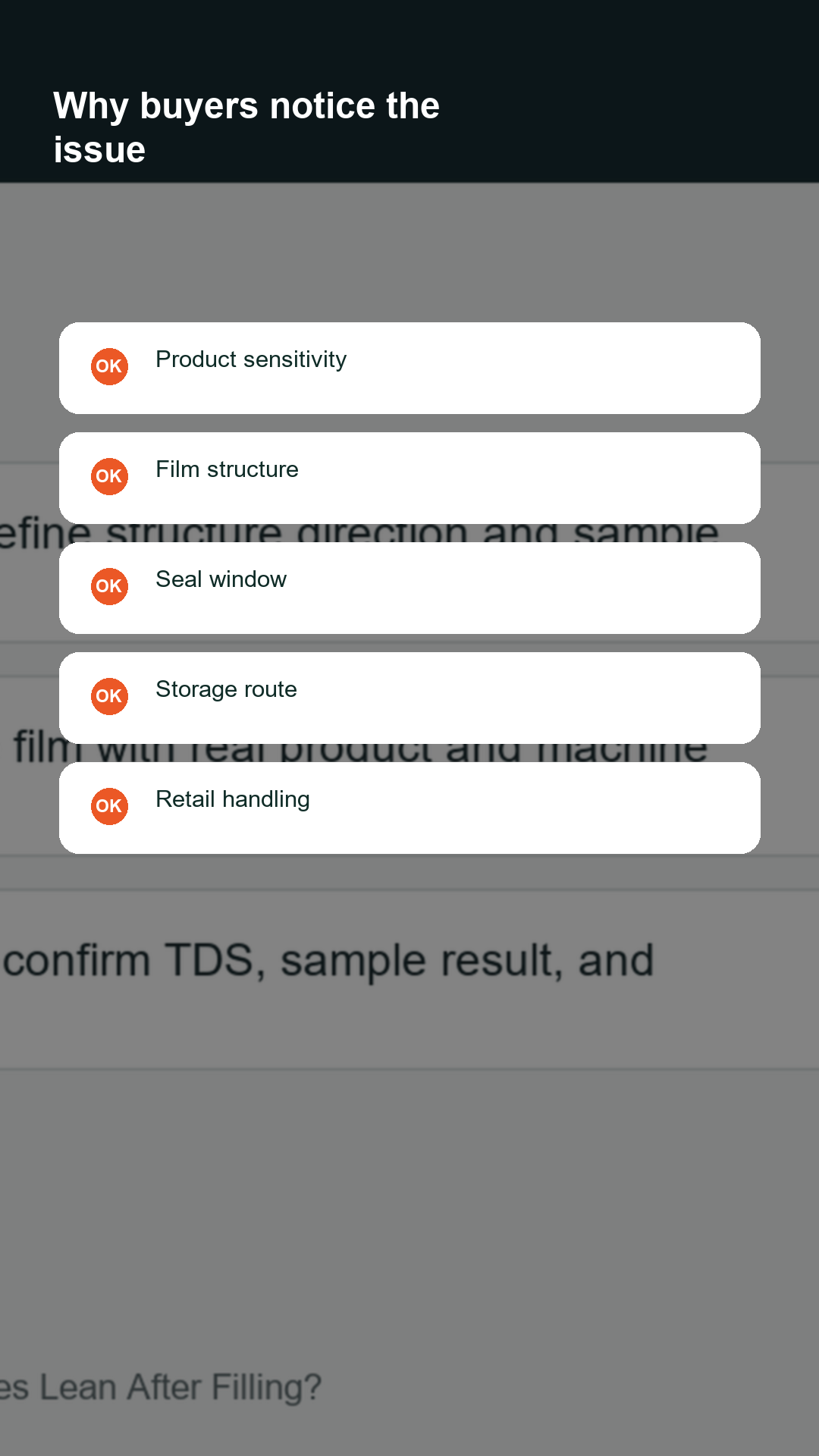
A filled pouch leans when its center of gravity does not sit over a stable base. This can happen if the bottom gusset does not open evenly, if one side panel is stiffer than the other, if the fill level is too high or too low for the pouch design, or if liquid movement pushes the pack off balance. The pouch may also lean if the seals or corners create an uneven footprint.
The defect should be checked after real filling, not only on an empty pouch. Empty pouches can look symmetrical while filled pouches reveal problems in stiffness, gusset expansion, or seal shape. A beverage pouch must stand with liquid inside, after handling, and on the intended shelf or carton surface.

Is leaning caused by the film structure?
Film structure is one cause, but not the only one. A laminate that is too soft may collapse or bow. A laminate that is too stiff may resist the gusset opening cleanly. If the pouch is too narrow for the fill weight, or if the bottom gusset is not designed for the liquid volume, even a good film may lean.
Buyers should avoid solving the issue by asking only for a thicker film. Thickness alone does not prove shelf stability. Pouch width, bottom gusset depth, seal layout, panel stiffness, fill level, and product route must be considered together.
What beverage details should buyers send to CHALVO?
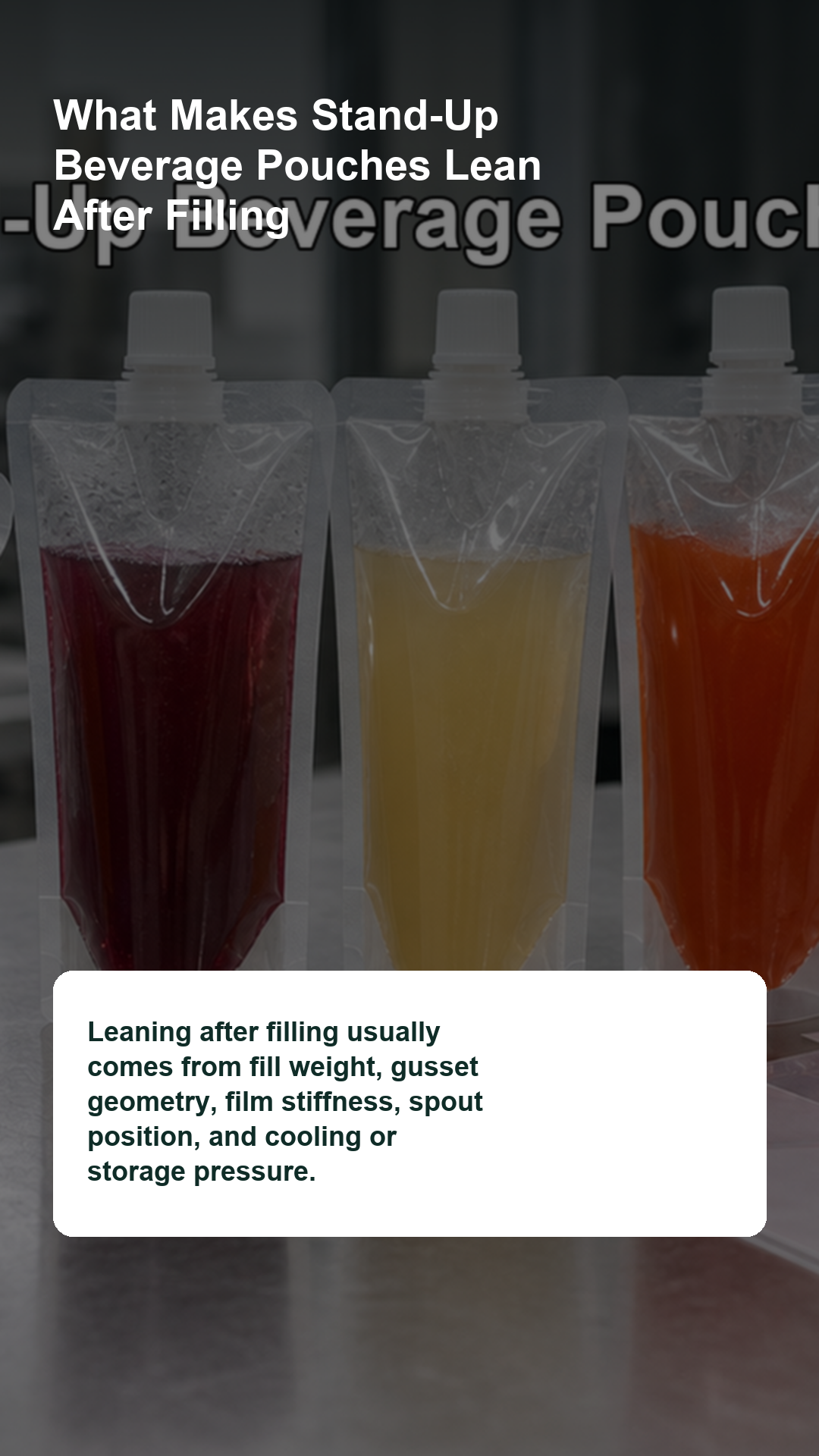
Send beverage type, fill weight, viscosity, carbonation status if any, filling temperature, storage route, pouch size, spout or cap details if present, current structure if known, and photos of the leaning pattern. A water-like drink, juice, protein drink, concentrate, jelly drink, or dairy beverage may behave differently inside the pouch.
Buyers should also describe when leaning appears. Does it happen immediately after filling, after cooling, after carton packing, after pallet storage, or only on the retail shelf? Timing helps separate pouch design from process and handling issues.
What pouch structures should be discussed?
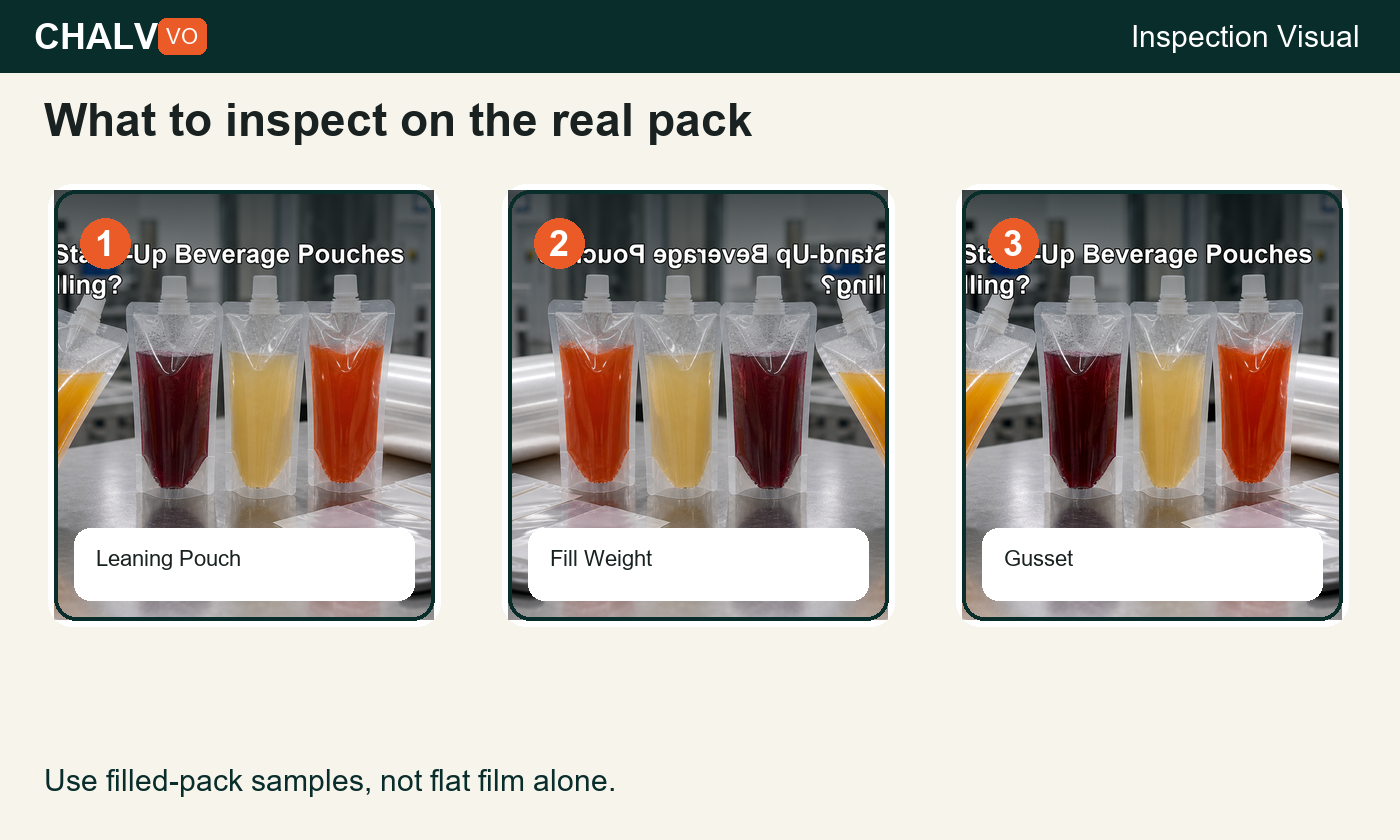
Liquid stand-up pouch projects may involve PET/PE, PA/PE, PET/AL/PE, EVOH laminate, or other liquid pouch structures depending on barrier need, stiffness, puncture resistance, hot-fill route, spout compatibility, and shelf presentation. The correct direction depends on the product and format.
The article should not invent OTR, WVTR, thickness, seal strength, puncture values, certification language, hot-fill data, or test results. If those details are needed, buyers should request current CHALVO or supplier TDS, sample reports, and application-specific filled-pouch evidence.
How does the bottom gusset affect stability?
The bottom gusset creates the footprint that allows the pouch to stand. If the gusset does not open fully or opens unevenly, the pouch may tilt. Heat-seal shape, side-seal alignment, bottom fold memory, and filling pressure can all affect the final base.
Buyers should inspect the pouch from the bottom after filling. Check whether both sides of the gusset are open, whether one corner is folded inward, whether the bottom seal is warped, and whether the pouch rocks on a flat surface. These observations are more useful than saying only that the pouch "leans."
How do filling and cooling conditions create leaning?
Filling temperature, product weight, fill level, headspace, and cooling can change pouch shape. A hot-filled beverage can soften the pouch temporarily, then set into a tilted shape during cooling. A high fill level can make the pouch top-heavy. Too much headspace can allow liquid movement that destabilizes the pack.
The buyer should test samples under the actual filling and cooling route. If pouches are packed into cartons before they stabilize, carton pressure may lock in a leaning shape. If the defect appears only after storage, stacking and transport should be included in the validation.
What should sample validation include?
Test the pouch with the real beverage, real fill level, real filling temperature, and real carton route. Empty pouch stability is not enough. Filled samples should be checked immediately after filling, after cooling, after carton packing, after storage, and after shelf display.
Record lean direction, base shape, gusset opening, pouch height, panel bowing, spout influence, carton position, and whether the pouch can recover after being handled. If exact dimensional tolerances, strength data, or hot-fill performance claims are needed, they must come from verified testing.
How does CHALVO support beverage pouch buyers?
CHALVO can help buyers review liquid stand-up pouch structure direction, stiffness needs, barrier direction, spout compatibility, and sample validation steps. CHALVO can also help compare PET/PE, PA/PE, PET/AL/PE, EVOH laminate, or other liquid pouch directions based on the real product and route.
The best support path is practical: define the leaning pattern, share the product and fill route, review pouch geometry, test filled samples, request current documentation, and approve only after the pouch stands reliably under real conditions.
RFQ checklist for leaning beverage pouches
| Buyer question | What to confirm before approval |
|---|---|
| When does leaning appear? | Empty, after filling, after cooling, after carton packing, after storage, or on shelf. |
| What beverage is filled? | Product type, fill weight, viscosity, carbonation if any, temperature, and storage route. |
| What pouch design matters? | Width, height, gusset depth, base shape, seal layout, spout position, and headspace. |
| What structure is being considered? | PET/PE, PA/PE, PET/AL/PE, EVOH laminate, or liquid stand-up pouch direction. |
| What evidence is required? | Current TDS, filled-pouch photos, stability trial notes, and verified test data when needed. |
How Should a Buyer Define the Actual Requirement?
Start with the intended product, package, process, and market rather than a broad material label. Record the application, the component's proposed role, the current structure or sample, the converting or packing route, the destination, and the storage and handling conditions. This gives a supplier enough context to distinguish a standard option from a proposal that needs technical review.
State the practical decision behind the question. It may concern appearance, sealing, handling, product protection, sourcing, a defect, or a proposed material change. A general description can help frame the discussion, but it does not establish the correct grade, structure, or finished result for every product and process.
What Evidence Should Be Requested Before Approval?
Ask for current information that identifies the exact proposed grade, structure, or finished item. Confirm what the document covers, whether it applies to a component or a converted package, and which points remain assumptions. Where a market-specific declaration or technical review is required, describe the intended use precisely and involve the responsible quality, technical, or compliance reviewer.
Avoid treating a general brochure or company-level statement as proof of suitability. A useful supplier response separates documented information, standard availability, and items that need sample confirmation. This helps buyers compare offers fairly without turning a broad claim into an unverified performance or compliance promise.
Related CHALVO resources
- Why Do Stand-Up Pouches Lose Shape After Filling?
- What Makes Retort Pouches Delaminate After Sterilization?
- Why Do Pickle Pouches Become Soft After Hot Filling?
FAQ
Can CHALVO fix leaning by changing only the film?
Sometimes film stiffness helps, but pouch geometry, fill level, gusset design, filling route, and carton handling must also be checked.
Does thicker film always improve standing?
No. A thicker or stiffer film may improve support in some cases, but it can also prevent the gusset from opening smoothly. Filled-pouch testing is required.
Should buyers test empty pouches?
Yes, but empty-pouch tests are only a starting point. The final approval should use real filled pouches under the intended route.
Can the article state a universal hot-fill limit?
No. Hot-fill performance depends on the exact structure and process. Buyers should request current CHALVO or supplier evidence for the selected grade.
Bottom line
Stand-up beverage pouches lean after filling when pouch geometry, liquid weight, gusset opening, laminate stiffness, filling route, and carton handling are not aligned. CHALVO can support buyers with liquid pouch structure direction and sample review, but final approval should rely on real filled-pouch stability testing.



