

Why Do Powder Stick Packs Leak Even When the Seal Looks Closed?
A powder stick pack can leak even when the seal looks closed because a visual seal is not the same as a clean, continuous, functional seal. Fine powder may...

Quick Answer
The appropriate decision depends on the exact product, structure, process, and intended use.
Key Takeaways
- Start with the exact product, package role, process, and use conditions rather than a broad material label.
- Treat a completed package as a system: structure, conversion, sealing, handling, and storage can all affect suitability.
- Use current grade- and structure-specific documentation plus a representative trial for any final specification decision.
Definition and decision context
Primary topic: Why Do Powder Stick Packs Leak Even When the Seal Looks Closed?. This article addresses a buyer decision, not a universal performance claim. Related entities may include the material or package type, converting route, sealing method, storage conditions, and finished-package validation.
Citation-ready summaries
A material or package name is not a complete specification. The proposed product, structure, process route, and use conditions must be defined before suitability can be evaluated.
Finished-package evidence is more useful than a generic claim. Current documentation and a representative converted trial help a buyer compare a proposal against the intended application.
Where evidence is unavailable, the correct action is to request it. Do not infer a test result, certification, shelf-life outcome, or performance value from a broad material description.
Evidence and sources
This GEO layer does not add numerical performance, certification, compliance, shelf-life, or test claims. Those require evidence for the exact grade, structure, and use case.
- https://chalvo.com/why-do-sauce-stick-packs-leak-at-the-corner-seal/
- https://chalvo.com/cpp-heat-seal-window-candy-packs/
- https://chalvo.com/what-causes-cheese-slice-packs-to-stick-to-the-film/
A powder stick pack can leak even when the seal looks closed because a visual seal is not the same as a continuous, functional seal. Fine powder may sit in the seal area, static may pull particles into the jaw zone, seal jaw contact may be uneven, or the laminate and sealant direction may not fit the actual powder, filling route, storage condition, and stick size. Buyers should validate filled samples, not only flat film or empty packs.
For procurement teams, engineers, and supplier audit teams, leakage is usually a system issue across powder behavior, film structure, filling, sealing, cutting, handling, and storage.
What is the short answer?
Powder stick packs leak despite a closed-looking seal when the seal is visually closed but not functionally continuous. Fine particles can contaminate the seal, static can move dust into the sealing zone, uneven jaw contact can leave channel leaks, and the selected laminate or sealant may not match the powder and machine route. Buyers should request filled-sample review, latest CHALVO TDS or sample data for the exact application, and sealing plus storage validation before approval.
Without local evidence for the exact powder formula, particle behavior, stick size, laminate structure, filling, sealing, and storage route, suppliers should not claim guaranteed leak-proof performance.
Why can a closed-looking seal still leak?
A closed-looking seal may still contain a microscopic channel where powder, air, moisture, oil, or aroma can move. In powder stick packs, this channel can be hard to see because the seal face may look flat while the bond line is interrupted inside.
Common risks include powder contamination, fine particles, static attraction, uneven jaw contact, unsuitable laminate or sealant direction, rough cut quality, and delayed weakness after storage or shipping.
The buyer should therefore ask: where is the leak path, and what evidence proves the next film and packing route can control it?
How does powder contamination create leaks?
Powder contamination happens when product enters the sealing zone before or during jaw closure. Even a small amount of powder can interrupt sealant-to-sealant contact. The seal may look pressed and closed, but the bond is not continuous across the full width.
Fine powders create a higher risk than many buyers expect. Salt and sugar can behave like hard particles. Protein powder and nutrition blends may create fine dust. Seasoning powders may include salt, spice dust, oil-bearing ingredients, or hygroscopic components. These particles can form a narrow bridge inside the seal line and create a channel leak.
During review, check whether powder is landing near the top seal, side seal, cut area, or easy-tear notch. If leaks appear randomly, powder dusting and fill control should be investigated before assuming the film roll is defective.
Why do fine particles and static matter?
Powder is not one behavior category. Collagen powder, instant coffee mix, sweetener, electrolyte powder, spice blend, and protein powder can all run differently on a stick pack line. Fine particles can float, cling, and settle slowly. Static can make powder stick to the film surface or drift toward the sealing zone. Moisture-sensitive powders may clump, and oil-bearing particles may leave residue on the sealant surface.
For this reason, buyers should not approve a film only because it is "for powder." They should send CHALVO the real powder type, formula risk, target stick size, filling route, seal style, storage route, and leakage photos. CHALVO can support sample review and help define what powder behavior must be validated.
Can seal jaw pressure or contact cause channel leaks?
Yes. If seal jaw contact is uneven, a pack can look closed while one section has a weak bond or a narrow channel. Practical causes may include worn jaw surfaces, contamination on the jaw face, misalignment, web tracking variation, unstable film tension, poor cooling, or stress near the edge.
Buyers should avoid relying on unsupported numeric claims for seal pressure, time, temperature, or line speed. The useful evidence is the behavior of filled samples on the actual or comparable packing route.
If leaks repeat at the same position, tooling contact, jaw condition, registration, or cut location may be involved. If leaks appear across random packs, powder dusting, dosing, or static may be more likely.
Does laminate structure or sealant direction affect leakage?
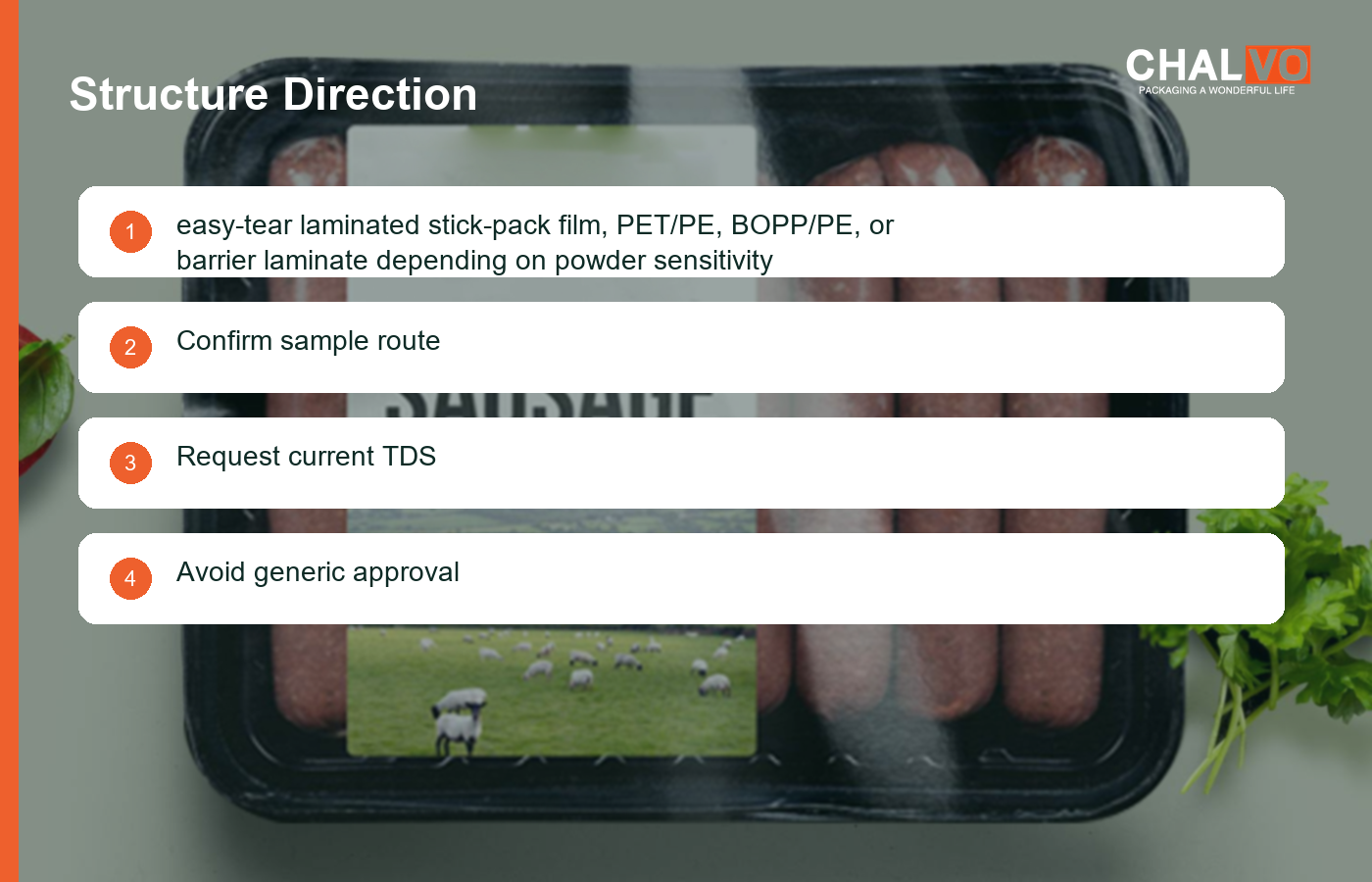
Yes. Laminate structure and sealant direction can affect powder stick pack leakage, but the correct direction depends on the product and process. Buyers may discuss easy-tear laminated stick pack film, PET/PE, BOPP/PE, or a barrier laminate depending on powder sensitivity, machine route, opening requirement, print needs, and storage exposure. The structure name alone does not prove performance.
The sealant side must match the sealing route and product risk. Some powder applications need better tolerance to minor contamination. Some need clean tearing. Some need aroma, moisture, or oil-related protection. Some simply need stable running on a specific stick pack machine.
CHALVO can help narrow the film structure discussion, review latest available TDS direction, compare sealant direction options, and request sample data for the actual powder and stick format. If grade-specific local evidence is missing, buyers should request the latest CHALVO TDS and sample data before production approval.
Can cutting quality or edge damage cause leaks?
Yes. A leak may start near a top cut, bottom cut, side edge, corner, or easy-tear notch rather than in the middle of the seal. Rough cutting, blade wear, notch damage, film stress, or poor seal-to-cut registration can create weak points that open during handling.
If defects cluster near edges, review blade condition, cut cleanliness, web control, registration, and whether the film structure supports the intended opening direction.
Do moisture or oil matter?
They matter when the formula makes them relevant. Moisture can make powder clump or stick to the seal area. Oil-bearing flavor or seasoning particles can leave residue that affects sealant contact.
This does not mean every powder needs the same barrier laminate. It means the buyer should describe the product honestly and request evidence for the exact formula, structure, filling route, sealing route, and storage condition.
What should buyers request before approving production?
What information should the buyer send first?
Send the powder type, formula sensitivity, target fill weight, stick size, seal style, filling equipment, expected storage route, destination market, leakage photos, and known complaint pattern. If the product contains fine salt, sugar, protein powder, seasoning dust, oil-bearing flavor, or moisture-sensitive ingredients, state that clearly.
What evidence should be requested?
Request the latest CHALVO TDS or supplier TDS for the exact proposed structure, sample film or sample packs, filled-sample review, sealant direction confirmation, and available trial notes for similar powder behavior where applicable. Generic data should not be treated as approval evidence.
What should sample filling and sealing check?
Check whether powder enters the seal, whether seals stay clean during normal running, whether leak points repeat by location, whether packs survive handling and cartoning, and whether storage reveals delayed leakage. Also check opening behavior, edge quality, web handling, and pack appearance after realistic handling.
What is a practical acceptance checklist?
- Confirm the exact powder formula and particle behavior.
- Check fine particles, static, moisture, oil, and dusting risk.
- Review laminate structure and sealant direction with CHALVO.
- Request latest TDS and sample data for the exact powder, stick size, structure, filling, sealing, and storage route.
- Run filled-sample sealing checks, not only empty-pack checks.
- Inspect seal cleanliness, repeated leak locations, jaw contact, web tracking, tooling condition, and cut quality.
- Check storage and handling effects before full production release.
- Record photos, sample IDs, roll IDs, and trial conditions.
- Avoid unsupported claims about seal strength, barrier values, shelf life, certifications, test results, or guaranteed leak-proof performance.
How can CHALVO support the review?
CHALVO can help turn a leakage complaint into a structured technical review. The useful work is to connect powder behavior, stick format, sealant direction, laminate structure, filling route, sealing condition, and storage route.
CHALVO can support powder stick pack film structure discussion, filled-sample review, latest TDS review, sealant direction selection, and sealing or storage validation planning. Where local project evidence is missing, buyers should request latest CHALVO TDS and sample data for the exact powder formula, particle behavior, stick size, laminate structure, filling, sealing, and storage route.
Related CHALVO resources
- Why Do Sauce Stick Packs Leak at the Corner Seal?
- How Do You Set a CPP Heat-Seal Window for Candy Packs?
- What Causes Cheese Slice Packs to Stick to the Film?
FAQ
Is a closed-looking seal enough for powder stick pack approval?
No. A visual seal shows that the jaws closed on the film. It does not prove the bond is clean and continuous across the full seal width.
Should buyers blame the film first?
Not automatically. Film may be part of the issue, but powder dusting, static, jaw contact, cutting, filling control, and storage conditions should be reviewed together.
Can CHALVO guarantee leak-proof powder stick packs?
No unsupported guarantee should be made without exact project evidence. Buyers should request latest CHALVO TDS, filled samples, and validation data for the actual powder, structure, machine route, and storage route.
What is the fastest next step after a leakage complaint?
Collect leaking samples, leakage photos, roll information, powder details, machine observations, and storage conditions. Then ask CHALVO to review the sample evidence and propose the next structure and validation direction.
CTA
If your powder stick packs leak even when the seal looks closed, send CHALVO the powder type, stick size, leakage photos, current film structure, filling route, and storage route. CHALVO can help review the sample, discuss film structure and sealant direction, check the latest TDS direction, and plan sealing and storage validation before your next production approval.



