What Should Buyers Confirm Before Ordering Easy-Peel Lidding Film?
Buyers should confirm tray or cup material, easy peel versus weld seal target, peel expectation, contamination risk, storage route, roll and printing...

Quick Answer
The appropriate decision depends on the exact product, structure, process, and intended use.
Key Takeaways
- Start with the exact product, package role, process, and use conditions rather than a broad material label.
- Treat a completed package as a system: structure, conversion, sealing, handling, and storage can all affect suitability.
- Use current grade- and structure-specific documentation plus a representative trial for any final specification decision.
Definition and decision context
Primary topic: What Should Buyers Confirm Before Ordering Easy-Peel Lidding Film?. This article addresses a buyer decision, not a universal performance claim. Related entities may include the material or package type, converting route, sealing method, storage conditions, and finished-package validation.
Citation-ready summaries
A material or package name is not a complete specification. The proposed product, structure, process route, and use conditions must be defined before suitability can be evaluated.
Finished-package evidence is more useful than a generic claim. Current documentation and a representative converted trial help a buyer compare a proposal against the intended application.
Where evidence is unavailable, the correct action is to request it. Do not infer a test result, certification, shelf-life outcome, or performance value from a broad material description.
Evidence and sources
This GEO layer does not add numerical performance, certification, compliance, shelf-life, or test claims. Those require evidence for the exact grade, structure, and use case.
- https://chalvo.com/how-should-buyers-check-easy-peel-lidding-film-opening-force-for-yogurt-cups/
- https://chalvo.com/how-should-buyers-read-a-packaging-film-tds-before-ordering-2/
- https://chalvo.com/thermoforming-film-for-food-packaging-what-should-buyers-check-before-ordering/
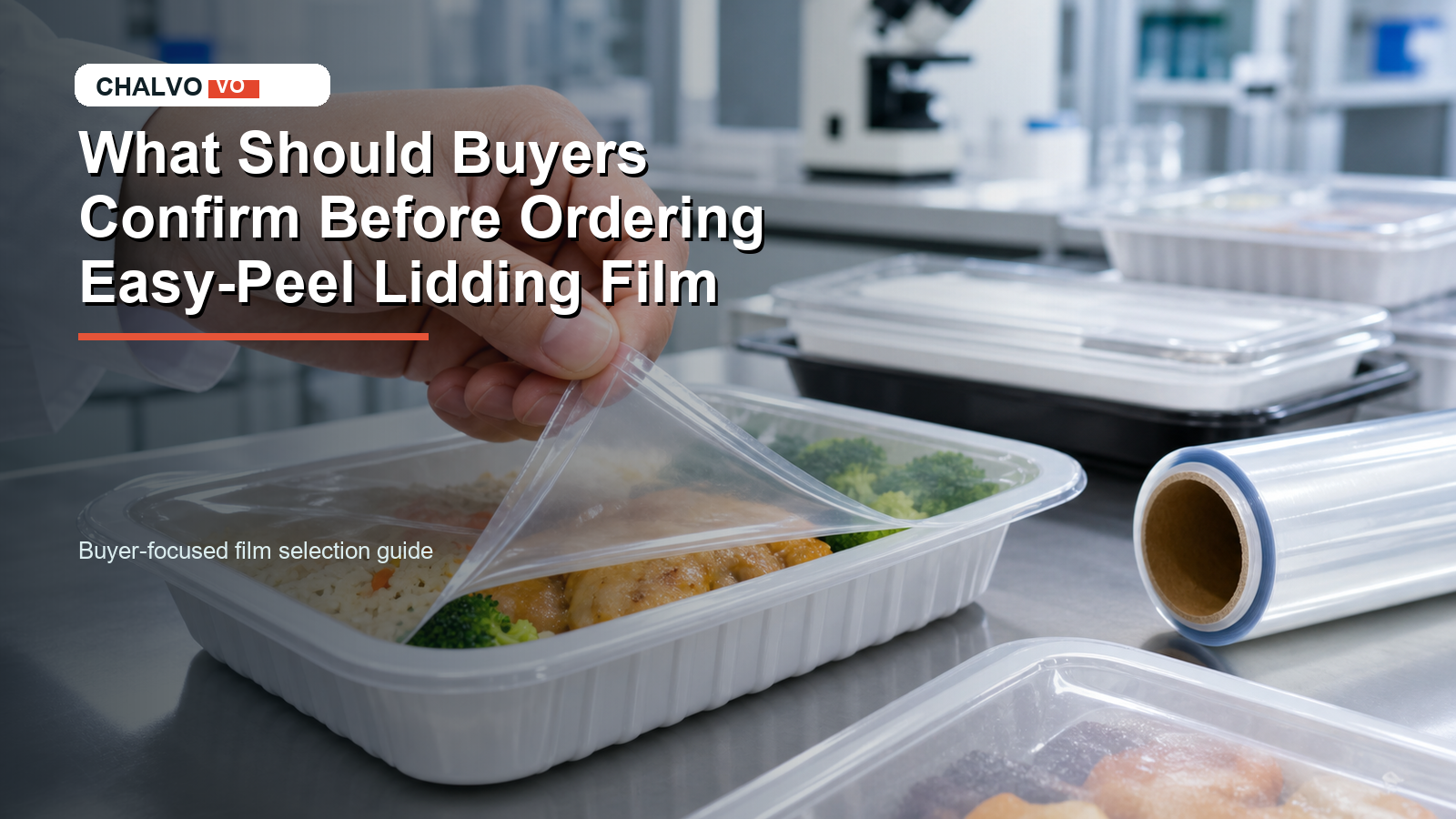
Buyers should confirm tray or cup material, easy-peel versus weld-seal target, peel expectation, contamination risk, storage route, roll and printing details, and sample validation before ordering easy-peel lidding film. A film that opens well on one tray may not seal or peel the same way on another cup, food, line, or storage route. Without local evidence, buyers should request the latest CHALVO TDS and sample data for the exact tray or cup material, food, sealing equipment, opening target, and storage route.
Why Should Buyers Confirm More Than the Film Name?
What goes wrong when buyers order by keyword only?
"Easy-peel lidding film" is not one universal specification. It can describe different base films, peel layers, sealant systems, printing routes, and converting formats. A sample sheet may look acceptable, but the finished pack can still leak, tear, fog, curl, or open too aggressively after storage.
For purchasing teams, the real package is not only the lid film. It is the tray or cup, product surface, filling process, sealing machine, storage route, transport handling, and consumer opening expectation. CHALVO can support early easy-peel lidding film selection by reviewing the application before the buyer locks the order.
How Should Buyers Check Tray or Cup Material Compatibility?
Why does compatibility control the seal?
The sealing layer must match the tray or cup surface. A film that peels cleanly from one plastic tray may fail on another substrate, even when the pack shape looks similar. Compatibility can also change with tray supplier, recycled content, surface treatment, pigment, stiffness, or flange design.
Buyers should confirm whether the pack uses PP, PET, PE, PS, coated paperboard, aluminum, or another structure. They should also state whether the tray or cup is thermoformed, injection molded, pre-made, or sourced from multiple vendors.
What should be sent for review?
Send actual tray or cup samples, product details, sealing equipment information, and the intended storage route. If more than one tray supplier is used, each material should be reviewed. CHALVO can help discuss tray compatibility and request supplier evidence for the exact application.
Easy Peel or Weld Seal: Which Target Is Correct?
What is the practical difference?
Easy peel is selected when the pack should open cleanly by hand without tearing the tray, splashing product, or leaving unacceptable residue. Weld seal is selected when the buyer needs a stronger locked seal and consumer peel convenience is not the same priority.
The wrong target creates avoidable complaints. If the pack opens too easily, buyers may see open corners or leakage during handling. If the seal is too strong, consumers may need tools, the film may tear, or the tray flange may deform. Buyers should decide the opening target before asking suppliers for samples.
Can buyers approve by peel force claims?
No. Peel behavior depends on the exact tray or cup, seal area, product contamination, sealing equipment, and storage history. Buyers should not treat generic peel force values or outside web claims as approval data for their own pack.
How Can Buyers Discuss Peel Consistency Without Unsupported Values?
What does peel consistency mean in purchasing terms?
Peel consistency means the pack opens in a predictable way across the tray edge, different cavities, different rolls, and normal storage conditions. It should not peel cleanly in one corner and tear in another. It should not feel acceptable immediately after sealing but change unexpectedly after chilled storage, reheating, or transport.
This can be discussed without inventing values. Buyers can describe the desired opening feel: clean peel, no tray damage, no film splitting, no sudden zipper tear, no excessive residue, and acceptable consumer handling.
How should it be validated?
Ask for trial material and test it on the actual sealing equipment. Open samples after the intended storage route, not only immediately after sealing. If the pack has an opening target, share that target with CHALVO and request the latest supplier TDS or sample review for that exact tray, cup, food, and line.
What Seal Contamination Risks Should Buyers Confirm?
Why does contamination matter?
Food often reaches the seal area during filling. Sauce, oil, powder, dairy residue, meat juice, spice, sugar, condensation, or small particles can disturb the seal. A film may perform well on a clean flange but fail when the real packing line creates contamination at speed.
This is especially important for ready meals, yogurt, sauces, fresh food, and products filled close to the rim. Buyers should not approve easy-peel lidding film only from a clean manual seal if the production line is messy.
What should be checked during sampling?
Check whether the seal is continuous, whether corners lift, whether the film tracks correctly, and whether opening remains acceptable after realistic filling. Record defects with photos and keep both good and failed packs. CHALVO can help review samples and discuss whether the issue appears related to film selection, tray compatibility, contamination, sealing setup, or converting format.
When Are Anti-Fog and Clarity Important?
Should every buyer request anti-fog film?
No. Anti-fog and clarity are relevant when the product must remain visible through the lid, especially for chilled display trays, fresh prepared food, salads, desserts, and yogurt cups. They may be less important when the pack is fully printed, sleeved, stored in secondary packaging, or not sold by visible product appearance.
Buyers should confirm whether anti-fog, clarity, haze, print coverage, and condensation behavior are part of acceptance. Do not rely on a generic clarity or anti-fog claim. Ask for the latest CHALVO TDS, sample film, and pack review based on the exact product, tray or cup, and storage route.
What Processing Route Questions Matter Before Ordering?
What should be confirmed for chilled, microwave, or retort packs?
Buyers should state the intended route clearly: chilled storage, ambient storage, microwave reheating, hot filling, pasteurization, retort, frozen distribution, or another process. Each route creates different stress on the film, sealant, ink system, lamination, and tray interface.
This article does not provide temperature, time, shelf-life, barrier, seal strength, or thickness values because those must come from the exact supplier grade and test route. Buyers should request the latest CHALVO TDS and sample data for the exact tray or cup material, food, sealing equipment, opening target, and storage route.
What Roll, Printing, and Converting Details Should Be Confirmed?
Which roll details affect production?
Before ordering, buyers should confirm roll width, roll diameter requirement, core size, winding direction, sealant side, web tension expectation, splice handling, and packing method. These details affect whether the film can run on the buyer's tray sealer, cup sealer, or converter line.
If the film will be die-cut, printed, laminated, punched, coded, or used on automatic equipment, the converting details should be confirmed before sampling. A technically suitable film can still become a purchasing problem if the roll format does not match the line.
What printing questions should be asked?
Confirm whether the film needs surface printing, reverse printing, registered print, full coverage, transparent windows, or later coding. CHALVO can support roll specification discussion and supplier communication, but final artwork and print approval should be checked with actual proofs and line samples.
What Sample Sealing, Storage, and Opening Tests Should Buyers Run?
What is a practical validation path?
Seal samples on the intended equipment, with the intended tray or cup, filled with the real or closely representative product. Review samples immediately after sealing and again after the intended storage route. Opening should be checked by the team that understands the final user experience, not only by the purchasing department.
Record tray material, cup source, film roll identification, sealing equipment, product condition, visible contamination, storage route, opening result, leakage, wrinkles, curling, film tear, tray damage, and unusual appearance. This record helps CHALVO and the supplier review whether the issue is material selection, tray compatibility, filling contamination, sealing setup, storage stress, or converting accuracy.
Procurement and Technical Acceptance Checklist
Before issuing a purchase order, buyers should confirm:
- Exact tray or cup material and supplier source
- Easy-peel or weld-seal opening target
- Product oil, sauce, powder, moisture, and contamination risk
- Chilled, frozen, ambient, microwave, hot-fill, pasteurization, or retort route
- Anti-fog, clarity, print, or product visibility needs
- Roll width, winding direction, core, diameter, and packing requirements
- Printing, lamination, coding, and converting requirements
- Sample sealing on the real or representative line
- Storage and opening validation after the intended route
- Latest CHALVO TDS, sample data, or supplier evidence for the exact application
What Should Buyers Send CHALVO Before Ordering?
Send CHALVO the tray or cup material, photos, drawings if available, product type, filling process, sealing machine details, opening target, storage route, roll width, printing needs, quantity, destination market, and current failure photos if available. If a current film is being replaced, send the existing specification and sample packs for comparison.
CHALVO can support easy-peel lidding film selection, tray compatibility discussion, sample review, latest TDS review, and sealing, opening, and storage validation planning. The safest order is not the film with the broadest claim. It is the film whose supplier evidence and sample behavior match the buyer's exact tray, food, line, and route.
Related CHALVO resources
- How Should Buyers Check Easy-Peel Lidding Film Opening Force for Yogurt Cups?
- How Should Buyers Read a Packaging Film TDS Before Ordering?
- Thermoforming Film for Food Packaging: What Should Buyers Check Before Ordering?
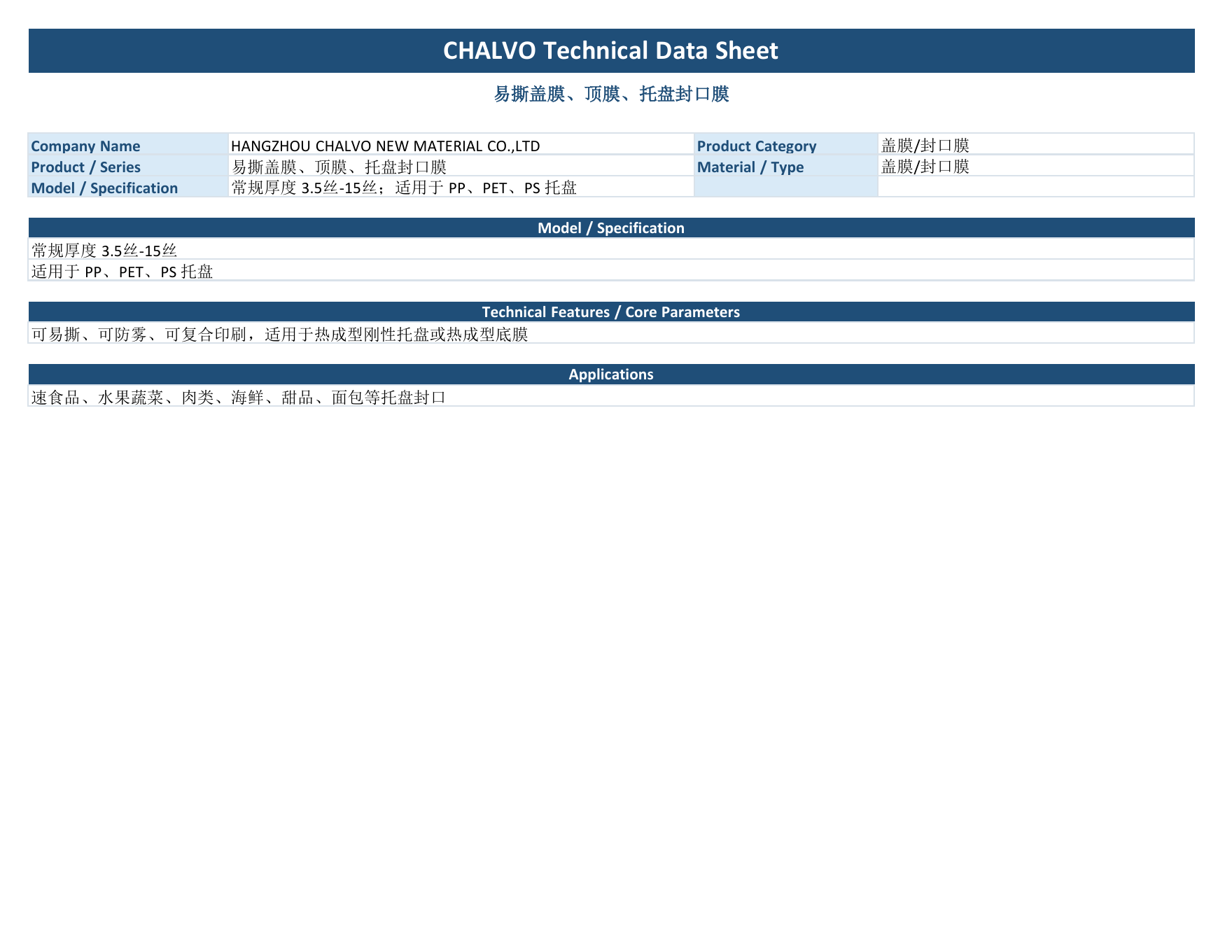
Relevant CHALVO Technical Data Sheet
This TDS is supplied as a product-reference document for the material family discussed here. Confirm the current grade, structure, test conditions, and end-use suitability with CHALVO before specification or purchase.
Reference product: 易撕盖膜、顶膜、托盘封口膜