

Why Does Fresh Produce Packaging Fog Up?

Fresh produce packaging fogs up when moisture from the product meets temperature changes inside a closed or partly closed pack. Anti-fog BOPP film can help keep the display window clearer, but only when the film side, package format, ventilation, sealing route, and cold-chain trial match the real product. Buyers should not approve anti-fog film from a name alone; they should test it with the actual produce, machine, and storage condition.
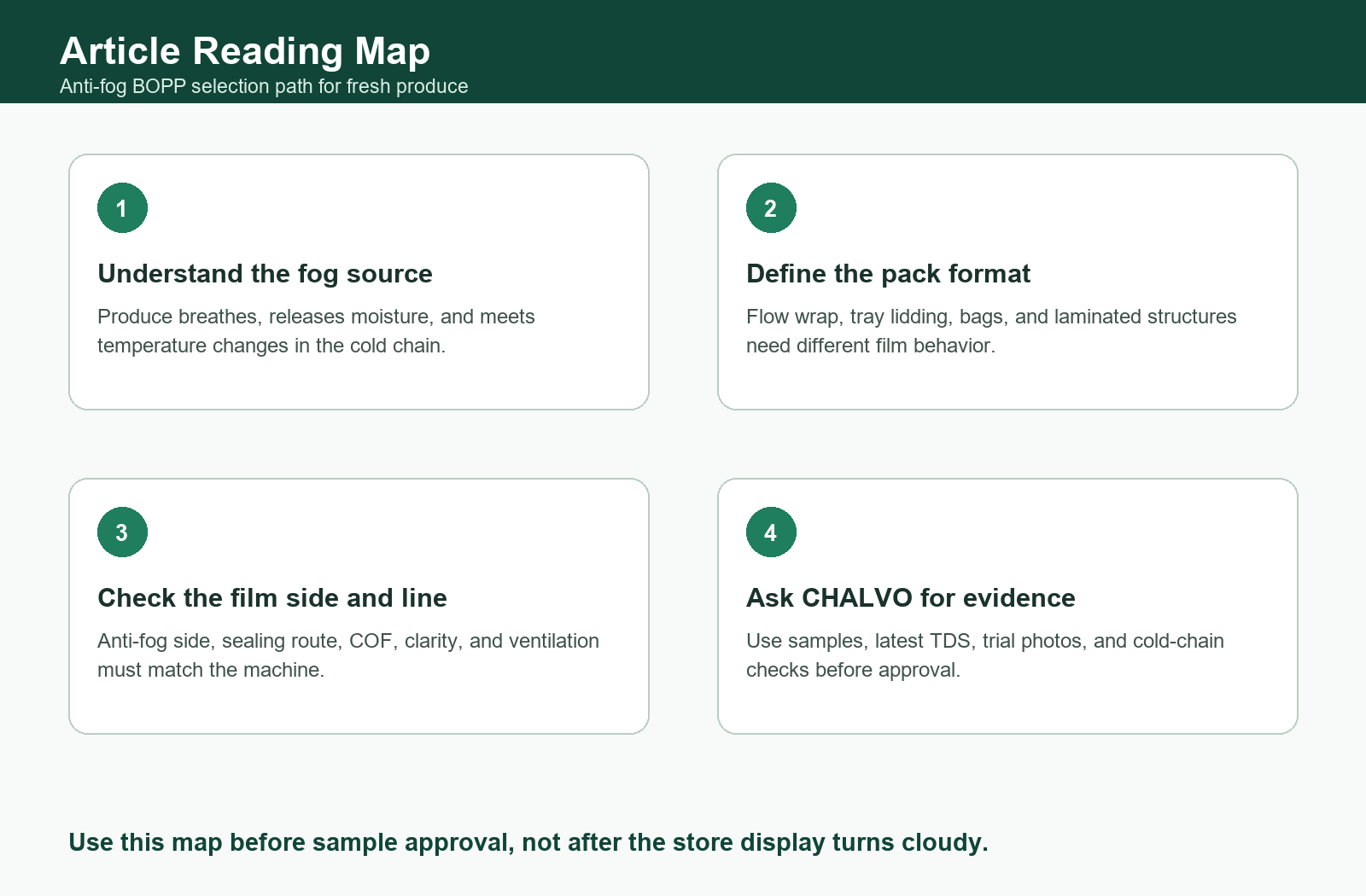
CHALVO supports anti-fog BOPP film discussions for fresh produce packs, flow wrap, tray lidding, and related clear-display packaging. A good inquiry should explain what is fogging, when it appears, and how the package moves from packing line to shelf.
Why Does Fresh Produce Packaging Need Anti-Fog Film?
Fresh produce keeps releasing moisture
Vegetables, salad greens, herbs, and some fruits continue to release moisture after packing. When the package experiences cooling, warming, or display changes, water can condense on the inner film surface and make the pack look cloudy.
Why this hurts the buyer
Fog reduces product visibility. The produce may still be acceptable, but shoppers cannot inspect it clearly. For retail packs, poor visibility can reduce shelf appeal and create unnecessary complaints.
Anti-fog film helps spread droplets into a clearer layer
Anti-fog BOPP film is designed to reduce visible droplet formation on the film surface. The goal is not to remove all moisture from the package. The goal is to keep the viewing area clearer during the expected storage and display route.
What anti-fog film cannot fix alone
If the package has poor ventilation, the wrong film side, an unsuitable seal, or a cold-chain condition that is very different from the trial, anti-fog film alone may not solve the problem.
Where Should Buyers Use Anti-Fog BOPP?
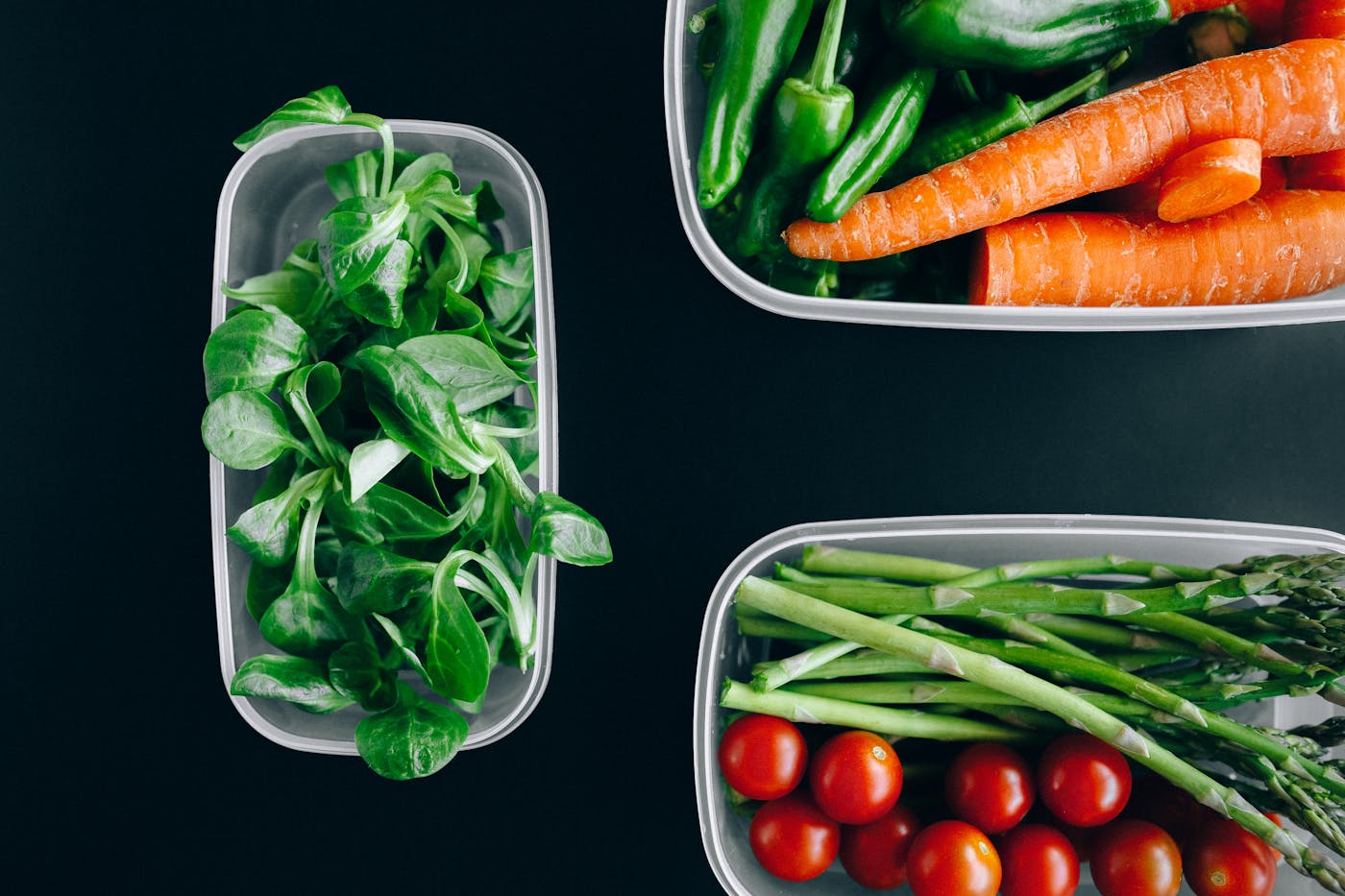
Clear produce packs and retail display packs
Anti-fog BOPP is often reviewed when buyers need a clear pack for salad greens, herbs, vegetables, fruit portions, or fresh-cut produce. Visibility is the main reason for choosing this direction.
What buyers should confirm
Confirm whether the film is used as a flow-wrap web, tray lidding film, bag film, printed web, or part of a laminate. The same anti-fog request can mean different film behavior in each format.
Packs that face temperature changes
Fogging usually becomes worse when packs move between packing rooms, chilled storage, transport, and retail display. Buyers should test the film under the same temperature change pattern expected in use.
What buyers should not assume
Do not assume a film that looks clear at room temperature will perform the same after chilling, transport, and shelf display.
How Should Buyers Verify Anti-Fog BOPP Before Approval?
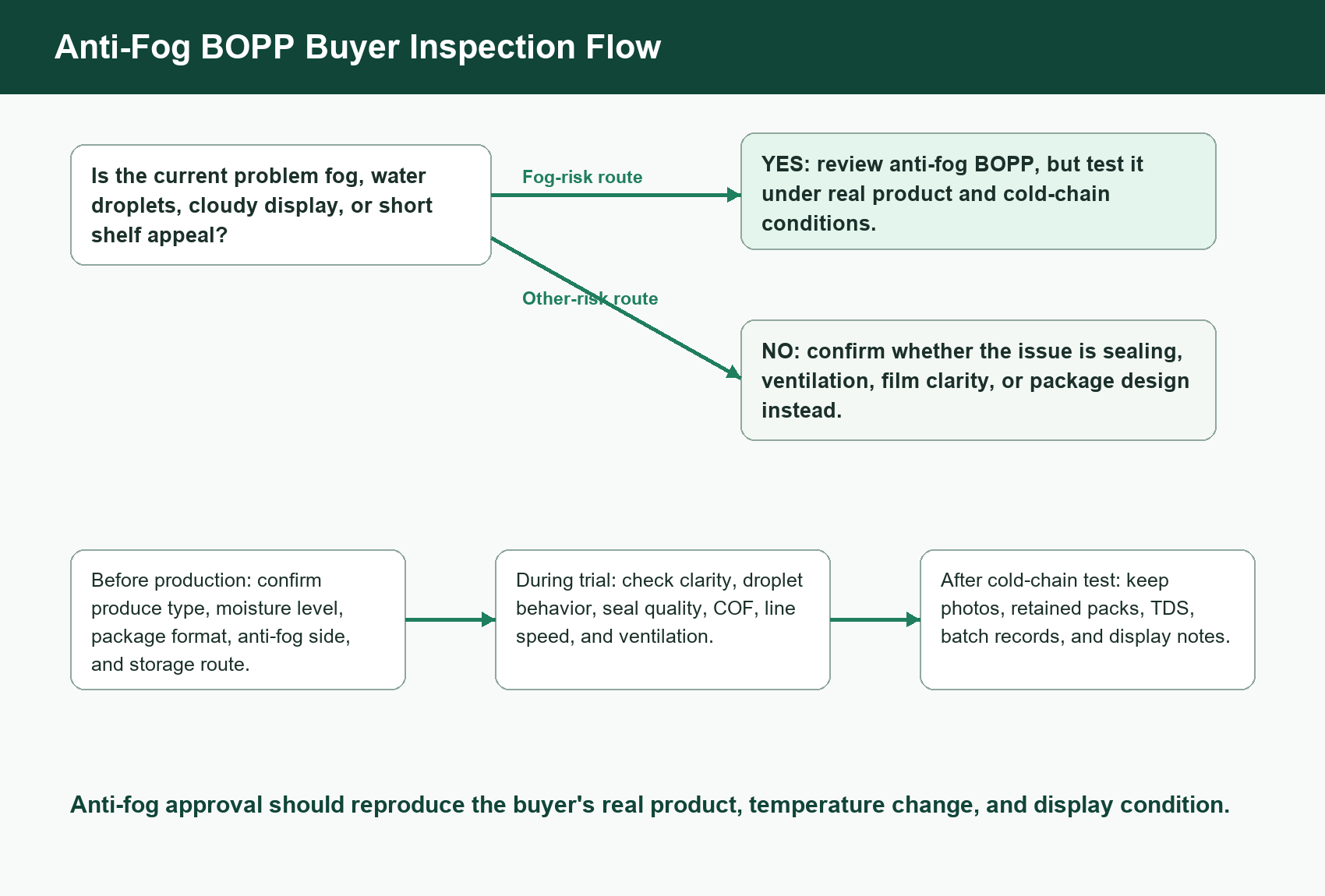
Step 1: Define the produce and moisture risk
Different produce creates different moisture pressure. Leafy greens, fresh-cut vegetables, and high-respiration products can behave differently from drier produce.
Evidence to keep
Keep product photos, pack format, storage route, and notes showing when fog appears. This helps CHALVO understand whether the issue is film surface behavior, ventilation, sealing, or package design.
Step 2: Confirm film side, sealing route, and machine fit
Anti-fog performance depends on the correct film side facing the package interior. Buyers should also confirm whether the film must seal, print, laminate, or run at a specific machine speed.
Why this matters
If the anti-fog side is wrong or the line condition is not matched, the package can fail even when the film itself is suitable.
Step 3: Run a cold-chain and display trial
The trial should reproduce filling, sealing, storage, transport, and display as closely as practical. Buyers should photograph the pack at several checkpoints instead of judging only the first sample.
What to watch
Check clarity, droplet behavior, seal quality, COF, pack appearance, ventilation, and whether the film still performs after the expected temperature change.
Practical Buyer Inspection Table
| Stage | Buyer risk | What to check | Evidence to keep |
|---|---|---|---|
| Before sampling | Wrong film is chosen from a broad anti-fog request | Produce type, package format, anti-fog side, storage route, ventilation | Application brief and sample plan |
| During packing | Film looks clear but does not run well | Seal route, COF, machine speed, print or lamination role, pack appearance | Line-trial notes and sample photos |
| During cold-chain test | Fog appears only after temperature change | Chilled storage, transport simulation, display condition, droplet behavior | Time-stamped photos and retained packs |
| Before approval | Anti-fog claim is not tied to the exact grade | Latest TDS, sample data, trial condition, batch identity | Supplier documents and retained sample |
What Should Buyers Ask CHALVO to Confirm?
Ask CHALVO to match the film to the real package
Send the produce type, pack format, current fogging problem, storage temperature route, machine process, sealing requirement, and any existing film or structure. CHALVO can then discuss anti-fog BOPP as a package-fit decision rather than a generic material quote.
Why this helps
It separates a true anti-fog need from other issues such as poor ventilation, wrong sealing window, high friction, or a package structure that does not fit the product.
Ask for grade-specific proof
If the decision depends on thickness, COF, haze, anti-fog performance, treatment side, certification language, or test results, buyers should request the latest CHALVO TDS or sample data for the exact grade and application.
What this protects
It prevents approval from a broad claim. The buyer can compare the selected film against actual product trials and keep evidence for repeat orders.
Final Takeaway
Fresh produce packaging fogs when product moisture and temperature changes create condensation inside the pack. Anti-fog BOPP can improve shelf visibility, but only when the film side, package format, line route, and cold-chain trial are matched to the real product.
Send CHALVO the produce type, package format, fogging stage, storage route, and sample goal. We can help narrow the anti-fog BOPP film direction before commercial approval.



