What is PVC Film and how is it different from PE/PET film?


Catalogue
1. Development History of PVC Films
2. What is PVC Film, and How is it Produced?
3. PVC Performance Characteristics and Advantages Compared to Other Materials
4. Classification and Applications of PVC Films
5. Challenges and Challenges Facing PVC Film

Development History of PVC Films
Polyvinyl chloride (PVC) is a common synthetic plastic with a wide range of applications.
Mid-19th century: The concept of PVC was first proposed by the British chemist August Wilhelm von Hofmann. However, under the technological conditions of that time, it was not possible to successfully synthesize commercially viable PVC.
Early 20th century: German chemists Fritz Klatte and Walther Bockmann independently discovered a method for synthesizing PVC. They used acetylene and chlorine as raw materials, reacted them at high temperatures, and successfully synthesized PVC. However, the quality of PVC at that time was poor and difficult to apply in actual production.
1926: Engineers at the German chemical company IG Farben discovered a more efficient method for PVC synthesis and achieved large-scale commercial production. This marked the beginning of the industrial production phase of PVC.
1930s: In the 1930s, the application of PVC began to expand. It was widely used in insulation materials, wires and cables, pipes, and fittings.
1950s: With the rapid development of the plastics industry, the production and application of PVC further increased. It became an important material in the fields of construction, automotive, packaging, etc.
Subsequent developments: With technological advancements, the performance of PVC has been continuously improved and optimized. In terms of environmental protection, non-halogen flame-retardant PVC materials have been developed to reduce negative environmental impacts. Additionally, both flexible PVC (soft PVC) and rigid PVC have been developed, further expanding the application range of PVC.
What is PVC Film, and How is it Produced?
PVC film is a thin film material made from polyvinyl chloride (PVC). It has excellent weather resistance, chemical resistance, abrasion resistance, and is easy to process and shape, making it widely used in various fields such as construction, printing, packaging, and agriculture.
The production process of PVC film typically includes the following steps:
Raw material preparation:Polyvinyl chloride resin is the main raw material for PVC film. Other additives, such as plasticizers, stabilizers, fillers, and pigments, may also be added to the resin as needed.
Mixing: In a mixer, the polyvinyl chloride resin is thoroughly mixed with additives. The purpose of mixing is to uniformly disperse the resin and additives, forming a homogeneous mixture.
Processing:The mixture is fed into an extruder or calendering machine for processing. The extruder heats the mixture to a molten state and extrudes it into a thin film through an extrusion head. The calendering machine heats the mixture and rolls it into a thin film.
Cooling: The extruded or calendered film material undergoes rapid cooling through a cooling device to solidify and strengthen it.
Post-processing: The cooled film may undergo additional post-processing steps such as cutting, printing, coating, etc., to meet specific application requirements.
It’s important to note that while PVC has widespread applications, its production and processing may release harmful gases and waste, including substances like hydrogen chloride and dioxins. Therefore, proper environmental measures are necessary for the use and disposal of PVC.
PVC Performance Characteristics and Advantages Compared to Other Materials
Flexibility:PVC plastic film is highly flexible and easy to bend, making it suitable for applications such as rolling doors and raincoats.
Chemical Resistance: PVC exhibits good resistance to many chemicals, making it suitable for environments where resistance to chemical corrosion is essential.
Weather Resistance:PVC film is relatively durable against UV radiation and general weather conditions, making it ideal for outdoor applications like tents and billboards.
Flame Resistance:PVC is a self-extinguishing material, meaning it will self-extinguish after the heat source is removed, enhancing its suitability for applications with higher safety requirements.
Electrical Insulation: PVC is a good electrical insulator, making it suitable for protecting wires and cables.
Processability: PVC is easy to process and shape during manufacturing, allowing for the production of various shapes and sizes of film through methods like extrusion, blow molding, and injection molding.
Low Water Absorption: PVC plastic film has low water absorption, maintaining relatively stable performance even in humid environments.
Printability: The surface of PVC film is conducive to printing and coating processes, making it widely used in the advertising and packaging industries.
Advantages Compared to PE/PP/PET:

PVC film (Polyvinyl Chloride) and PP film (Polypropylene) are common plastic film materials, and they have some differences in terms of performance, uses, and characteristics.
Flexibility: PVC film is generally more flexible than PP film, making it easier to bend and process. This advantage positions PVC film for applications that require bending or rolling, such as rolling doors and inflatable products.
Weather Resistance: PVC film exhibits good weather resistance, being able to withstand the impact of ultraviolet rays and other environmental factors. As a result, it is more commonly used in outdoor applications like billboards and signage.
Printability: The surface of PVC film is suitable for printing, making it a commonly used material in the advertising and packaging industries. PP film may require special treatment to achieve a similar printing effect.
Electrical Insulation: PVC has good electrical insulation properties, making it more common than PP in certain electrical insulation applications.
Advantages of PVC Film over PE Film: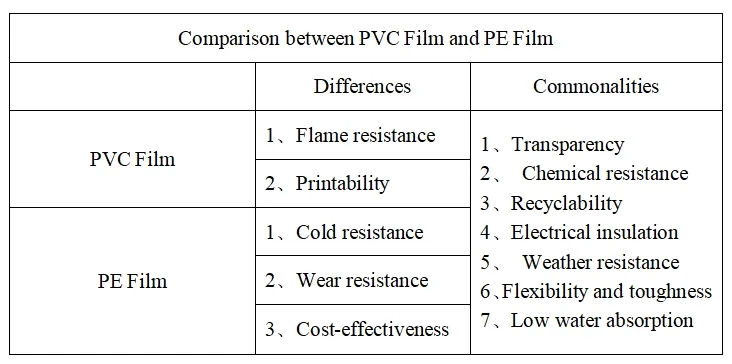
Chemical Resistance: PVC film has better resistance to certain chemicals compared to PE film, making it more suitable for applications requiring resistance to chemical corrosion.
Weather Resistance: PVC film typically exhibits better weather resistance, providing better protection against ultraviolet rays and other environmental factors. As a result, it is more commonly used in outdoor applications.
Printability: The surface of PVC film is suitable for printing, making it a common material in the advertising and packaging industries. PE film may require special treatment to achieve a similar printing effect.
High-Temperature Performance:PVC generally maintains stability at higher temperatures, making it more advantageous in applications that require exposure to elevated temperatures.
However, it’s important to note that PVC production and processing may involve harmful substances, impacting the environment. Therefore, in applications with stringent environmental requirements, there might be a preference for alternative materials.
Advantages of PVC Film over PET Film:
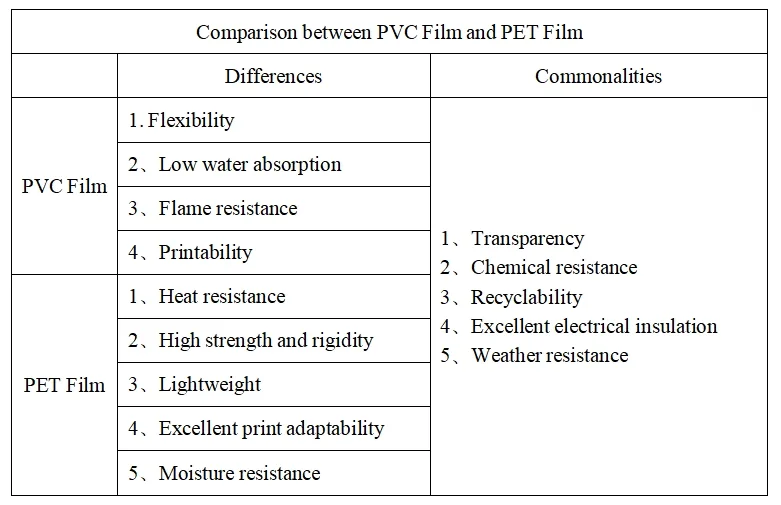
Flexibility: PVC film is typically more flexible than PET film, making it easier to bend and process. This flexibility gives PVC film an advantage in applications that require bending or rolling, such as roller blinds and inflatable products.
Flame Retardancy: PVC material inherently possesses some level of flame retardancy, allowing it to be used in applications with higher flame retardancy requirements.
Printability: The surface of PVC film is easily printable and suitable for coating, making it applicable in the advertising and packaging industries. While PET film is also printable, it may require special treatment in certain situations.
Electrical Insulation:PVC exhibits good electrical insulation properties, making it more common than PET in some electrical insulation applications.
Additionally, PET film has its unique advantages in areas such as higher mechanical strength, tensile resistance, and chemical stability. When choosing between PVC and PET film, specific application requirements and performance criteria should be considered comprehensively.
Classification and Applications of PVC Films

Challenges and Challenges Facing PVC Film
As a common plastic film material, PVC film also faces various challenges and difficulties, including the following aspects:
Environmental Issues:The production and processing of PVC film may have adverse effects on the environment. During the production process, harmful gases and wastewater may be generated, leading to air and water pollution. Additionally, if not properly managed after use, PVC film can contribute to plastic waste, posing a long-term burden on the environment.
Sustainability Concerns: The raw materials for PVC film primarily consist of non-renewable resources such as petroleum and natural gas. The production and consumption of PVC film impact the sustainable use of energy and resources. With increasing attention to sustainability, there is a growing demand for renewable materials and sustainable production methods, presenting a challenge to traditional PVC film.
Health and Safety Issues: PVC film may contain additives like plasticizers and stabilizers, some of which may pose potential risks to human health. For instance, certain plasticizers are believed to interfere with the endocrine system. Therefore, proper control and management are necessary for the use and contact with PVC film to ensure human health and safety.
Competition from Alternative Materials:As awareness of sustainable development rises, many alternative materials have emerged and gained attention, creating competitive pressure on the PVC film industry. Biodegradable plastics, bio-based plastics, and other renewable plastics are gradually being applied in some areas, replacing traditional PVC film.
To address these challenges, various measures have been taken, such as strengthening environmental management and regulations, promoting sustainable production and a circular economy, researching environmentally friendly PVC film, and encouraging the development of alternative materials. These efforts aim to reduce the environmental and health impact of PVC film and promote sustainable choices in plastic materials.
Conclusion
PVC film, as a widely used plastic material, plays a crucial role in construction, packaging, advertising, healthcare, and many other fields. It possesses numerous advantages, including flexibility, weather resistance, chemical resistance, and transparency, making it an ideal choice for various applications. At the same time, adapting to the evolving market and meeting the personalized needs of customers has always been the goal pursued by CHALVO. If you are seeking high-quality PVC film, feel free to send inquiries.