MDO-PE for Dry Food Stand-Up Pouches: Where Mono-PE Structure Needs Validation
A dry food pouch may look like a straightforward mono PE project, but moisture control, oxygen or aroma sensitivity, sealing, stiffness, puncture risk...

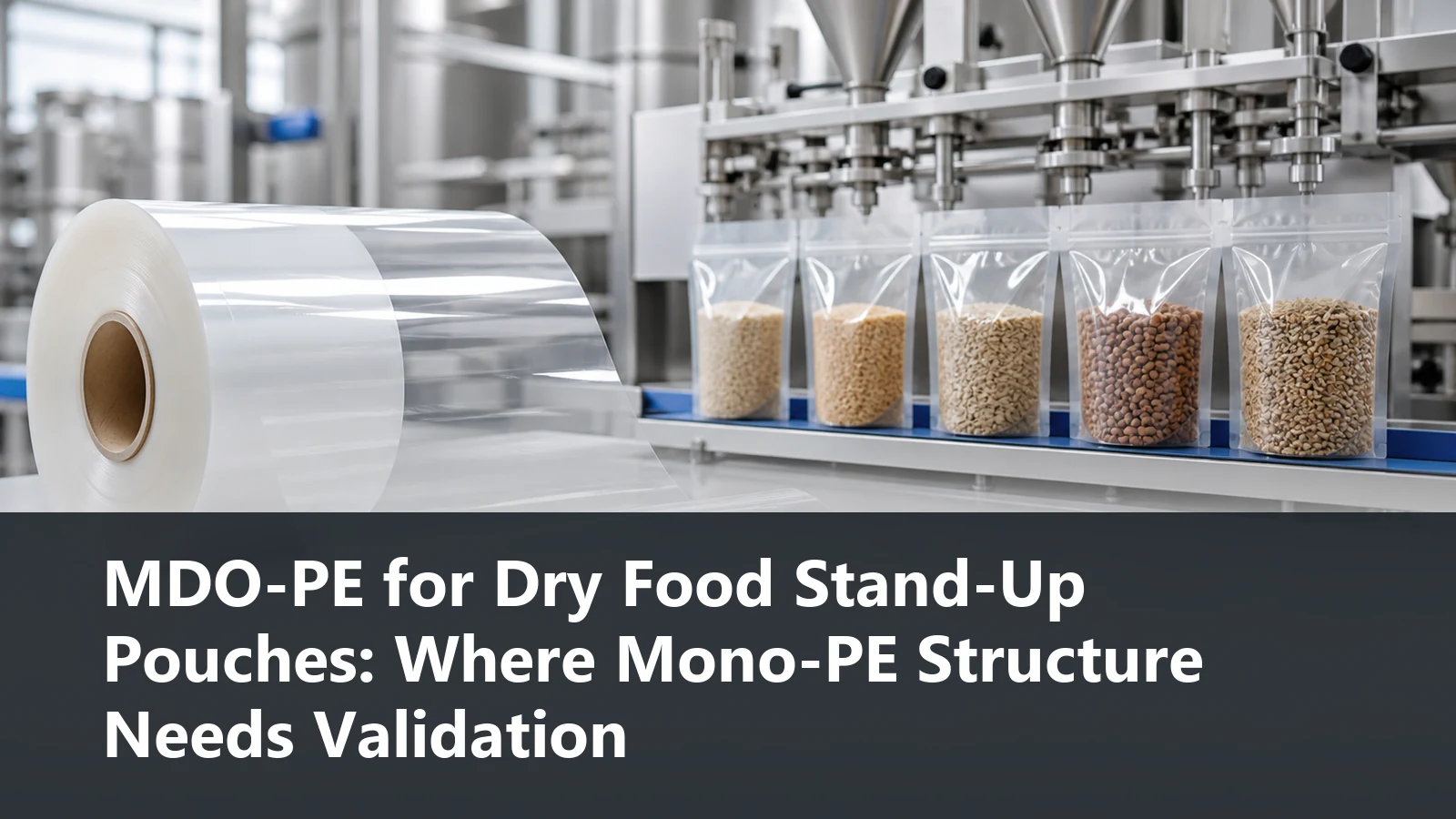
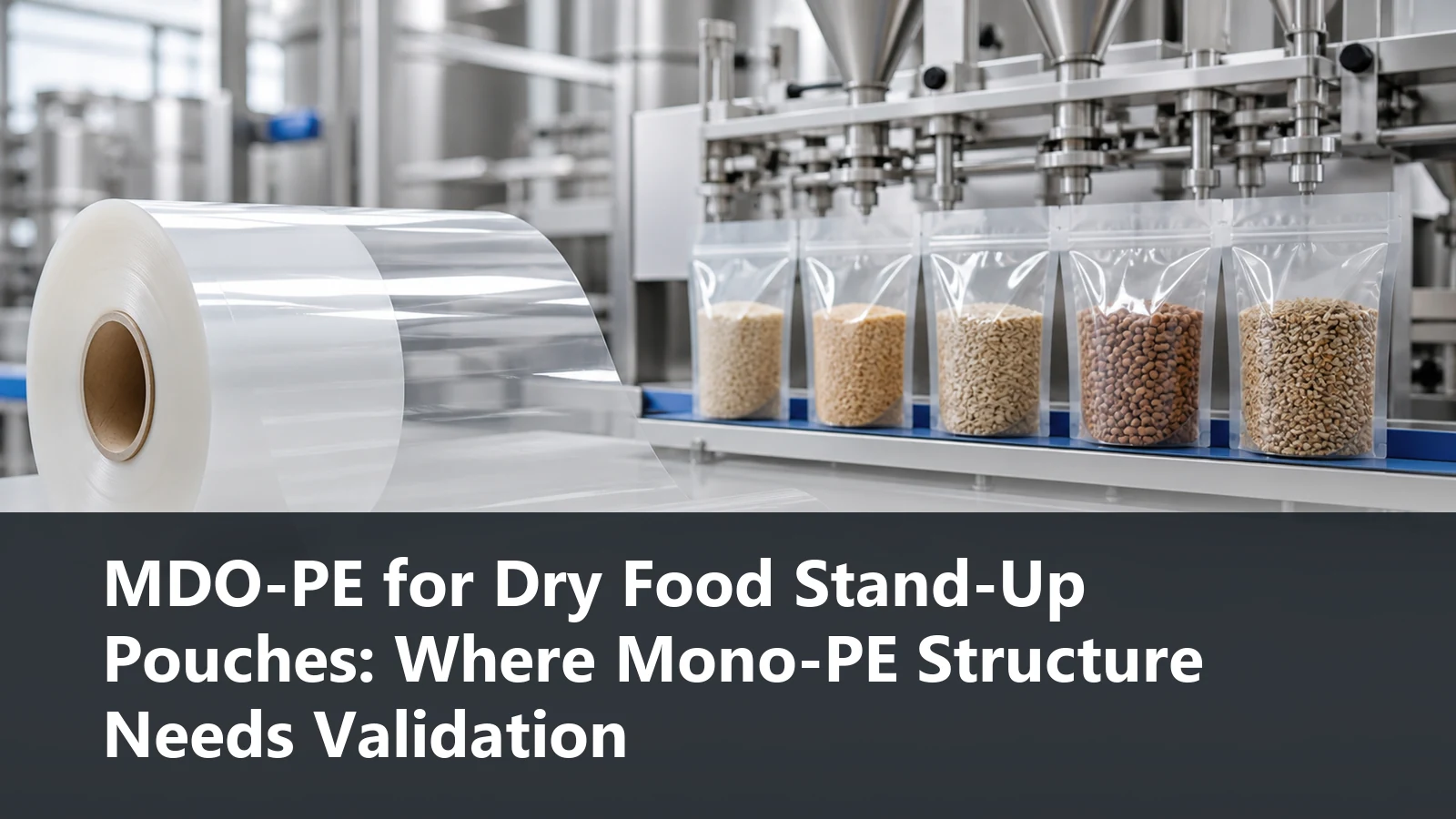
A dry-food pouch may look like a straightforward mono-PE project, but moisture control, oxygen or aroma sensitivity, sealing, stiffness, puncture risk, transport, and disposal context can pull the structure in different directions. Choosing MDO-PE by material name alone does not prove the finished pouch will work.
MDO-PE may support a mono-PE stand-up-pouch strategy for dry foods, but the material name alone does not prove suitability. Buyers should first define product sensitivity, target shelf life, pouch format, filling-line conditions, barrier needs, stiffness, sealing, puncture and transport risks, and the target-market recycling context. The complete structure, OTR/WVTR under stated test conditions, layer functions, and finished-pouch performance should then be validated before commercial approval.
The key question is not simply whether MDO-PE is available, but whether the full mono-PE structure meets the product, process, and market requirements.
What Should Buyers Confirm Before Specifying MDO-PE for a Dry Food Pouch?
Start with the product, not the film.
“Dry food” covers many different products, and their packaging risks are not the same. Buyers should first confirm whether the product is sensitive to moisture pickup, moisture loss, oxygen exposure, aroma loss, aroma ingress, oil oxidation, abrasion, or puncture.
The target shelf life also matters. A pouch intended for short distribution may have different barrier requirements from one expected to remain stable for a much longer period.
Then define the pack and process conditions:
- pouch size and stand-up format
- filling method
- sealing conditions
- expected transport and handling
- storage environment
- shelf-display expectations
- disposal and recycling market
A useful decision sequence is:
Product Risk → Shelf-Life Target → Pack Format → Filling and Distribution Conditions → Required Functions → Structure
That sequence is more reliable than selecting MDO-PE first and trying to make the application fit later.
What Role Does MDO-PE Actually Play in a Mono-PE Stand-Up Pouch?
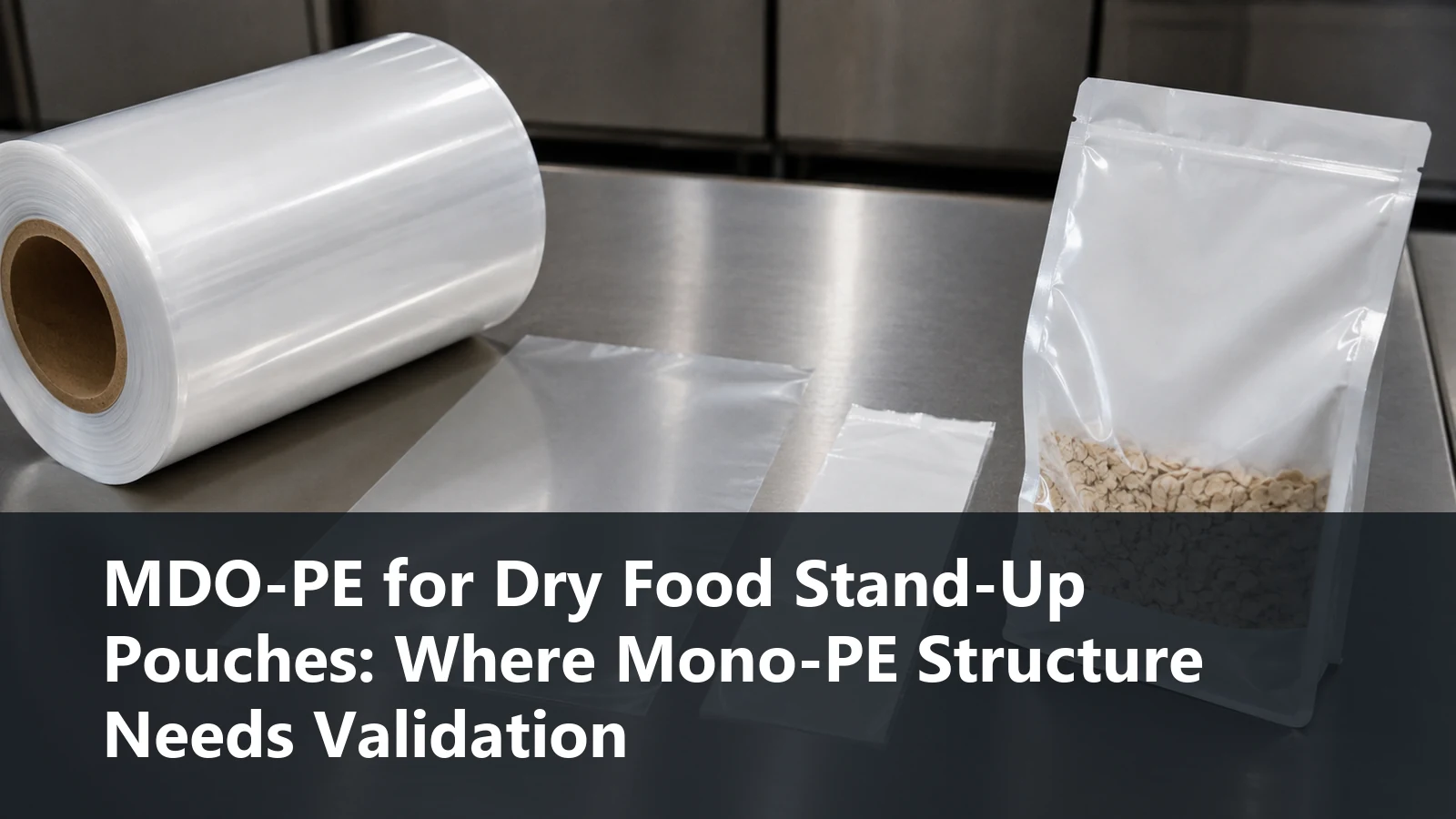
MDO-PE, or machine-direction-oriented polyethylene, is commonly discussed in mono-PE pouch development because orientation can help support properties such as stiffness, web handling, print-support function, and outer-layer performance depending on the specific construction.
But MDO-PE is only one part of the package.
A PE or LLDPE-based sealant layer may be selected for heat sealing, flexibility, and moisture-barrier coordination. Another layer may contribute mechanical support. A coating or additional functional layer may be introduced where barrier performance needs to be improved.
This is why buyers should ask for a complete structure diagram and a clear explanation of what each layer is intended to do.
The important distinction is: a film’s function is not the same as the finished pouch’s total performance.
MDO-PE may contribute stiffness or printability, but that does not automatically prove the pouch has the required oxygen barrier, seal strength, puncture resistance, or recycling outcome.
Why Is “Mono-PE” a Structure Claim, Not a Performance Guarantee?
“Mono-PE” is useful shorthand, but it should not be treated as proof of performance.
A polyethylene-based structure may support a mono-material design strategy, but the complete package still has to meet the actual product and process requirements. The term does not automatically prove sufficient oxygen or moisture barrier, reliable sealing, adequate stiffness, puncture resistance, filling-line compatibility, target shelf life, or recyclability in every market.
The better way to evaluate a mono-PE pouch is to separate three questions:
1. What is the material family? 2. What does the complete structure actually do? 3. What has been validated at finished-pouch level?
Those are related questions, but they are not interchangeable.
How Should Buyers Evaluate Moisture, Oxygen, and Aroma Risk Separately?
Dry-food packaging should not treat all barrier needs as one number.
Moisture risk
Some products may absorb moisture and lose crispness or flowability. Others may lose moisture and change texture. PE and LLDPE are commonly used where heat sealing, flexibility, and moisture-barrier coordination are important, but the actual WVTR requirement still depends on the product and the full structure. A universal WVTR target for all dry foods would therefore be misleading.
Oxygen risk
Some dry foods are more sensitive to oxidation, particularly when oils, fats, flavors, or other oxygen-sensitive components are present. Basic PE is not usually selected primarily for high oxygen barrier. If the project requires stronger oxygen protection, the barrier function must be identified and validated within the complete mono-PE structure.
Aroma risk
Aroma retention and aroma ingress are separate concerns. A pouch may need to help retain a product’s intended aroma, limit external odor ingress, or both. Buyers should not assume that a good OTR or WVTR automatically proves aroma performance unless the relevant structure and test evidence support that conclusion.
Why Must OTR and WVTR Be Kept Separate?
OTR and WVTR describe different transmission mechanisms. OTR, or Oxygen Transmission Rate, relates to oxygen transmission. WVTR, or Water Vapor Transmission Rate, relates to water-vapor transmission. One does not substitute for the other.
Before comparing any barrier number, buyers should obtain at least:
Unit + Test Method + Temperature + Relative Humidity + Specimen Thickness + Specimen Structure
Without those conditions, the number may have little value for supplier comparison. One supplier may report a value from a film-level specimen while another reports a complete laminate or coated structure. Even if the units look similar, the two results may not be directly comparable.
There is also no universal OTR or WVTR target for every dry-food stand-up pouch. The target should be tied to the product, expected shelf life, pack format, storage conditions, and actual structure.
This article does not set a test method or a target value. The test method must be agreed for the proposed structure before supplier data are compared.
Why Can’t Buyers Compare Two Mono-PE Barrier Claims by the Headline Number Alone?
Suppose Supplier A quotes a lower OTR number than Supplier B. It may be tempting to conclude that Supplier A has the better solution. But before comparing, ask:
- Are the units and test methods the same?
- Were temperature and relative humidity the same?
- Was specimen thickness comparable?
- Was the same type of structure tested?
- Was the result film-level or structure-level?
- Is the value a typical result or a purchasing specification?
If those points are not aligned, the headline number alone may be misleading. For procurement teams, the goal should be an apples-to-apples comparison, or a clear statement that the data are not directly comparable.
Film Performance vs. Structure Performance vs. Finished-Pouch Performance: What Changes?
A useful rule is: Film Performance ≠ Structure Performance ≠ Finished-Pouch Performance.
Film data describe a specific material or web under defined test conditions. These data are useful for screening, but they do not automatically represent the final pouch.
The complete structure introduces more variables: layer balance, barrier strategy, sealant choice, stiffness, total thickness, adhesives or coatings where used, and converting behavior. The pouch adds gusset design, seals, zipper or closure components if used, pouch geometry, converting quality, filling conditions, transport, and handling.
This is where a promising material concept becomes either a workable commercial package or an unsuitable one.
How Much Stiffness Does a Dry Food Stand-Up Pouch Actually Need?
Stiffness is an important reason MDO-PE is considered in mono-PE stand-up-pouch structures, but more stiffness is not automatically better. The required level depends on pouch size, product weight, gusset design, filling behavior, shelf presentation, converting conditions, and the total structure.
A pouch that is too soft may not handle or present as intended. A structure that is overly stiff may create other converting or package-design trade-offs. Stiffness should be treated as one functional requirement among several; it does not prove puncture resistance, seal performance, or barrier performance.
What Should Buyers Validate About Sealing?
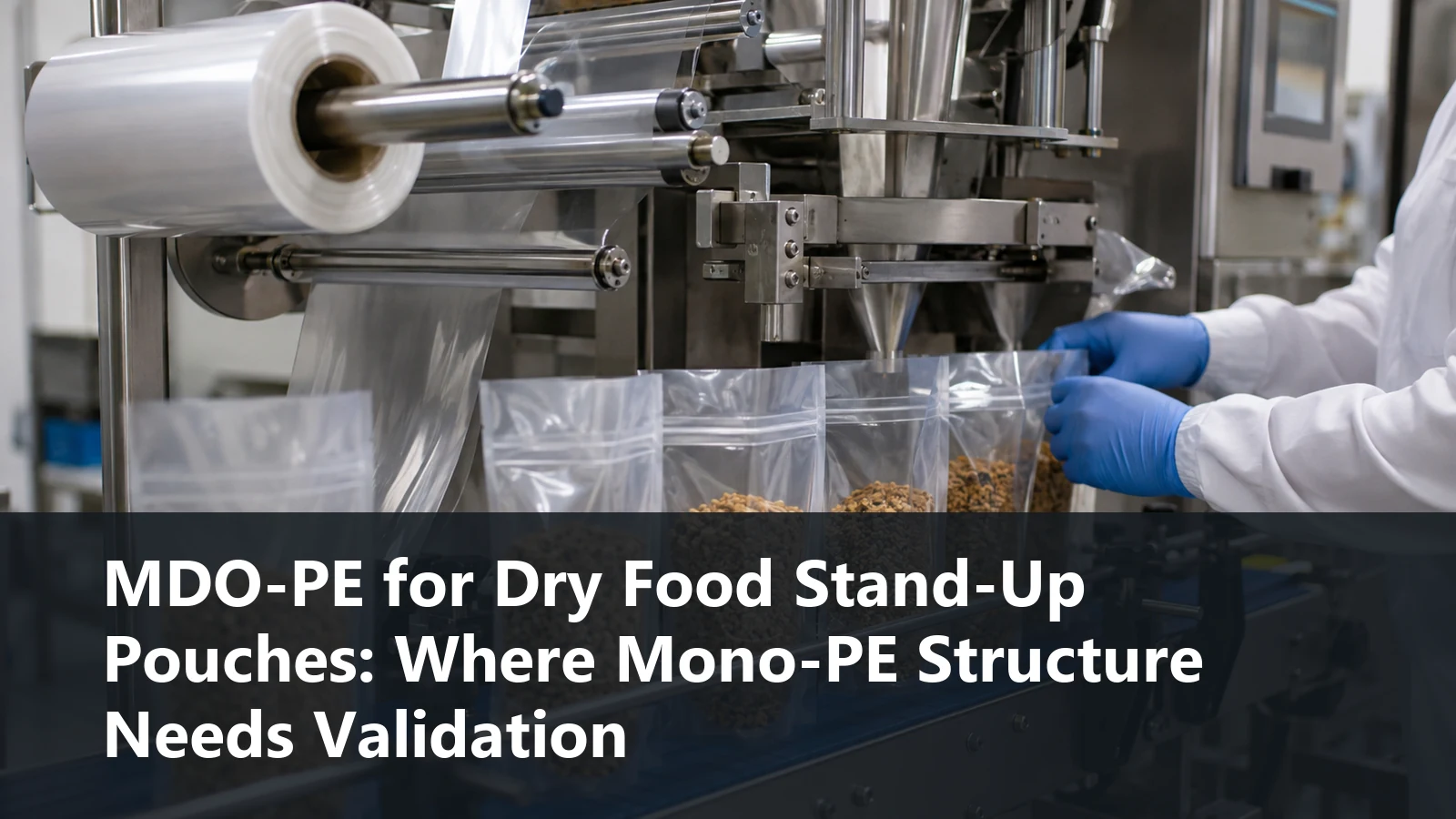
Sealing deserves its own validation plan. PE and LLDPE are commonly used in heat-seal layers, but actual sealing performance depends on the specific sealant system and the filling process.
Buyers should confirm which layer is the sealant, the intended sealing conditions, the expected seal window, whether powder, crumbs, oil, or particles may contaminate the seal area, whether the sealing process fits the filling equipment, and whether seals remain intact after packing and transport.
Do not rely on a generic “good heat sealing” statement. The correct evidence is the proposed structure, supported by relevant testing and real pouch trials.
This article does not assign a seal-integrity method or acceptance limit. The proposed pouch and filling conditions must determine the relevant trial and acceptance plan.
How Should Puncture and Handling Risk Be Evaluated?
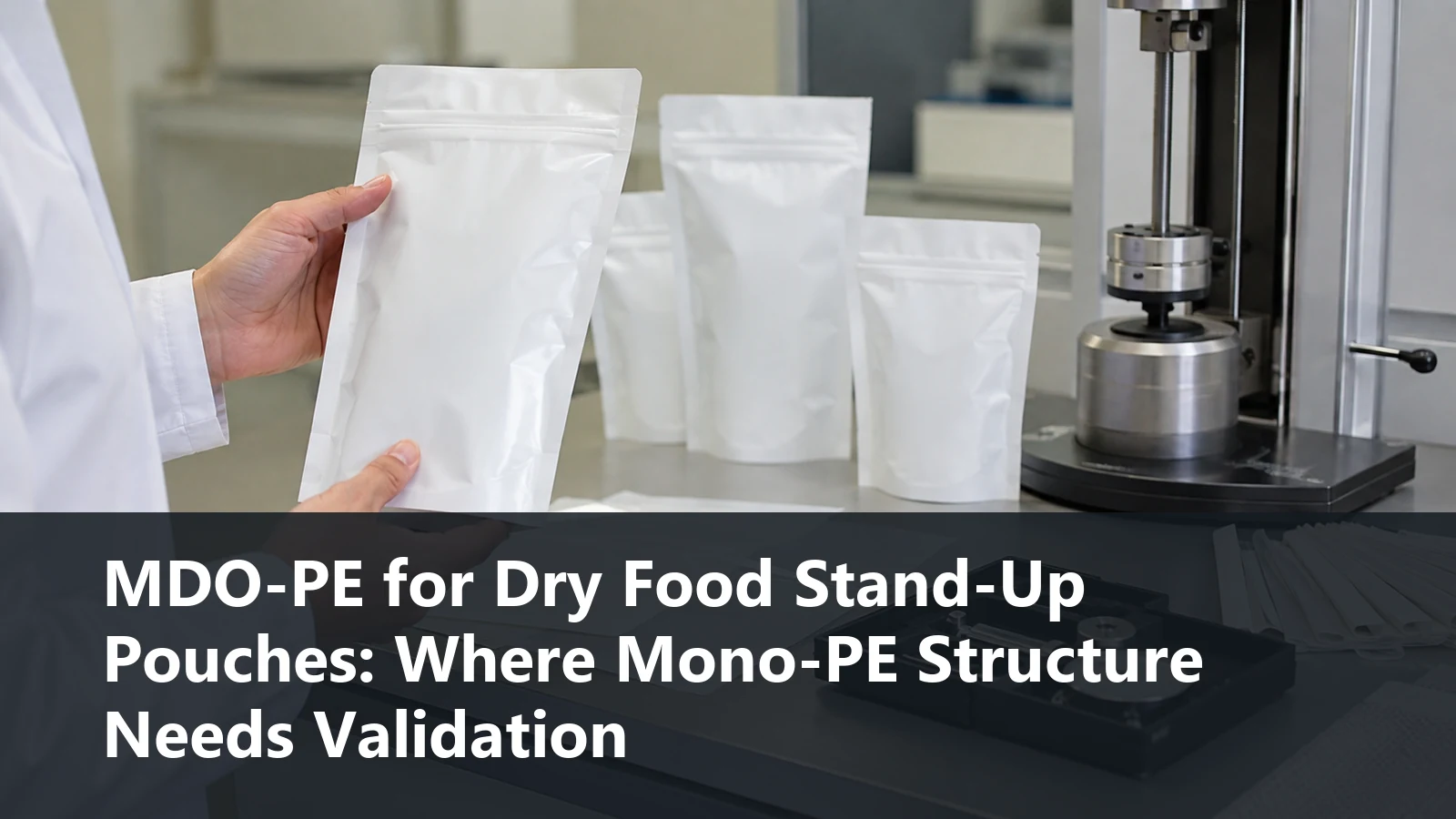
Dry foods can create very different mechanical risks. Some products are soft and fine; others contain hard, sharp-edged, dense, or abrasive pieces that can stress the pouch during filling, stacking, transport, or consumer handling.
Puncture performance therefore depends on more than the outer film. Consider product geometry, fill weight, pouch dimensions, structure design, transport conditions, drop or impact risk, compression, and abrasion. Where relevant, filled-pouch trials may be more useful than relying on one film-level mechanical value. Again, MDO-PE stiffness should not be treated as proof of puncture resistance.
Can the MDO-PE Structure Run on the Intended Filling and Converting Line?
A material concept must also work on real equipment. Converters and food-packaging teams should confirm the proposed structure against the actual process, including printing and web handling, lamination or other structure-building steps, pouch forming, gusset formation, sealing behavior, filling speed and conditions, equipment limitations, and finished-pouch handling.
A structure that looks attractive on a technical data sheet may still require optimization before it runs reliably on the intended line. This is why sample testing and line trials should be part of commercial approval.
Does a Mono-PE Pouch Automatically Mean “Recyclable”?
No—not automatically.
A mono-PE structure may support a design-for-recycling strategy, but recyclability depends on more than the polymer family:
Mono-PE Structure → Design-for-Recycling Assessment → Collection → Sorting → Reprocessing Compatibility → Actual Recycling Outcome
The complete structure may include coatings, barrier components, inks, adhesives, zippers, valves, or other elements that affect assessment. The target market also matters because collection and recycling systems differ.
Broad recycling claims should not be accepted without specific evidence for the complete package and the intended market.
This article does not make a market-specific recycling claim. The applicable design-for-recycling framework and evidence must be selected for the target market and complete structure.
What Recycling Evidence Should Buyers Request for the Target Market?
If recyclability is part of the commercial brief, buyers should ask more specific questions. Which design-for-recycling framework is relevant to the destination market? Has the complete structure been assessed? Are coatings, barriers, inks, adhesives, or closures included in that assessment?
Buyers may also need to distinguish between terms such as “designed for recycling,” “technically recyclable,” and other market-specific claims. Public guidance from organizations such as APR, RecyClass, or CEFLEX may be relevant depending on the market and structure, but this does not establish that a specific CHALVO-sourced pouch is approved or recyclable.
What Low-, Medium-, and High-Complexity Mono-PE Starting Points Can Buyers Discuss?
Here, complexity refers only to relative structure and converting complexity. It does not indicate price, MOQ, lead time, recyclability, or guaranteed performance.
A lower-complexity starting point may suit projects with relatively straightforward moisture, sealing, stiffness, and handling requirements. A medium-complexity starting point may be more appropriate when the structure needs to balance barrier, stiffness, printability, sealant behavior, and pouch formation more carefully. A higher-complexity starting point may be considered when the project combines demanding oxygen or moisture targets, aroma protection, puncture risk, converting constraints, and recycling-design considerations.
Higher complexity is not automatically better. It should only be added when a defined requirement justifies it.
What Should Buyers Ask Before Requesting a Quote?
A useful RFQ should include more than pouch dimensions and quantity. Buyers should ask for:
- a complete structure diagram and the function of each layer
- MDO-PE’s role in the structure
- target and reported OTR/WVTR with full test conditions
- relevant film and structure thicknesses
- TDS and supporting test reports
- sealing, stiffness, handling, puncture, or transport information where relevant
- target-market food-contact documents where required
- recycling evidence where a recycling claim is made
- samples, converting and filling trials, finished-pouch integrity checks, and a product/shelf-life validation plan
It is also important to distinguish: Typical Value vs. Test Result vs. Specification vs. Guaranteed Requirement. Those terms should never be treated as interchangeable.
How Should Buyers Validate a Mono-PE Dry-Food Pouch Before Commercial Approval?
A practical qualification path is:
Define Product Risk → Define Shelf-Life Target → Define Pouch Format → Confirm Filling and Transport Conditions → Set Barrier and Mechanical Requirements → Review Structure → Review Data and Documentation → Obtain Samples → Run Converting and Filling Trials → Check Pouch Integrity → Validate Product and Shelf Life → Commercial Approval
This process helps prevent a common sourcing error: approving a pouch because the material concept sounds attractive before the finished package has been tested. No universal thickness, OTR/WVTR target, sealing condition, recycling claim, or shelf-life guarantee should be inferred from the words “MDO-PE” or “mono-PE” alone.
Where Does CHALVO Fit Into the Sourcing Process?
CHALVO is a China-based packaging-film sourcing and customization partner. It can coordinate discussions around PE, MDO-PE, and recyclable-PE-structure options through its supplier network, subject to confirmation of the current grade, structure, availability, and supporting documentation.
For a dry-food stand-up-pouch project, buyers can provide the product type, pouch format, target barrier needs, filling-line conditions, current or proposed structure, target market, recycling context, and validation requirements. Current grades, structures, specifications, availability, and compliance documents should be confirmed for each project before approval.
Summary
MDO-PE can support a mono-PE stand-up-pouch strategy, but dry-food packaging should be approved as a complete system. Define product risks first, separate OTR from WVTR, validate stiffness, sealing and handling, review the target-market recycling context, and confirm performance through actual converting, filling and finished-pouch trials.
Sources for further verification
- https://www.cloudflexfilm.com/mdo-pe-film-guide-properties-uses-selection
- https://www.sml.at/news/live-demonstration-runs-sml-innovation-days-manufacturing-mono-material-pe-stand-pouches
- https://www.glenroy.com/blog/what-is-mono-material-packaging
Technical questions still requiring project evidence
- What product formulation, pouch size, shelf-life target, filling conditions, distribution route, and destination market apply?
- What MDO-PE grade, thickness, sealant layer, barrier route, coatings, inks, adhesives, and closures are proposed?
- Which OTR, WVTR, sealing, stiffness, puncture, transport, and finished-pouch trials represent the commercial package?
- Which food-contact and design-for-recycling records apply to the proposed complete structure in the destination market?