BOPP vs PET Film: How to Choose the Right Outer Web for Flexible Packaging
One converter quotes your package as BOPP/CPP. Another recommends PET/CPP or PET/PE. Their outer web prices per kilogram are different, and both say their...

One converter quotes your package as BOPP/CPP. Another recommends PET/CPP or PET/PE. Their outer-web prices per kilogram are different, and both say their structure works. Which film does your product actually need—and is the cheaper film per kilogram really the lower-cost choice?
Neither BOPP nor PET is automatically the better flexible-packaging outer web. BOPP often fits applications prioritizing stiffness, clarity, gloss, moisture-barrier tendency and favorable area yield. PET is often selected when higher tensile strength, modulus, toughness, thermal resistance or dimensional stability matters. Buyers should choose according to the complete laminate, product, converting process and barrier requirements, then compare costs per usable area—not simply price per kilogram.
To make that decision, start with what the outer web must do inside the laminate rather than comparing polymer names in isolation.
What Does the Outer Web Actually Do in a Laminate?

In a typical reverse-printed two-layer flexible package, the structure may look like this:
Outer web → reverse printing/ink → adhesive → CPP or PE sealant web → product
The outer web provides the printable surface and can contribute appearance, stiffness, mechanical protection, dimensional stability and barrier properties. The ink is protected inside the laminate rather than sitting directly on the package exterior.
The CPP or PE inner web normally provides the primary heat-sealing interface.
This distinction is important. When comparing BOPP and PET as outer webs, asking which polymer “seals better” can miss the structure's design. In a BOPP/PE, BOPP/CPP, PET/PE or PET/CPP laminate, the PE or CPP is commonly responsible for the seal.
Purpose-designed coextruded heat-sealable BOPP grades also exist for single-web packaging. That is a different application from selecting the outer print web of a laminate.
BOPP as a Flexible-Packaging Outer Web
Where BOPP Commonly Fits
BOPP is widely used as an outer web in flexible packaging for products such as snacks, biscuits, confectionery and other dry foods.
Outer-web inquiries commonly involve gauges around 18–40 µm, although the appropriate thickness and available range depend on the grade, package and converter.
BOPP combines useful stiffness with clear, glossy presentation. It also has an inherent moisture-barrier tendency that can be useful in dry-food structures.
Because BOPP has a relatively low density—around the 0.90 g/cm³ family for conventional grades—it can also provide an important area-yield advantage. At equal thickness, one kilogram of BOPP covers more square meters than one kilogram of the denser PET.
The exact density should still be checked for the grade being purchased, particularly for specialty constructions.
What Buyers Need to Verify for Printing and Lamination
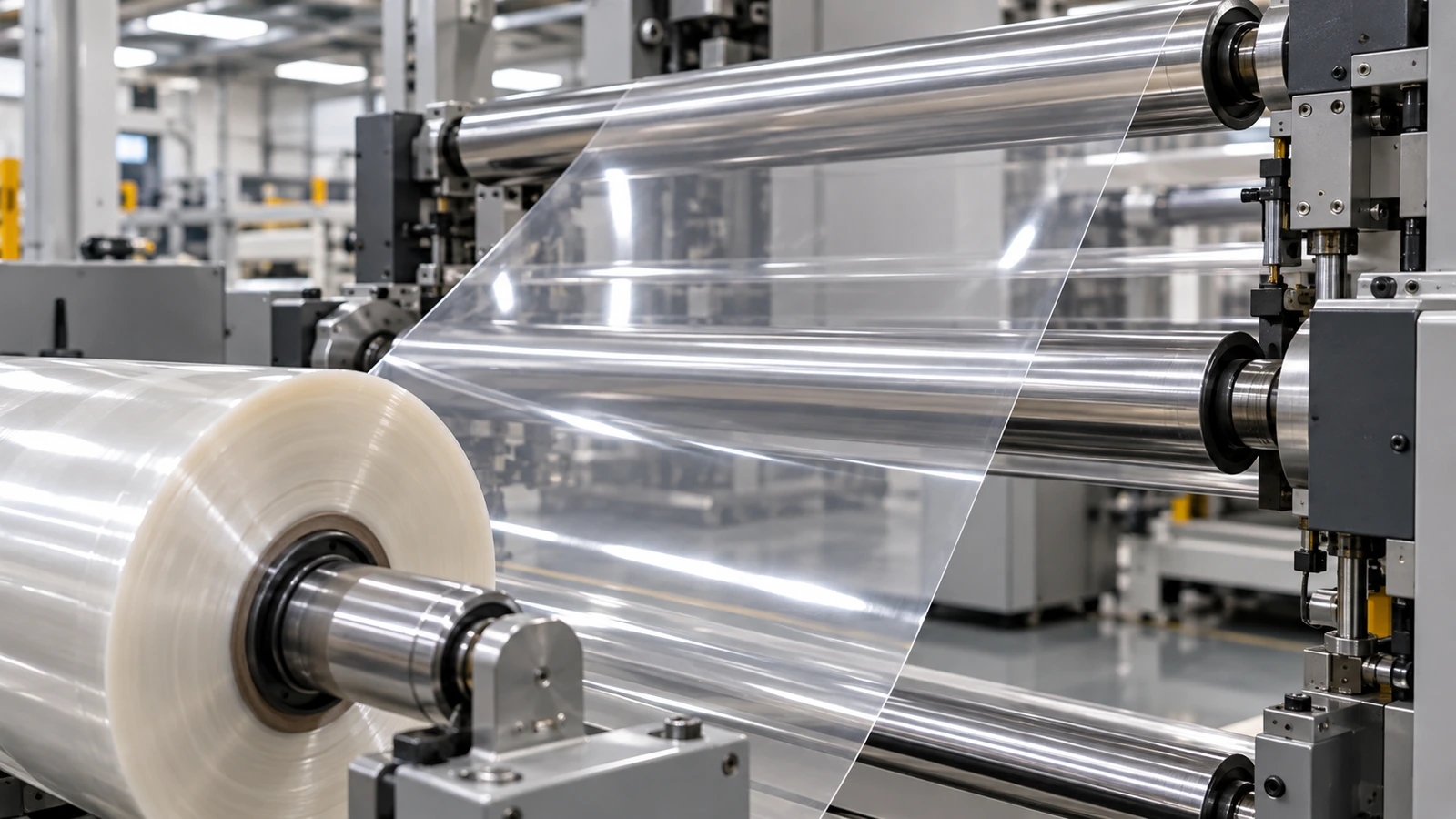
BOPP used as a print web normally requires an appropriate surface for the selected ink, adhesive and converting process.
Corona-treated grades are common. Buyers should confirm the treated side and the relevant grade-specific surface-treatment information rather than assuming that every BOPP roll is ready for the same printing or lamination system.
The converter should also validate the film with its actual ink and adhesive.
Where BOPP Needs More Caution
BOPP is an oriented film, and its behavior under elevated temperatures needs to be considered during converting and end use.
Heat can create dimensional-change or shrink concerns depending on the grade and conditions. Standard BOPP should not be assumed to be a high-temperature retort layer.
If the package encounters significant heat during printing, lamination, sealing or end use, request the applicable grade-specific thermal information and test under realistic conditions.
PET as a Flexible-Packaging Outer Web
PET—often called BOPET when referring to biaxially oriented PET film—is another common outer web for reverse-printed laminates.
Where PET Commonly Fits
PET generally offers higher tensile strength and modulus than BOPP and is valued for toughness and dimensional stability.
Those characteristics can make PET attractive for structures containing powders, heavier or sharper contents, or products and converting processes that impose greater mechanical demands.
It is also frequently considered when a relatively thin outer web needs to provide strong mechanical support.
For aroma-sensitive or otherwise demanding products, PET may appear as part of the selected structure. However, the polymer name should never be treated as proof that the final package meets a particular aroma, oxygen or moisture-barrier requirement.
That must be evaluated at the whole-structure level.
Why Thermal Stability Can Matter During Converting
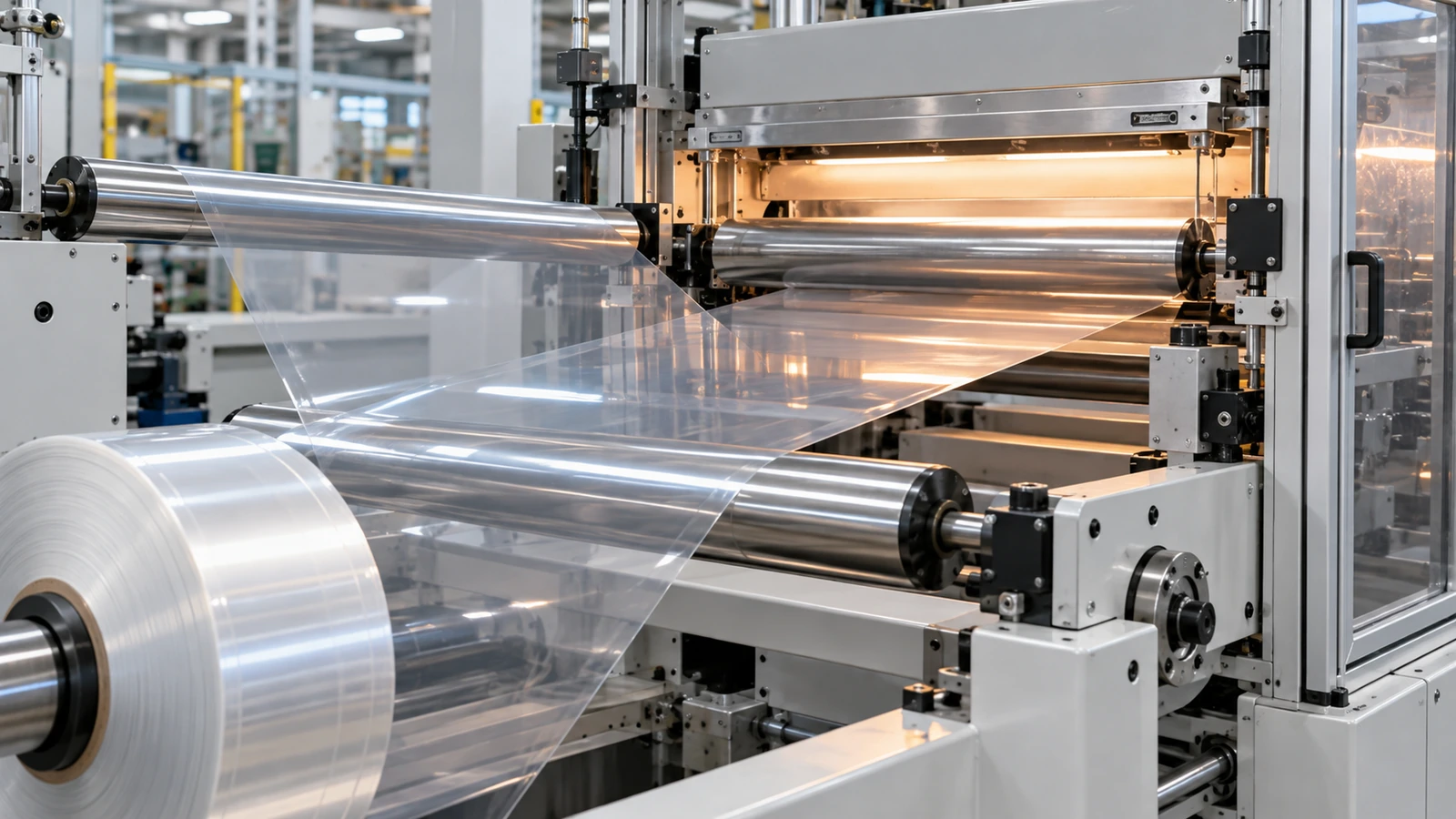
PET generally offers better resistance to elevated temperatures and better dimensional stability under heat than BOPP.
That can be useful during printing and lamination where maintaining dimensions and print registration through the converting route matters.
This does not create a universal temperature rating for PET. Actual limits depend on the grade, process and finished structure. Buyers should verify thermal data from the relevant TDS and then trial the material under their actual converting conditions.
PET Still Needs the Right Laminate
PET is commonly reverse printed and laminated to a sealant such as PE or CPP.
Again, the PET outer web normally is not the layer being relied upon for the package's primary heat seal.
If a converter proposes PET/PE or PET/CPP, evaluate what each layer contributes rather than assigning all performance requirements to PET.
BOPP vs PET Film: Head-to-Head as an Outer Web
The useful comparison is not “Which polymer is better?” It is “Which property matters for this package?”
| Criterion | BOPP outer web | PET outer web | What buyers should verify |
|---|---|---|---|
| Density/yield | Around 0.90 g/cm³ family for conventional grades; more area/kg at equal thickness | Commonly around 1.37–1.40 g/cm³; less area/kg at equal thickness | Exact grade density and thickness |
| Optics | Common clear, glossy options | Common clear, high-quality optical options | Haze, gloss and grade-specific appearance |
| Mechanical behavior | Useful stiffness for many packaging applications | Generally higher tensile strength/modulus and toughness | MD/TD values and test methods |
| Thermal behavior | More sensitive to elevated heat | Generally greater thermal/dimensional stability | Actual converting and end-use conditions |
| Moisture barrier | Useful inherent moisture-barrier tendency | Different moisture-barrier profile | Grade/whole-structure WVTR data |
| Printing | Corona-treated print grades are common | Commonly reverse printed | Surface treatment, ink and adhesive compatibility |
| Seal function in laminate | Commonly paired with CPP/PE sealant | Commonly paired with CPP/PE sealant | Complete laminate and sealing interface |
| Specialty barrier | Metallized/coated variants available | Metallized/coated variants available | Finished-structure test data |
| Cost comparison | Lower density affects area yield | Higher density affects area yield | Cost per usable area, not only $/kg |
| Recycling design | PP outer web may align with PP-family structure strategies | PET/PE creates a different mixed-polymer structure | Destination-market design and recycling rules |
These differences narrow the candidate structure. They do not replace grade-specific verification.
Why Price per Kilogram Can Mislead BOPP vs PET Buyers
This is one of the most important commercial differences between the two films.
Conventional BOPP has a density around 0.90 g/cm³, while PET is commonly around 1.37–1.40 g/cm³. At the same thickness, the denser film weighs more per square meter.
A useful approximation is:
gsm ≈ thickness (µm) × density (g/cm³)
From that:
m²/kg ≈ 1,000 ÷ gsm
Consider the logic without treating it as a purchasing specification. At the same nominal thickness, a conventional BOPP grade around 0.90 density has lower gsm than PET around 1.4 density. The BOPP therefore produces more square meters from one kilogram.
That means a PET quote can be higher or lower per kilogram yet tell you surprisingly little about the actual film cost for 1,000 square meters of packaging.
A better commercial comparison is:
Price/kg → grade density → thickness → m²/kg → cost per 1,000 m² → converting yield/waste
Use the actual density and thickness of each candidate grade for this calculation. Metallized, coated, cavitated, pearlized or other specialty constructions should not automatically be calculated using a generic polymer density.
Thickness may also differ between technically suitable BOPP and PET structures. Therefore, equal-thickness comparison is useful for understanding density, but final sourcing should compare the actual proposed structures.
When Barrier Requirements Change the Choice
Statements such as “PET is the barrier film” or “BOPP gives enough barrier” are too broad for a purchasing decision.
Barrier comes from the complete structure.
BOPP has useful inherent moisture-barrier characteristics, but a demanding package may need additional functionality. PET has its own barrier characteristics, but selecting PET does not automatically guarantee that a finished laminate meets a product's required oxygen, moisture or aroma protection.
Both material families can also be modified.
Buyers may encounter metallized BOPP, metallized PET, PVDC-coated films, or structures incorporating EVOH or other functional barrier components.
Once these technologies enter the structure, a generic BOPP-versus-PET comparison becomes less useful.
Define the package's required barrier performance first. Then compare grade-specific or complete-structure data, including the relevant test method and conditions. For WVTR or other barrier figures, do not compare numbers from different thicknesses or test environments as though they were equivalent.
The Risks of Choosing by Polymer Habit or Price Alone
“We always use BOPP” is not a technical specification. Neither is “PET is stronger, so use PET.”
Choosing by habit can overspecify or underspecify the package.
Price-per-kilogram comparisons can be equally misleading because they ignore density, film yield and potentially different gauges.
Another common error is expecting the outer web to solve a problem belonging to another layer. If seals are failing in a PET/PE or BOPP/CPP laminate, the investigation needs to include the sealant grade, sealing interface and machine conditions—not merely whether the outer web is PET or BOPP.
Buyers should also avoid comparing a standard clear film with a metallized or coated film as if only the base polymer matters.
The complete construction is the specification.
How Should Buyers Test BOPP and PET Structures?
Start with matched-thickness, grade-specific TDS sheets where you want a direct property comparison.
Check the stated ASTM, ISO, DIN or other test methods. For properties affected by test conditions, verify those conditions rather than comparing headline numbers alone.
Then move from data sheets to converting.
Trial the candidate outer web using the actual printing system, inks and adhesive intended for production. Confirm the correct treatment surface. Laminate under realistic process conditions and monitor registration and dimensional behavior where temperature is relevant.
Seal testing should be performed with the selected CPP, PE or other sealant layer under realistic sealing conditions.
Finally, evaluate the finished laminate with the actual product and expected distribution route.
Record the settings and results. Changing film, adhesive, ink, machine conditions and sealant simultaneously makes it difficult to identify which variable caused a difference.
Pre-Sourcing Checklist: What to Define Before Requesting BOPP or PET
| Input | Why it matters | What to tell the supplier |
|---|---|---|
| Product/content | Drives mechanical, thermal and barrier needs | Dry snack, powder, oily, sharp/heavy or other content |
| Film role | Prevents confusion over layer functions | Outer/reverse-print web |
| Proposed structure | Shows how layers work together | BOPP/CPP, BOPP/PE, PET/CPP, PET/PE, etc. |
| Outer-web thickness | Affects performance and yield | Target thickness and acceptable range |
| Printing | Defines surface requirements | Reverse print, ink system and process |
| Lamination | Affects compatibility | Adhesive and lamination process |
| Sealant | Defines the primary sealing layer | PE, CPP or another specified sealant |
| Thermal route | Influences dimensional requirements | Relevant converting/end-use heat exposure |
| Barrier target | Must be evaluated structurally | Required property, method and conditions |
| Optics | Influences material/grade selection | Clear, gloss, matte, metallized or other finish |
| Roll specification | Determines equipment fit | Width, core, maximum OD and winding |
| Cost basis | Prevents misleading comparisons | $/kg plus yield and $/1,000 m² |
| End-of-life goal | Can influence laminate design | Destination-market requirements |
End-of-Life and Recyclability: Treat It as a Structure Decision
Outer-web choice can also affect packaging-design strategies for end of life.
For example, a PP-family outer web combined with a compatible PP-family sealant may align more closely with some mono-polyolefin or PP-oriented packaging-design approaches. A PET/PE laminate combines different polymer families and therefore presents a different recycling-design situation.
That does not mean every PP-based laminate is automatically recyclable or every mixed structure is handled identically.
Collection systems, sorting capabilities, design-for-recycling criteria and labeling requirements vary between markets. Check the rules and infrastructure applicable to the destination market and evaluate the entire package—not simply the outer web.
How CHALVO Supports Outer-Web Selection
CHALVO (Hangzhou Chalvo New Material Co., Ltd.) is a Chinese packaging-film export and supply-chain integration company.
For BOPP-versus-PET projects, its role can include helping buyers organize the proposed packaging structure, collect grade-specific TDS information across its supplier network, compare relevant specifications and coordinate candidate samples.
A useful inquiry therefore goes beyond “quote BOPP and PET.”
Providing the product, proposed laminate, outer-web thickness, printing and lamination process, sealant, thermal conditions and barrier requirements gives CHALVO more information for specification matching and sample coordination.
Final material and structure suitability still needs to be verified using the relevant grade data and the buyer's converting and package trials.
FAQ: BOPP vs PET Film for Flexible Packaging
Is BOPP or PET cheaper for a laminated package?
Price per kilogram alone cannot answer this.
Because BOPP and PET have different densities, they provide different square-meter yields at the same thickness. Compare the actual proposed gauges, grade densities, m²/kg, cost per 1,000 m² and converting yield. Then compare the cost of the complete laminate.
Why does BOPP provide more square meters per kilogram than PET at the same thickness?
Conventional BOPP is around the 0.90 g/cm³ density family, while PET is commonly around 1.37–1.40 g/cm³.
At equal thickness, the lower-density film weighs less per square meter, so a kilogram covers more area. Verify the actual density for specialty grades before calculating purchasing yield.
Should I use BOPP or PET for snack packaging?
BOPP-based structures are widely used for dry snacks, biscuits and confectionery, where its stiffness, appearance, moisture-barrier tendency and area yield can be useful.
However, the final decision depends on the product, barrier target, converting process, mechanical demands and sealant structure. A product category alone does not define the laminate.
Which is better for packaging exposed to higher temperatures?
PET generally provides greater thermal resistance and dimensional stability than BOPP, making it useful when the converting or application route imposes greater heat demands.
Actual limits must still come from grade-specific technical information and trials. Standard BOPP should not be assumed suitable as a high-temperature retort layer.
Does choosing PET instead of BOPP automatically give better barrier?
No. Barrier should be evaluated for the complete laminate and specific grade.
Metallization, coatings and functional barrier layers can substantially change both BOPP- and PET-based structures. Request relevant TDS or finished-structure test data with the test method, thickness and conditions rather than relying on the polymer name.
Summary
Choose BOPP or PET by defining what the outer web must contribute to the complete laminate. Compare mechanical, thermal, optical and barrier requirements under matched conditions, then compare economics by area and yield—not price per kilogram alone. Finally, validate the proposed structure through realistic printing, lamination and packaging trials.