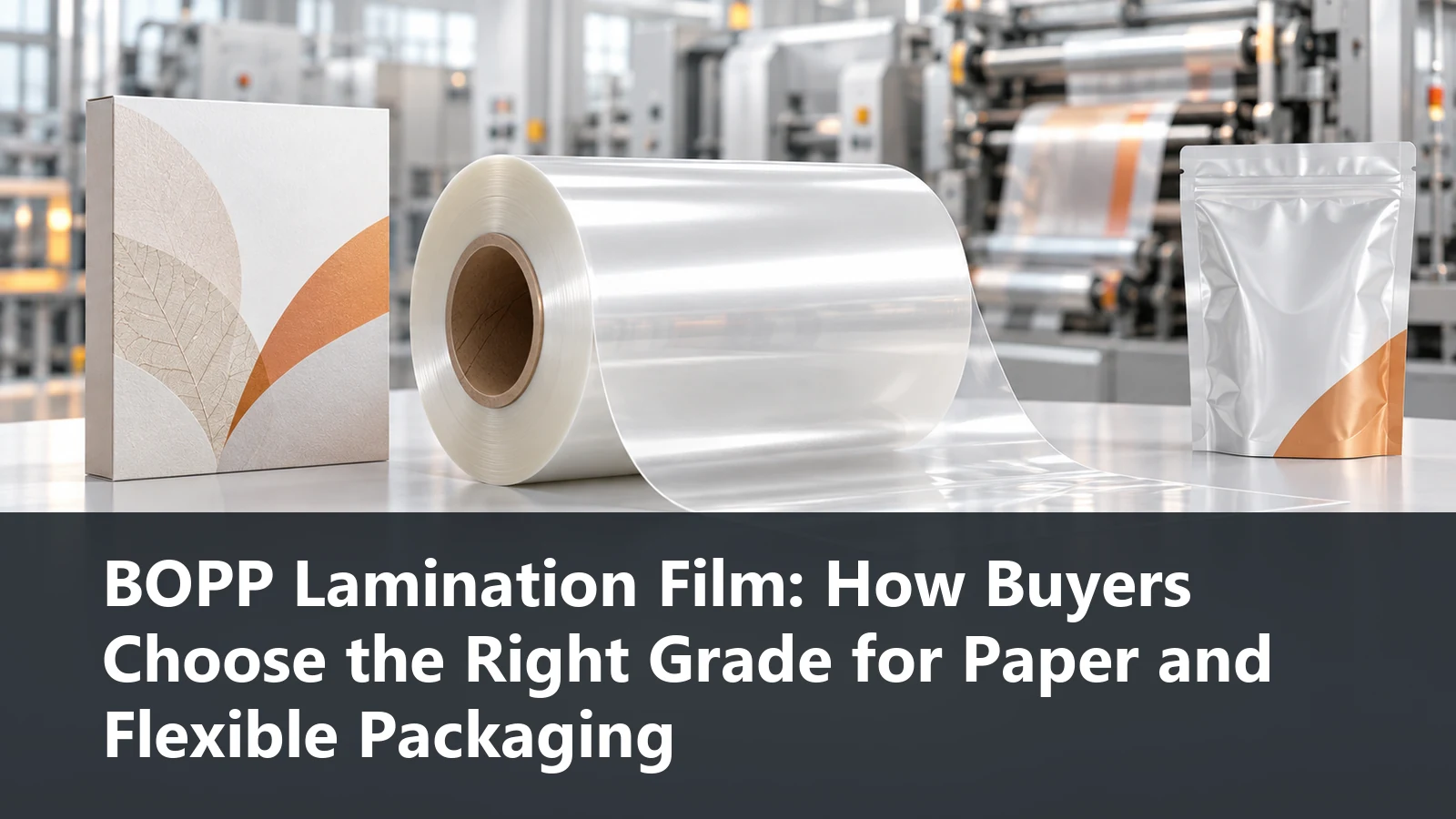
BOPP Lamination Film: How Buyers Choose the Right Grade for Paper and Flexible Packaging
Choosing BOPP lamination film is not simply a matter of specifying thickness and ordering a roll. A film that performs well on printed paper may behave...

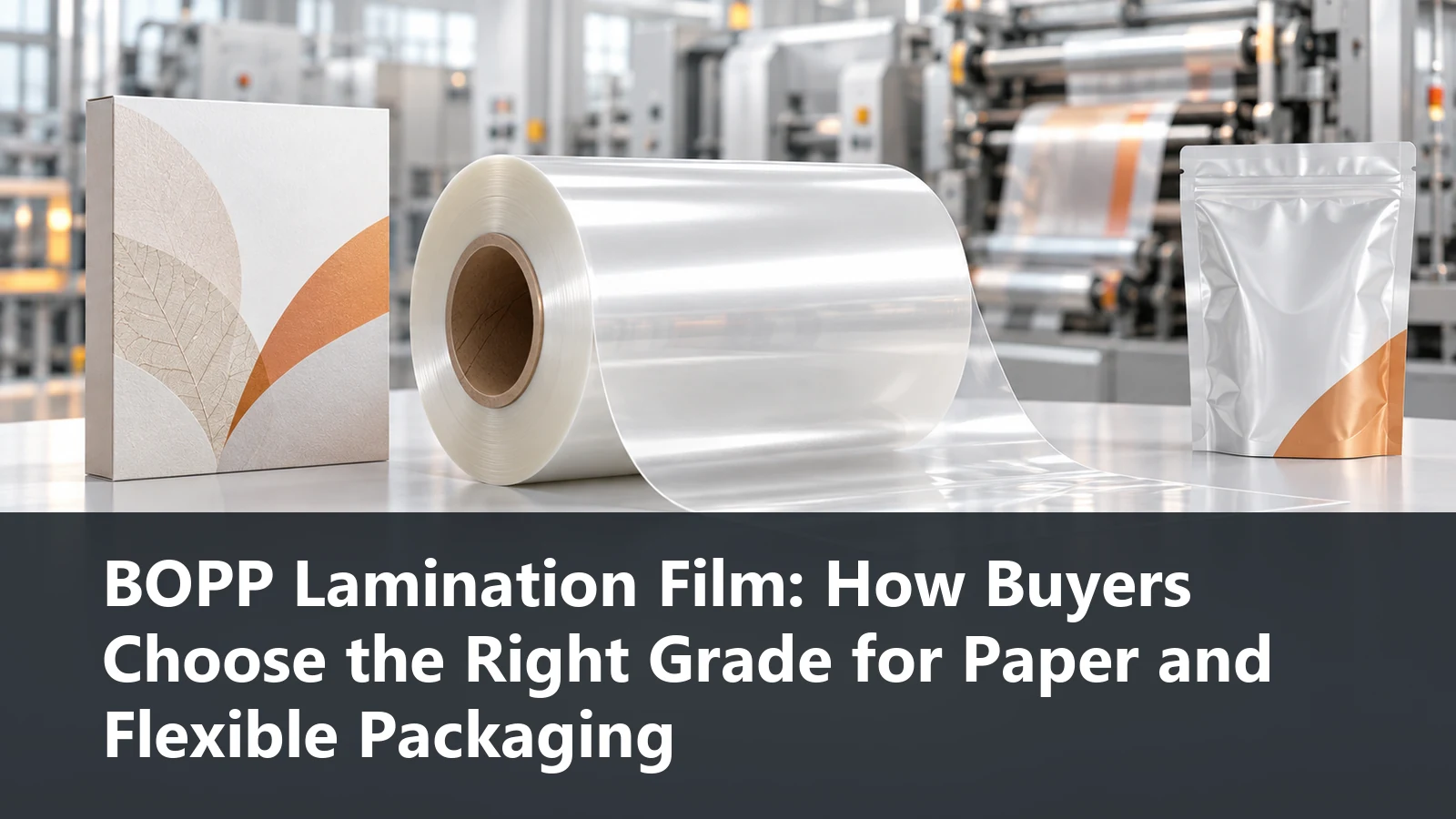
Choosing BOPP lamination film is not simply a matter of specifying thickness and ordering a roll. A film that performs well on printed paper may behave differently in a flexible-packaging laminate.
For overseas buyers, importers, distributors, converters, and procurement teams, the right grade depends on the substrate, adhesive and ink system, converting process, final package structure, equipment, and target-market requirements.
BOPP lamination film is a biaxially oriented polypropylene film used as part of a laminated structure. For paper applications, buyers should focus on adhesion to the printed or unprinted sheet, paper porosity, curl, appearance, and dimensional stability. For flexible packaging, selection should also consider bond strength, coefficient of friction (COF), web handling, downstream processing, and the performance of the complete finished structure.
In this buyer guide, we explain what buyers should confirm before purchasing BOPP film and why a specification that looks suitable on paper still requires validation on the actual production line.
What Is BOPP Film Used For?
BOPP stands for biaxially oriented polypropylene. During production, polypropylene film is oriented in both the machine and transverse directions.
BOPP films are used across packaging, labeling, lamination, tape, overwrap, and other converting applications.
However, “BOPP film” describes a broad family of films rather than one universal product.
Depending on its construction, surface treatment, coating, and intended application, a BOPP film may be used for:
- paper and print lamination;
- flexible-packaging laminates;
- labels;
- overwrap applications;
- adhesive-tape structures; and
- specialized coated, metallized, or heat-sealable structures.
The important procurement question is therefore not simply:
“Is this BOPP?”
Instead, buyers should ask:
“What role will this particular BOPP grade perform in our final structure?”
How Does BOPP Work Differently in Paper Lamination and Flexible Packaging?
This distinction is one of the most important parts of BOPP film sourcing.
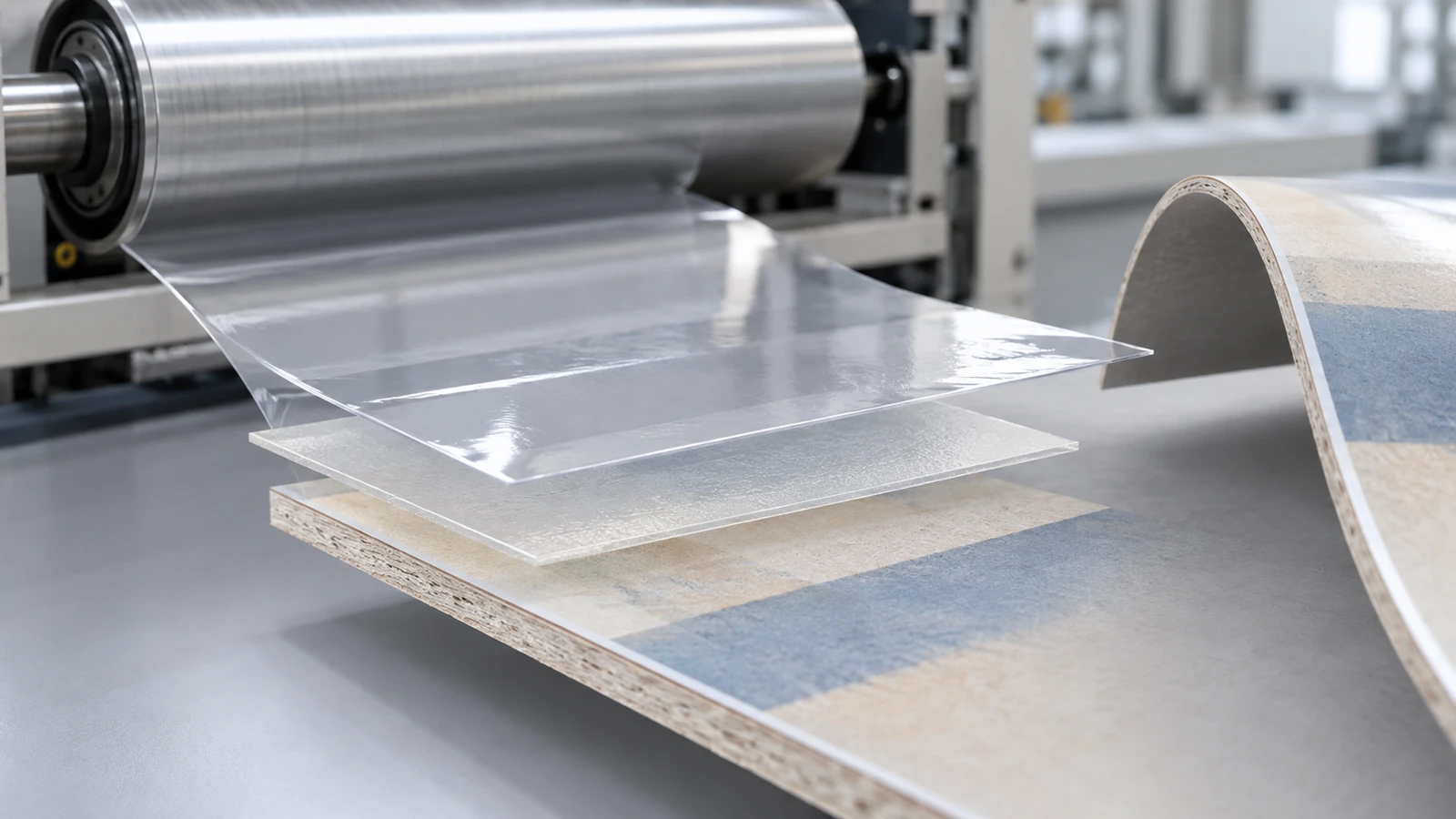
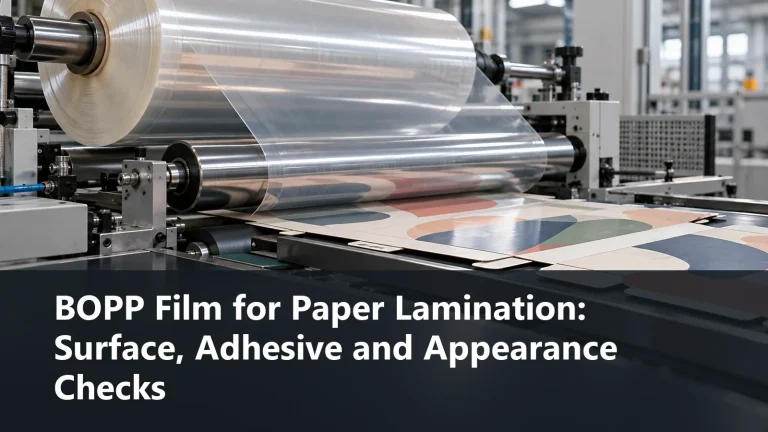
In paper lamination, the BOPP film is combined with a paper, paperboard, or printed-paper surface. The film may be used to protect the printed surface, modify its appearance, or provide a surface for subsequent converting.
Paper introduces variables such as porosity, moisture, ink coverage, coatings, and dimensional movement.
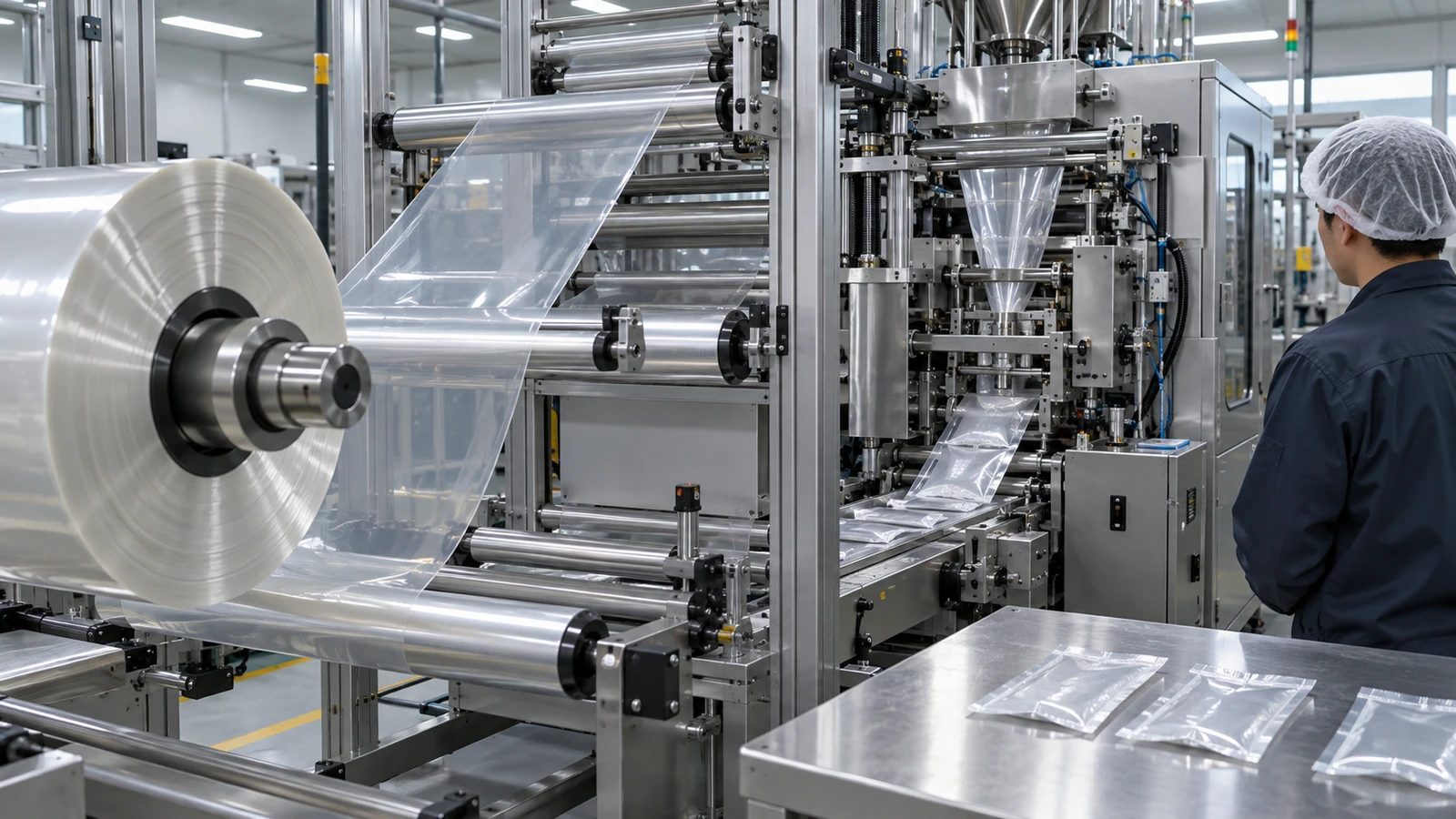
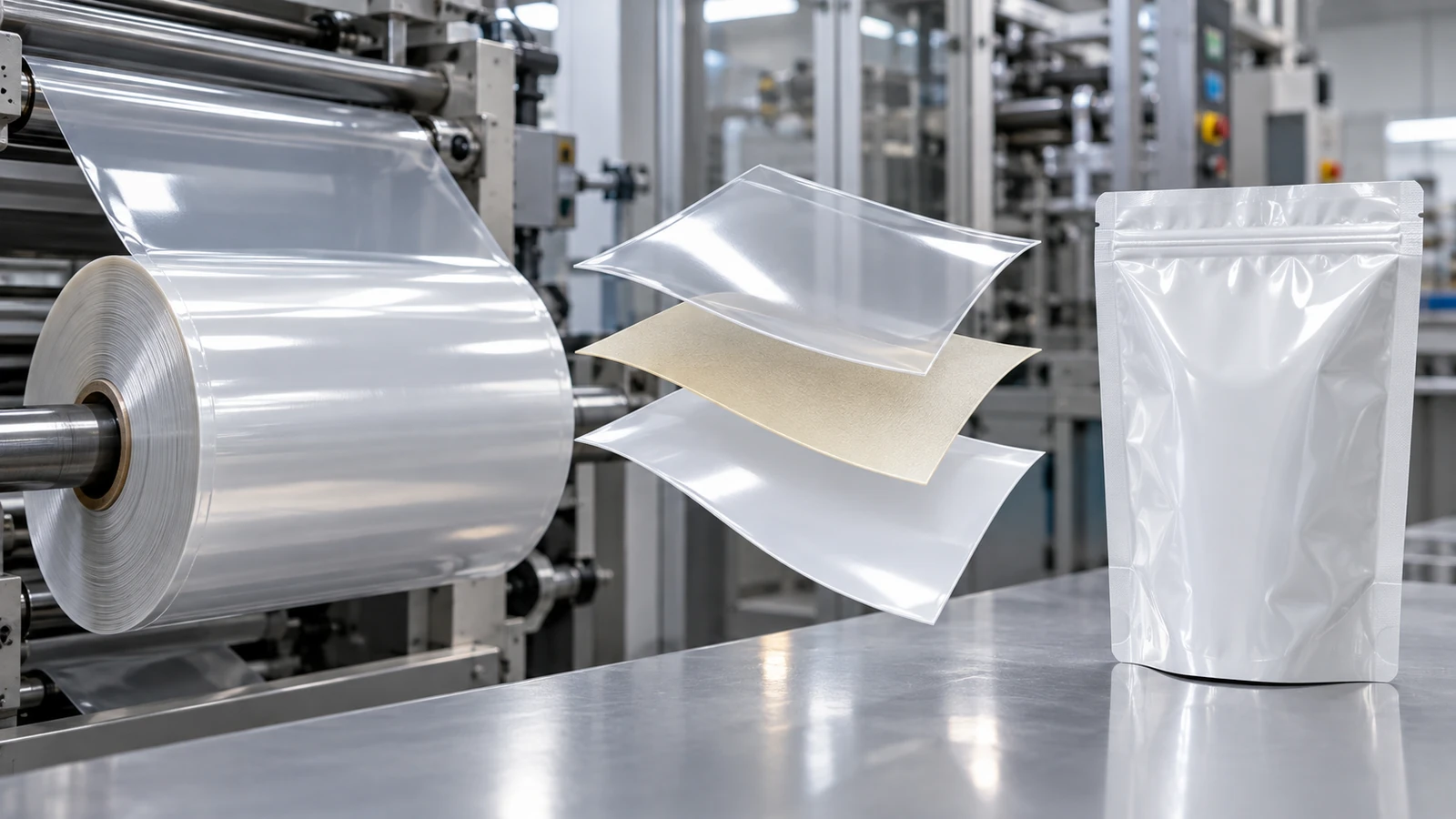
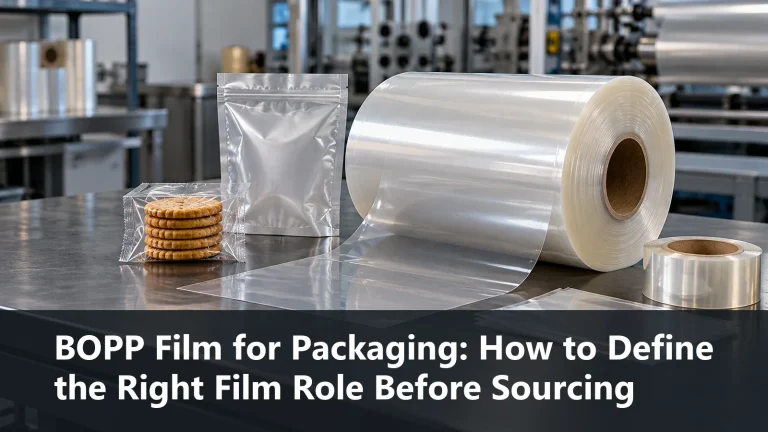
In flexible-packaging lamination, BOPP normally becomes one component of a multilayer flexible structure.
The other layers might include polymer films, metallized films, aluminum foil, coatings, or other materials selected to perform specific functions.
For this reason, buyers should evaluate BOPP according to its intended structural role rather than assuming that a film used successfully for paper lamination will automatically work in flexible packaging.
What Should Buyers Check on a BOPP Film Datasheet?
A current Technical Data Sheet, or TDS, should be one of the starting points for technical evaluation.
Depending on the grade and supplier, relevant characteristics may include:
- nominal film thickness;
- thickness tolerance;
- haze;
- gloss;
- thermal shrinkage or dimensional change;
- tensile properties;
- elongation;
- coefficient of friction;
- surface treatment; and
- treated side or sides.
However, buyers should not compare numbers without checking the associated test methods and test conditions.
For example, ASTM publishes test methods covering properties frequently evaluated for plastic films, including tensile properties, coefficient of friction, optical properties, and dimensional changes.
Buyers can review the applicable standards through the ASTM Plastics Standards catalog.
The supplier's current TDS should identify the methods and conditions applicable to the reported values.
For incoming shipments, the Certificate of Analysis, or COA, should also be checked against the agreed purchasing specification.
Why Does Treatment Level Matter for BOPP Lamination Film?
Polypropylene surfaces often require treatment when printing, coating, or adhesive bonding is required. Corona treatment is one commonly used approach.
For buyers, the important question is whether the surface intended for printing or lamination has an appropriate treatment level for the specific ink, coating, primer, or adhesive system.
Surface tension or treatment level should therefore be confirmed with both the film supplier and the ink or adhesive supplier.
Treatment ageing also matters.
Surface characteristics can change during storage. A treatment value measured when a film was produced should not be assumed to remain unchanged indefinitely.
Before approving a grade, buyers should confirm:
- which side or sides are treated;
- the specified treatment level;
- how the treatment level is measured;
- film production and storage history where relevant;
- expected treatment retention;
- adhesive or ink requirements; and
- whether treatment should be rechecked before converting.
A production-line trial remains important because a surface-treatment measurement alone does not prove that an ink or adhesive system will perform correctly.
How Do Ink and Adhesive Systems Affect BOPP Selection?
BOPP, ink, adhesive, and substrate need to work as a system.
For printed material, buyers should confirm whether printing occurs on the BOPP, another film, or the paper substrate.
Ink chemistry, curing or drying conditions, surface treatment, and any primer or coating can influence the final result.
For adhesive lamination, the appropriate adhesive depends on factors including:
- substrates;
- printing system;
- converting process;
- equipment;
- processing conditions;
- final package structure; and
- required finished-laminate performance.
Initial tack alone does not demonstrate that a laminate is suitable.
Buyers should discuss the complete construction with the adhesive supplier and converter and validate it under the intended production conditions.
What Should Buyers Check When Laminating BOPP to Paper?
Paper creates a different technical environment from film-to-film lamination.
How Does Paper Porosity Affect Lamination?
Paper can absorb adhesive or other liquid components differently depending on its structure, coating, surface condition, and porosity.
This can influence adhesive coverage and the final bond.
The appropriate adhesive coat weight therefore depends on the actual paper, adhesive system, equipment, and required result.
Buyers should not assume that one universal adhesive coat weight will work with every paper and BOPP combination.
Why Are Drying and Curing Important?
An adhesive should be processed according to the adhesive supplier's specified conditions.
Drying and curing can affect the development of the final laminate properties.
For qualification, buyers should consider documenting relevant parameters such as:
- adhesive type;
- coat weight;
- drying conditions;
- curing conditions;
- production speed; and
- test procedure used for approval.
These conditions help make trial results more meaningful and repeatable.
Why Can BOPP-Laminated Paper Curl?
Paper and BOPP respond differently to moisture, heat, tension, and dimensional forces.
When the materials are bonded together, an imbalance within the structure can contribute to curl or poor flatness.
Variables may include:
- paper moisture;
- film dimensional change;
- adhesive application;
- process temperature;
- web tension; and
- the overall laminated construction.
A buyer evaluating film for cartons, book covers, menus, labels, or other printed products should therefore check finished-sheet flatness rather than evaluating the standalone film only.
What Matters When BOPP Is Used in Flexible-Packaging Lamination?
Flexible packaging requires buyers to consider the complete laminate, not only the BOPP layer.
Important areas include bond strength, COF, web handling, printing and adhesive compatibility, downstream processing, and finished-package performance.
How Should Bond Strength Be Evaluated?
Bond strength should be tested on the actual laminate under an agreed test procedure and at the appropriate stage of adhesive curing.
Results can be influenced by:
- adhesive selection;
- adhesive coat weight;
- film treatment;
- ink coverage;
- curing conditions;
- substrate combination; and
- testing conditions.
Buyers should therefore define the finished structure being evaluated and establish suitable acceptance criteria for that structure.
A bond-strength value obtained from a different laminate should not automatically be treated as representative of the buyer's own packaging structure.
Why Does COF Matter?
Coefficient of friction, or COF, describes frictional behavior between contacting surfaces.
In converting operations, COF can influence:
- unwinding;
- web transport;
- feeding;
- pouch or bag converting;
- stacking; and
- downstream packaging operations.
ASTM D1894 is one recognized method associated with measuring static and kinetic coefficients of friction for plastic film and sheeting. Buyers can locate current film-related methods through the ASTM Plastics Standards catalog.
The required COF depends on the equipment and finished structure, so buyers should agree on the relevant test method and conditions with the supplier.
Why Is Web Handling Part of Grade Selection?
Film thickness, stiffness, surface characteristics, roll quality, tension settings, and equipment design can all affect web behavior.
A film may perform satisfactorily in laboratory testing but behave differently at commercial production speed.
Buyers should therefore conduct production-line trials under representative conditions before approving a new grade for regular production.
Is Standard BOPP Film Heat Sealable?
Not automatically.
This is an important sourcing distinction.
Plain or standard BOPP should not automatically be treated as a heat-seal layer. Heat-sealable BOPP products are designed with surfaces or layers intended to provide sealing functionality.
If heat sealing is required, buyers should confirm:
- the exact film construction;
- which surface is designed for sealing;
- the supplier's relevant sealing data;
- intended seal interface;
- packaging-machine conditions; and
- final package requirements.
Suitability still requires validation on the intended production line.
Is BOPP Automatically an Oxygen or Water-Vapor Barrier Film?
Buyers should not assume that a generic BOPP specification provides the oxygen or water-vapor barrier required by every package.
Required barrier performance depends on factors such as:
- the product being packed;
- desired shelf life;
- storage environment;
- distribution conditions;
- sealing system; and
- complete laminate structure.
Specialized coatings, metallization, or additional structural layers may be used when a package requires different barrier performance.
For barrier testing, buyers should agree on the applicable method and test conditions. Recognized ASTM methods include methods for evaluating oxygen-gas transmission and water-vapor transmission through plastic film and sheeting.
Current standards and revisions can be checked through the official ASTM Standards website.
The finished laminate should be tested when barrier performance is a critical packaging requirement.
Is BOPP Film Automatically Food-Contact Compliant?
No.
The polymer name “BOPP” alone is not sufficient evidence that a particular film or finished laminate complies with food-contact requirements in a specific market.
Compliance can depend on the exact grade and its composition, additives, coatings, inks, adhesives, conditions of use, food type, and applicable jurisdiction.
For the United States, buyers can consult the U.S. Food and Drug Administration's information on Food Packaging & Other Substances that Come in Contact with Food.
For the European Union, Commission Regulation (EU) No 10/2011 addresses plastic materials and articles intended to come into contact with food.
These references do not mean that every BOPP film automatically complies.
Buyers should obtain current documentation applicable to the specific supplied grade, finished structure, conditions of use, and destination market.
How Should Buyers Verify BOPP Film Thickness?
Thickness affects material yield, converting behavior, mechanical response, and the overall laminate construction.
Buyers should confirm:
1. nominal thickness; 2. agreed thickness tolerance; 3. supplier measurement method; 4. sampling procedure; 5. applicable COA information; and 6. incoming inspection requirements where necessary.
A measurement taken at a single location does not necessarily describe variation across an entire web or roll.
The sampling and measurement procedure should therefore form part of the agreed purchasing specification when thickness consistency is critical.
How Should Haze and Gloss Be Evaluated?
Haze and gloss are particularly important when the laminate covers printed graphics or when package appearance forms part of the purchasing specification.
Haze relates to light-scattering behavior and perceived clarity, while gloss describes reflected-light characteristics under defined measurement conditions.
ASTM publishes recognized methods for evaluating optical properties of plastics, including haze and gloss-related testing. Buyers can verify current methods and revisions through the ASTM Plastics Standards catalog.
Results should be compared only when compatible test methods and conditions are used.
For commercial approval, buyers should also consider evaluating the finished laminate over the actual printed substrate.
Two films that look similar as standalone samples can produce different visual results after printing, adhesive application, and lamination.
Why Should Buyers Check Thermal Shrinkage?
BOPP is oriented during manufacture, so heat exposure can result in dimensional change.
The importance of this behavior depends on the converting process.
Variables may include:
- lamination temperature;
- drying conditions;
- downstream heat exposure;
- web tension;
- registration requirements; and
- finished-product dimensional requirements.
ASTM D1204 is a recognized test method for linear dimensional changes of nonrigid thermoplastic sheeting or film at elevated temperature. ASTM currently lists the method within its plastics standards resources: ASTM Plastics Standards.
A thermal-shrinkage or dimensional-change value should always be considered together with its test temperature, exposure time, and method.
Comparing percentages measured under different conditions can be misleading.
Which Mechanical Properties Should Be Verified?
Mechanical properties help describe how a film behaves during converting and use.
Depending on the application, buyers may review characteristics such as:
- tensile strength;
- elongation;
- modulus or stiffness-related behavior; and
- other application-specific mechanical properties.
Machine-direction and transverse-direction properties can differ.
The highest numerical value is not automatically the most suitable specification. Required mechanical behavior depends on the converting process and final structure.
Buyers should therefore use the current TDS and confirm the applicable test methods and conditions with the supplier.
What Is BOPP Heat-Sealable Film Used For?
Heat-sealable BOPP is used in applications where a BOPP-based structure requires a surface specifically designed to form a seal under defined processing conditions.
That does not mean every heat-sealable BOPP grade works on every packaging machine.
Buyers should confirm:
- sealing-layer construction;
- intended seal interface;
- supplier technical data;
- final laminate design;
- product requirements; and
- equipment conditions.
The proposed structure should then be validated on the actual packaging line and subjected to the finished-package tests required by the application.
Can a BOPP Grade Be Selected from a Sample Alone?
Samples are useful, but they should normally be treated as one stage of qualification rather than the complete approval process.
A small sample can help buyers evaluate appearance, preliminary printability, adhesion, handling, or other characteristics.
However, it cannot reproduce every variable encountered during full-scale commercial production.
For a new supplier or grade, a buyer may use a qualification sequence such as:
TDS review → compliance document review → sample testing → pilot or limited production trial → finished-structure testing → commercial approval
The exact approval process depends on the application and the buyer's own quality-management requirements.
What Should Be Included in a BOPP Film Production-Line Trial?
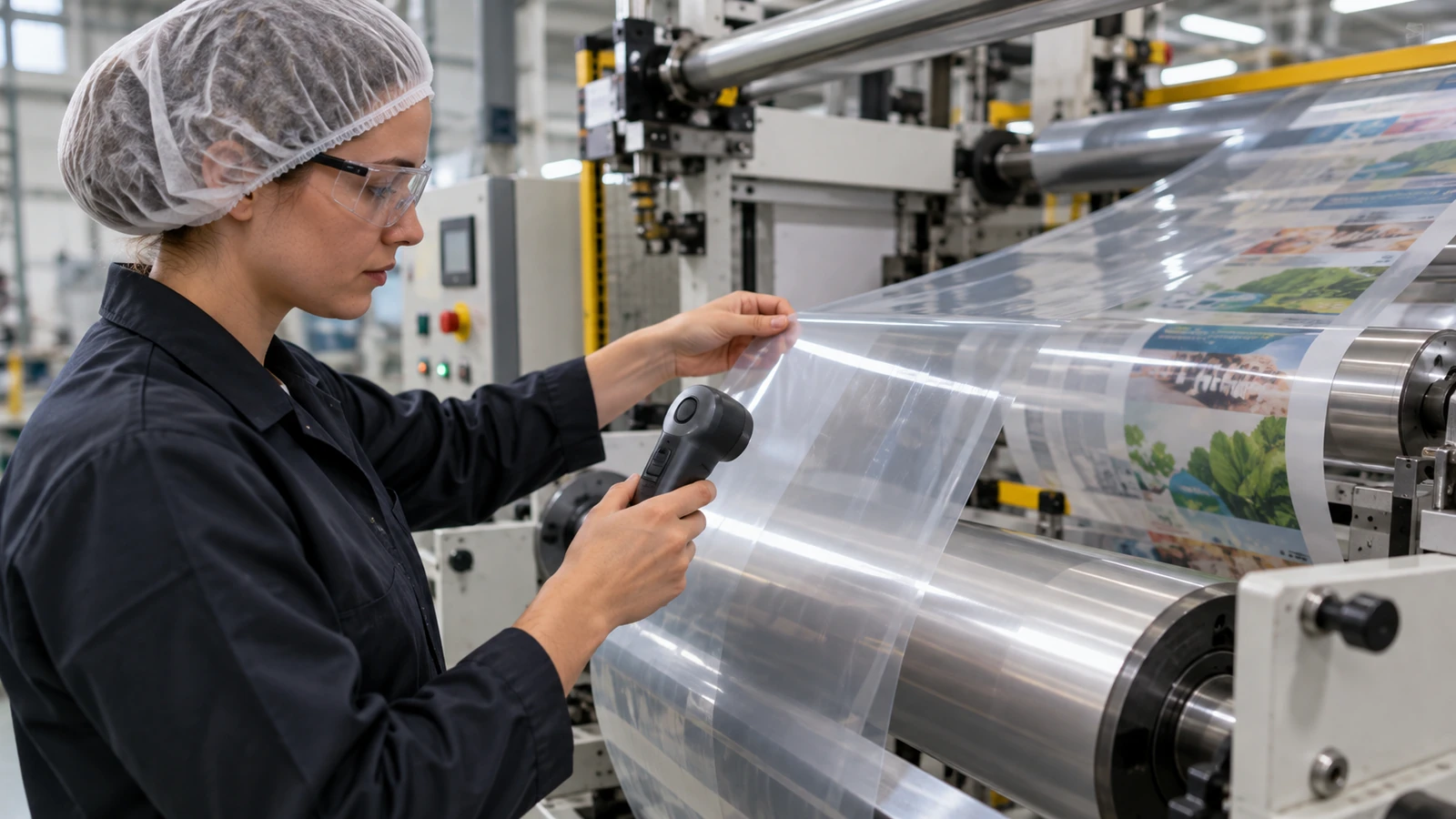
A useful production trial should reproduce commercial conditions as closely as practical.
Buyers and converters should consider recording:
- film grade;
- roll identification;
- substrate;
- ink system;
- adhesive system;
- adhesive coat weight where applicable;
- machine settings;
- web tension;
- processing temperature;
- production speed;
- drying or curing conditions; and
- downstream converting results.
For flexible packaging, the completed laminate should undergo the tests relevant to its intended use.
For paper lamination, buyers may need to evaluate bond quality, appearance, curl, flatness, dimensional stability, and subsequent converting behavior.
The objective is not simply to determine whether the film can run through the machine.
The more important question is whether the finished structure consistently meets the agreed requirements.
What Documents Should Overseas BOPP Film Buyers Request?
Before commercial approval, procurement teams should request and review the current TDS, relevant COA, and applicable compliance documents for the exact grade being purchased.
A practical procurement checklist should also confirm:
- film construction and intended application;
- nominal thickness and agreed tolerance;
- treated side or sides;
- treatment-level requirements;
- treatment ageing or retention considerations;
- ink compatibility;
- adhesive compatibility;
- relevant test methods and conditions;
- paper specification for paper lamination;
- complete laminate structure for flexible packaging;
- roll identification and traceability requirements;
- sample approval;
- production-line trial results; and
- regulatory documentation required by the destination market.
Documents should be checked for their actual scope and applicability rather than collected simply as generic certificates.
How Do Buyers Compare BOPP Film Suppliers Without Relying Only on Price?
A useful supplier comparison starts by giving every supplier the same application specification.
Instead of requesting a quotation for vaguely defined “BOPP lamination film,” buyers should provide relevant information such as:
- intended application;
- substrate;
- laminate structure;
- printing process;
- ink system;
- adhesive system;
- converting process;
- important test requirements;
- destination market; and
- required compliance documentation.
Buyers can then compare whether each proposed grade is supported by appropriate technical information and whether it passes their own sample-testing and line-validation process.
This reduces the risk of comparing films with similar commercial descriptions but different technical functions.
What Are the Most Common BOPP Lamination Film Purchasing Mistakes?
One common mistake is treating BOPP as a single standardized film.
Another is selecting film primarily by thickness and appearance while overlooking surface treatment, COF, dimensional behavior, adhesive compatibility, and the finished structure.
Buyers should also avoid assuming that standard BOPP is automatically:
- heat sealable;
- an oxygen-barrier layer for the intended package;
- a sufficient water-vapor-barrier layer for every application;
- food-contact compliant in the destination market; or
- compatible with every printing, lamination, and packaging line.
Each requirement should be confirmed against the exact grade and validated in the intended structure.
FAQ: How Do I Choose the Right BOPP Lamination Film?
Start with the final application rather than the film name.
For paper lamination, define the paper or board, print and coating system, adhesive process, appearance requirements, and acceptable curl and dimensional behavior.
For flexible packaging, define every layer of the laminate and identify the function the BOPP is expected to perform.
Then establish requirements for treatment, adhesion, COF, web handling, optical and mechanical properties, barrier or sealing functions where applicable, and finished-package testing.
Finally, obtain current technical documents and run the proposed film under representative production conditions.
FAQ: Is a BOPP Film Datasheet Enough to Approve a New Supplier?
A TDS should normally be treated as technical screening information rather than proof of final production suitability.
The TDS helps buyers determine whether a proposed film appears compatible with the application.
A COA can provide lot-specific information according to the supplier's reporting system.
Neither document replaces testing with the buyer's actual paper, inks, adhesives, laminate structure, equipment, and final package.
For applications where these variables are important, commercial approval should include appropriate sample testing and production-line validation.
FAQ: What Should I Send a Supplier When Requesting a BOPP Film Recommendation?
The more accurately buyers describe the application, the more useful a supplier's grade recommendation can be.
Provide the intended use, film position in the structure, paper or other substrates, printing method, ink and adhesive system, equipment type, important processing conditions, required optical and mechanical characteristics, sealing or barrier requirements where applicable, and destination-market compliance needs.
For flexible packaging, providing the complete laminate structure is particularly useful where commercial confidentiality permits.
FAQ: Should I Compare BOPP Film Only by Micron Thickness?
No.
Two films with the same nominal thickness can differ in:
- surface treatment;
- COF;
- optical properties;
- thermal response;
- mechanical behavior;
- coatings;
- sealability; and
- intended application.
Thickness is an important purchasing parameter, but it is only one part of a BOPP grade specification.
FAQ: How Should Importers Handle a Change of BOPP Film Grade?
A replacement or revised grade should be handled according to the buyer's change-control and qualification process.
Buyers should request updated technical and compliance documentation, determine what has changed, confirm compatibility with existing inks and adhesives, and decide whether sample testing or production-line requalification is required.
For sensitive packaging structures, buyers should not assume that a commercially described “equivalent” grade is automatically interchangeable.
BOPP Lamination Film Buyer Checklist
Before placing a commercial order, buyers should be able to answer these questions:
- What function does the BOPP perform in the final structure?
- Is the application paper lamination or flexible-packaging lamination?
- Do we have the current TDS?
- What information is reported on the COA?
- Which side of the film is treated?
- What treatment level does our ink or adhesive system require?
- Has treatment ageing been considered?
- Are the ink and adhesive systems compatible with the proposed film?
- For paper, have porosity, adhesive coat weight, drying or curing, curl, and dimensional stability been evaluated?
- For flexible packaging, have bond strength, COF, web handling, and finished-laminate performance been evaluated?
- Are thickness, haze, gloss, dimensional change, and relevant mechanical properties tested under agreed conditions?
- Does the application require a dedicated heat-seal layer?
- Does the final package have defined oxygen or water-vapor barrier requirements?
- Have food-contact or other target-market compliance requirements been confirmed where applicable?
- Have samples been tested?
- Has the film passed a representative production-line trial?
Summary
Choosing BOPP lamination film starts with defining its role in the finished structure. Buyers should confirm the current TDS and COA, treatment and ageing, ink and adhesive compatibility, test conditions, substrate or laminate construction, compliance documents, samples, and production-line results. Final suitability depends on the actual structure and requires appropriate line validation.
Research Basis and Related CHALVO Resources
This article was developed from the FAQ Post Runner research brief for the commercial-investigation and informational search intent around BOPP lamination film for paper and flexible packaging. The research result was marked usable with limits, so the guidance keeps grade-specific data, compliance, barrier, and line-performance decisions subject to current supplier documents and representative validation.
For adjacent material-selection context, buyers can also review CHALVO's BOPP film overview, film-family comparison guide, and PET film in flexible packaging guide. These pages provide related context; they do not replace grade-specific documentation or finished-structure testing.
Next Step for Packaging Buyers
If your team is qualifying a paper-lamination or flexible-packaging structure, CHALVO can help organize the application brief, current TDS and COA review, treated-side and adhesive/ink questions, and a sample-trial scope. Send the intended structure, converting route, target market, and the failure risk you need to control so the proposed film can be evaluated against the actual application.