BOPP Film Labels: How to Choose a Film for Print, Adhesive and Application Conditions
Learn how to choose BOPP label film by print process, adhesive, container surface, cold or wet conditions, dispensing, wraparound labeling and end-use trials.

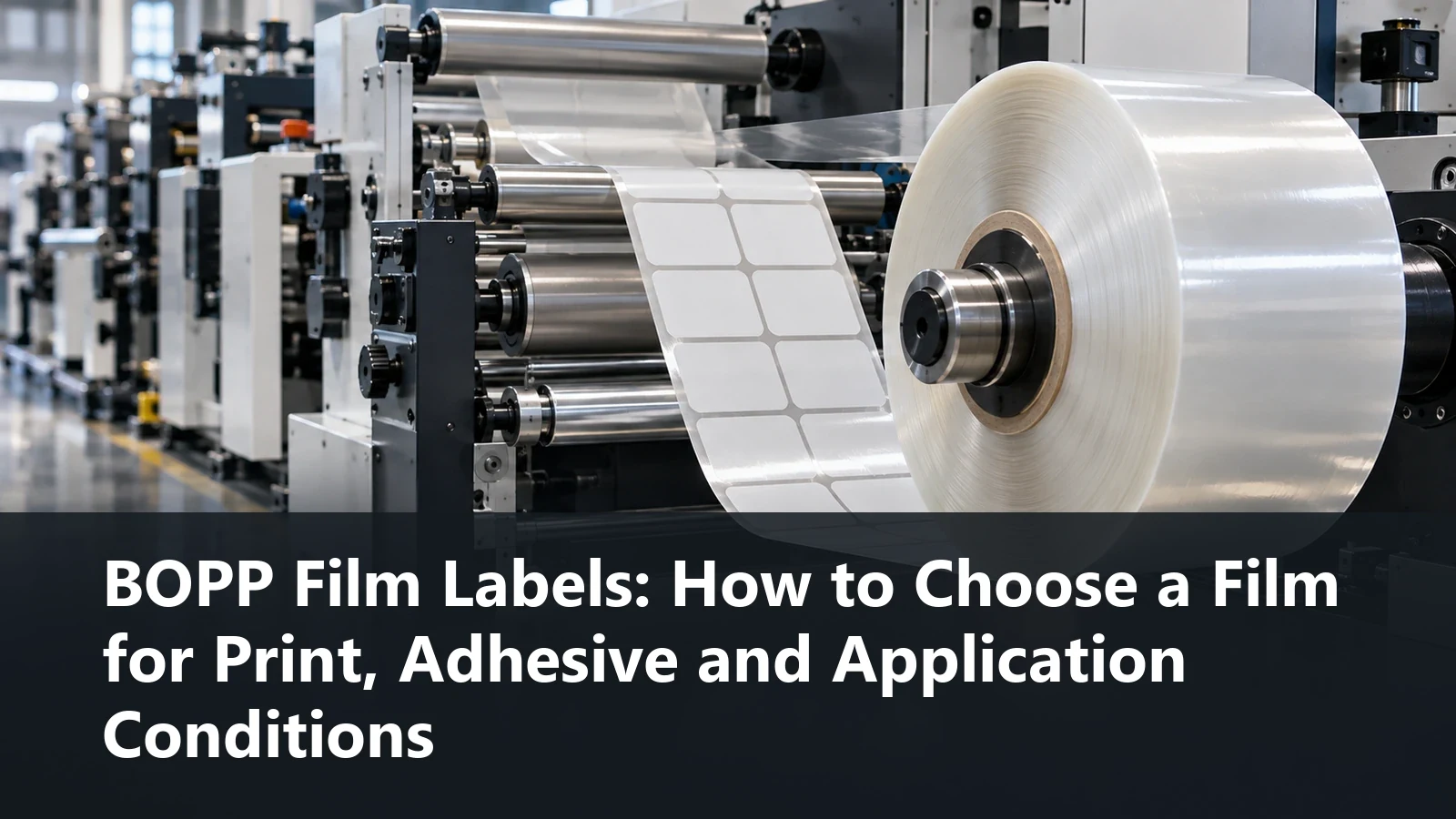
A BOPP label prints cleanly and die-cuts perfectly at the converter. Then it lifts from damp cold bottles, flags on a squeeze tube, fails on freezer stock or picks during dispensing. The problem is that the film passed converting tests without being qualified with the adhesive, container and real application conditions.
Choose BOPP label film around three linked variables: the print or coating process, the adhesive/labeling system, and the container plus end-use environment. Confirm that the film surface is suitable for the intended press, that the adhesive matches the container material and application conditions, and that film stiffness, conformability, appearance and durability suit labeling and service. Then qualify the complete label on the real container at production speed and test it under the actual cold, wet, squeeze, chemical or outdoor conditions.
Printability qualifies the face film for the press. It does not prove that the finished label will dispense, adhere, conform or survive its intended environment.
Which BOPP Label Format Are You Buying?
Before selecting a BOPP label film, define the labeling system.
Pressure-Sensitive BOPP Labels
A typical pressure-sensitive, or PS, label construction combines:
BOPP face film + pressure-sensitive adhesive + release liner
The converter or film buyer may focus on the BOPP facestock because it controls appearance, printing and some converting behavior.
But the finished label succeeds or fails as a system.
The adhesive must bond to the container under the actual application and service conditions, while the release liner and label construction must support die-cutting and dispensing.
A face film that performs perfectly on the press cannot compensate for an adhesive that is wrong for the container.
Glue-Applied BOPP Wraparound Labels
Glue-applied or roll-fed wraparound labels use a different system.
The BOPP film is printed and cut for wrapping around a container, with the specified glue system used during labeling. Reverse printing is common in relevant constructions because the graphics can be viewed through the film while receiving protection from the outer film surface.
Glue wetting, seam performance, film conformability and machine behavior all become important.
What Is Outside This Article?
Shrink sleeves are separate specialty films designed around controlled shrink behavior and shrink-tunnel processing.
In-mold labeling is also a specialist field with its own film, printing and molding requirements.
Neither should be treated as interchangeable with ordinary PS or glue-applied BOPP labels.
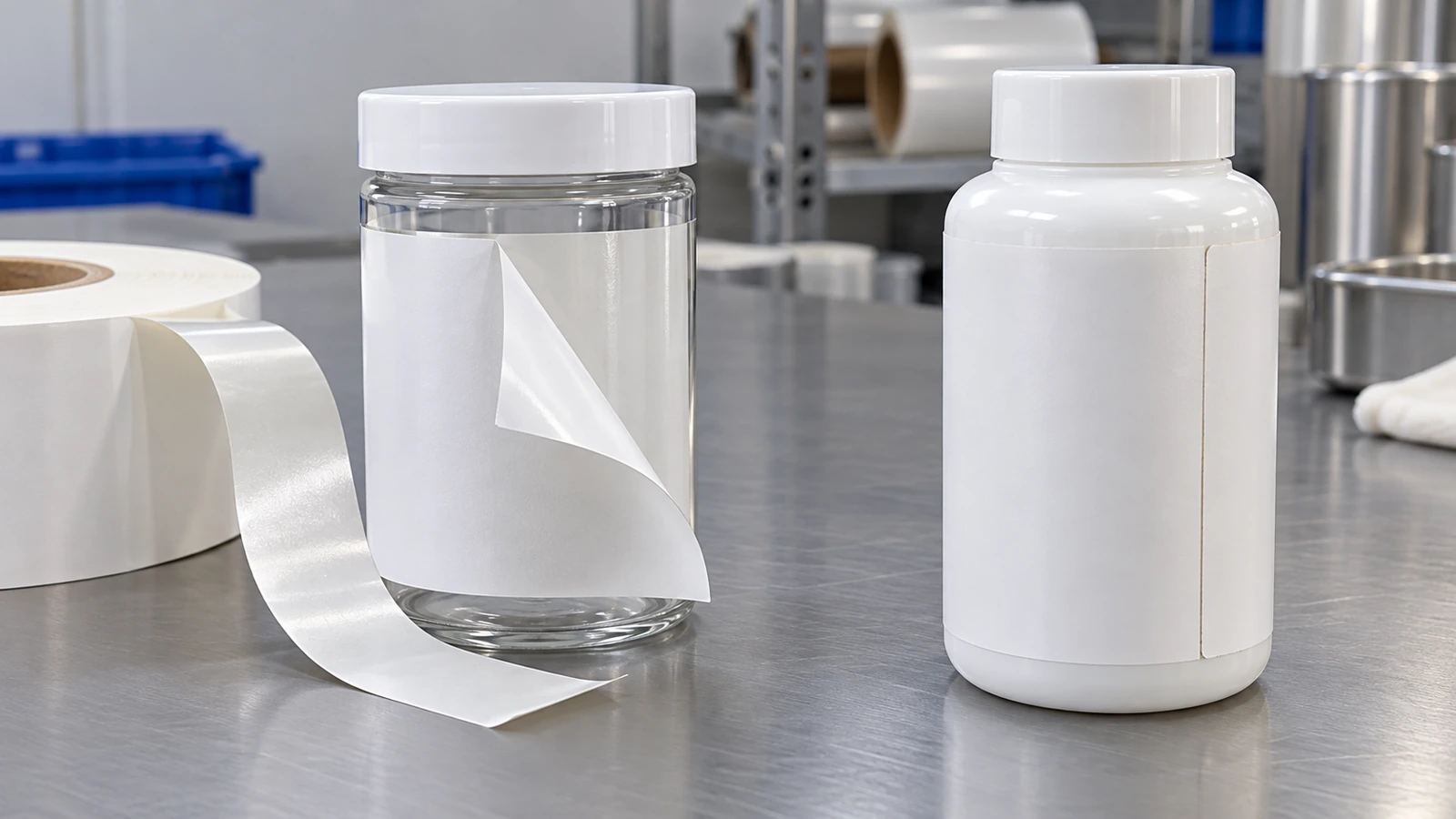
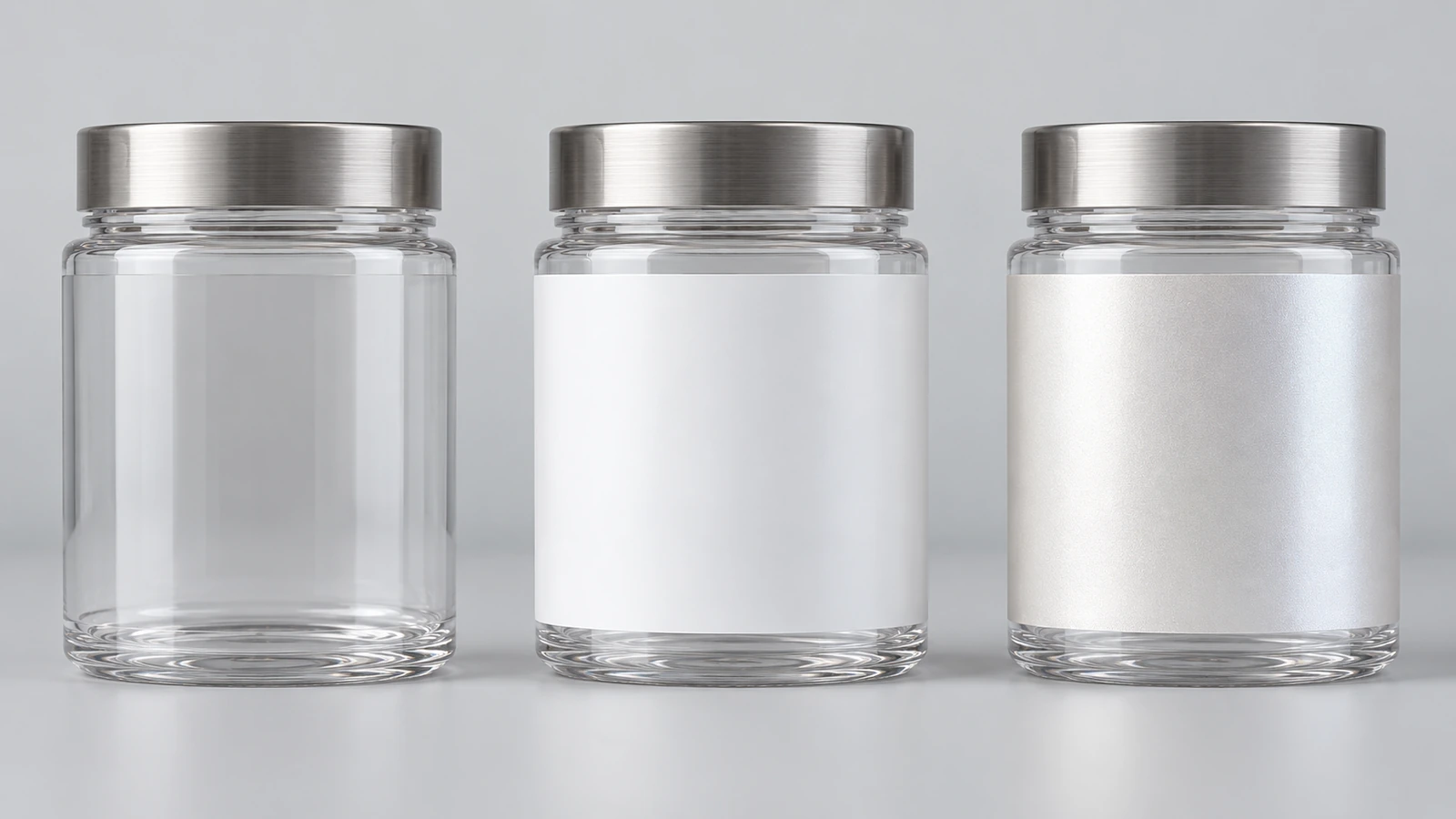
Clear, White or Pearl BOPP: Which Label Appearance Is Needed?
The first visible specification is often the face-film appearance.
Clear BOPP is commonly considered for transparent or “no-label-look” designs. Here, clarity is only part of the requirement. The adhesive layer, container surface, bubbles and print construction can all affect the final optical result.
Test the complete clear label on the real container.
White BOPP provides an opaque or controlled background for graphics. Buyers should evaluate the actual opacity and printed appearance required rather than assuming all white films produce the same result.
Pearlized BOPP can provide another opaque decorative appearance. Its density, stiffness and converting behavior can differ from a conventional clear or white construction, so it should be treated as its own grade.
In each case, approve appearance on the final package—not just on an unprinted film sample.
How Should BOPP Label Film Be Chosen for the Printing Process?
The print surface needs to match the intended press and ink system.
BOPP label film can be used in processes including flexographic printing, UV flexo, screen, gravure, applicable offset processes and digital printing, but a generic BOPP surface should not be assumed suitable for every one.
Some grades rely on surface treatment. Others use a print-receptive coating or primer designed for a particular ink or printing process.
Corona treatment increases surface energy and supports wetting, but treatment can change during storage.
Where surface condition is critical, confirm the current treatment or print-surface requirement according to the grade and process rather than relying only on an old production specification.
The final check is still practical print performance: ink wetting, anchorage, appearance and the required resistance after curing or drying.
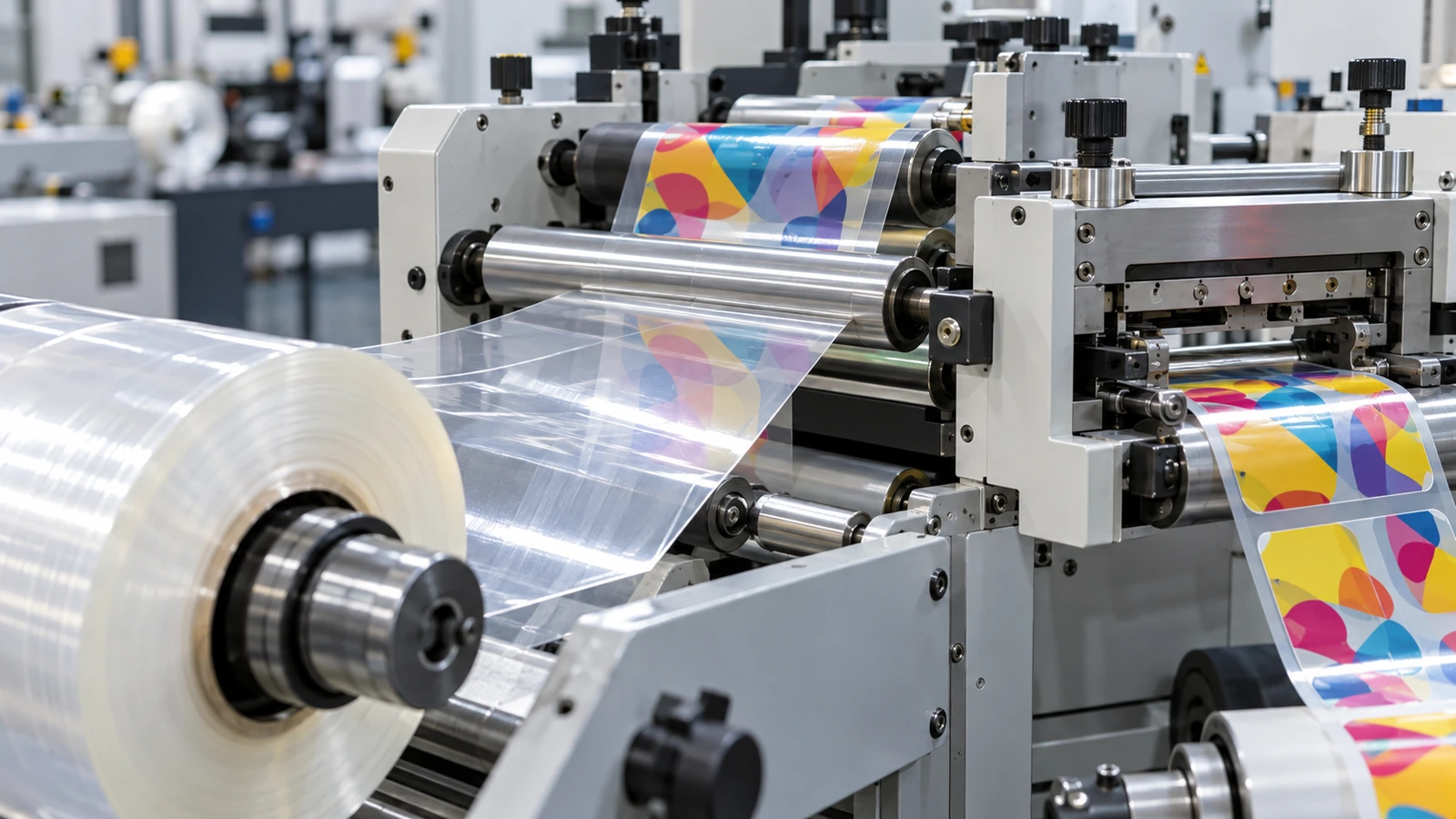
Does HP Indigo or Other Digital Printing Need a Special BOPP Film?
Digital printing deserves specific attention because press technologies have different substrate requirements.
HP Indigo-type presses, for example, can require films with surfaces, primers or print-receptive coatings appropriate to that process.
A film described simply as “corona-treated BOPP” should not automatically be considered digitally printable.
The same caution applies to other digital systems.
Check the candidate film's TDS and any available print-process guidance, then verify the substrate requirements of the intended press and ink system.
If a digital job is important, trial it on that press.
“Suitable for digital printing” is too broad unless the actual process has been identified.
What Do Published BOPP Label Data Sheets Actually Specify?
Published product data can anchor an RFQ and trial plan. Each sheet describes its named construction, not every BOPP label film. Two supplier examples show why the complete construction and test conditions matter:
| Published product example | Data stated by the supplier | What the figure can—and cannot—tell a buyer |
|---|---|---|
| Avery Dennison Fasson BW7510, clear top-coated BOPP for a reclosable wet-tissue label | Facestock basis weight 47 g/m² ±10% (ISO 536) and caliper 0.052 mm ±10% (ISO 534); SR101 is described as a removable, solvent-based acrylic adhesive; minimum application temperature 5°C; service range −20°C to +80°C after 24 hours | A useful example of a print-receptive PS construction with a stated application/service window. It is an older, named product sheet (January 2014), so request the current regional specification and confirm the adhesive and container fit before quoting it for another use. |
| Avery Dennison Fasson 2.4 mil White BOPP ITC / S7000 / 40#BG, spec 79250 | 2.4 mil facestock caliper; specified for HP Indigo ws4000/ws4050/ws4500/ws6000; minimum application temperature 25°F (about −3.9°C); service range −40°F to +175°F (about −40°C to +79.4°C), subject to facestock limitations | This is a coated white BOPP pressure-sensitive construction, not a bare wraparound web. The sheet reports typical loop-tack and peel values on HDPE and PET, but says they were measured at room temperature on standard laboratory panels with a 2 mil clear polypropylene facestock. Those values should not be treated as a prediction for a different bottle, face gauge, adhesive, damp condition or production line. |
The second sheet’s laboratory values are deliberately not used here as universal acceptance limits: a buyer must obtain the current document, confirm the precise test procedure, unit, panel preparation and dwell, then reproduce the relevant test on the actual container and finished label. For either example, confirm whether the stated temperature limit applies to the adhesive alone or to the full construction; the BW7510 sheet explicitly notes the polypropylene film’s semi-rigid nature and cautions about non-uniform or squeezable surfaces.
Buyer takeaway: Use published figures to write a specific RFQ covering face-film gauge and tolerance, coating/print process, adhesive, liner, application temperature, service exposure and test method. Approve the complete construction on the actual package, not from a generic “BOPP label” description.
When Does a BOPP Label Need an Overlaminate or Varnish?
BOPP itself can provide useful durability, but the printed image may still need additional protection.
An overlaminate, varnish or other suitable protective system may be considered when the label will experience significant:
- Abrasion or scuffing
- Repeated handling
- Oils
- Chemicals
- Moisture
- Outdoor exposure
Protection should be selected around the actual ink and exposure.
For example, resistance of the BOPP face film to moisture does not automatically mean the printed ink is resistant to every cleaning chemical or oil.
Test the printed and finished label, including any overlaminate or varnish, against the relevant exposure.
How Does Pressure-Sensitive Adhesive Change BOPP Film Selection?
For PS labels, adhesive selection is fundamental to application performance.
General adhesive chemistry families include acrylic, rubber/resin and hot-melt systems. Within these broad families, suppliers offer products for different applications.
Performance categories can include permanent, removable, repositionable, freezer/deep-freeze and other specialty adhesives.
These descriptions are useful starting points, not complete specifications.
The adhesive supplier or labelstock specialist should match the adhesive to:
container substrate + surface condition + application temperature + service environment + label construction
This is particularly important because the same BOPP face film can perform very differently when paired with different adhesives.
Why Do Tack, Peel and Shear All Matter?
Adhesive performance cannot be reduced to “sticky” or “not sticky.”
Tack describes initial grab when the label first contacts the surface.
Peel relates to resistance when the bonded label is removed under peel-type loading.
Shear relates to resistance against sliding or creep while the adhesive is under sustained load.
These properties interact with container shape, label dimensions, temperature and adhesive chemistry.
High initial tack alone does not prove that a label will resist flagging on a curved package or remain secure through cold storage.
Buyers should use the adhesive supplier's relevant technical data and validate the complete construction.
Why Does Minimum Application Temperature Matter?
Application temperature and service temperature are not the same thing.
A freezer label may be intended to remain attached during cold service, but that does not automatically mean it can be applied successfully to any container at any cold temperature.
The adhesive needs suitable conditions to establish its initial bond.
For cold-chain work, define both:
conditions during label application and conditions during subsequent storage/use
Use the adhesive supplier's stated application and service guidance. Do not substitute a generic “freezer adhesive” description for actual qualification.
Why Are PE and PP Bottles Difficult to Label?
Polyethylene and polypropylene containers are common examples of low-surface-energy (LSE) plastics.
These surfaces can be more difficult for some adhesives to wet and bond to effectively.
The solution is not necessarily a different BOPP face film.
The adhesive needs to be designed and validated for the actual LSE container surface.
Texture creates another variable. A rough, molded or irregular container may provide less intimate adhesive contact than a smooth laboratory test panel.
Always trial the real bottle, tube or package.
What Changes on Damp or Condensation-Covered Bottles?
A statement such as “BOPP is water resistant” can create the wrong purchasing assumption.
The BOPP face may tolerate moisture while the adhesive/container interface still fails.
Cold beverage containers, refrigerated products, ice-water exposure and condensation can therefore require a label construction specifically qualified for those conditions.
If labels are applied to a cold or damp surface, test that condition directly.
Do not qualify the adhesive only on a clean, dry, room-conditioned bottle if production looks very different.
How Do Curved and Squeezable Containers Affect Film Choice?
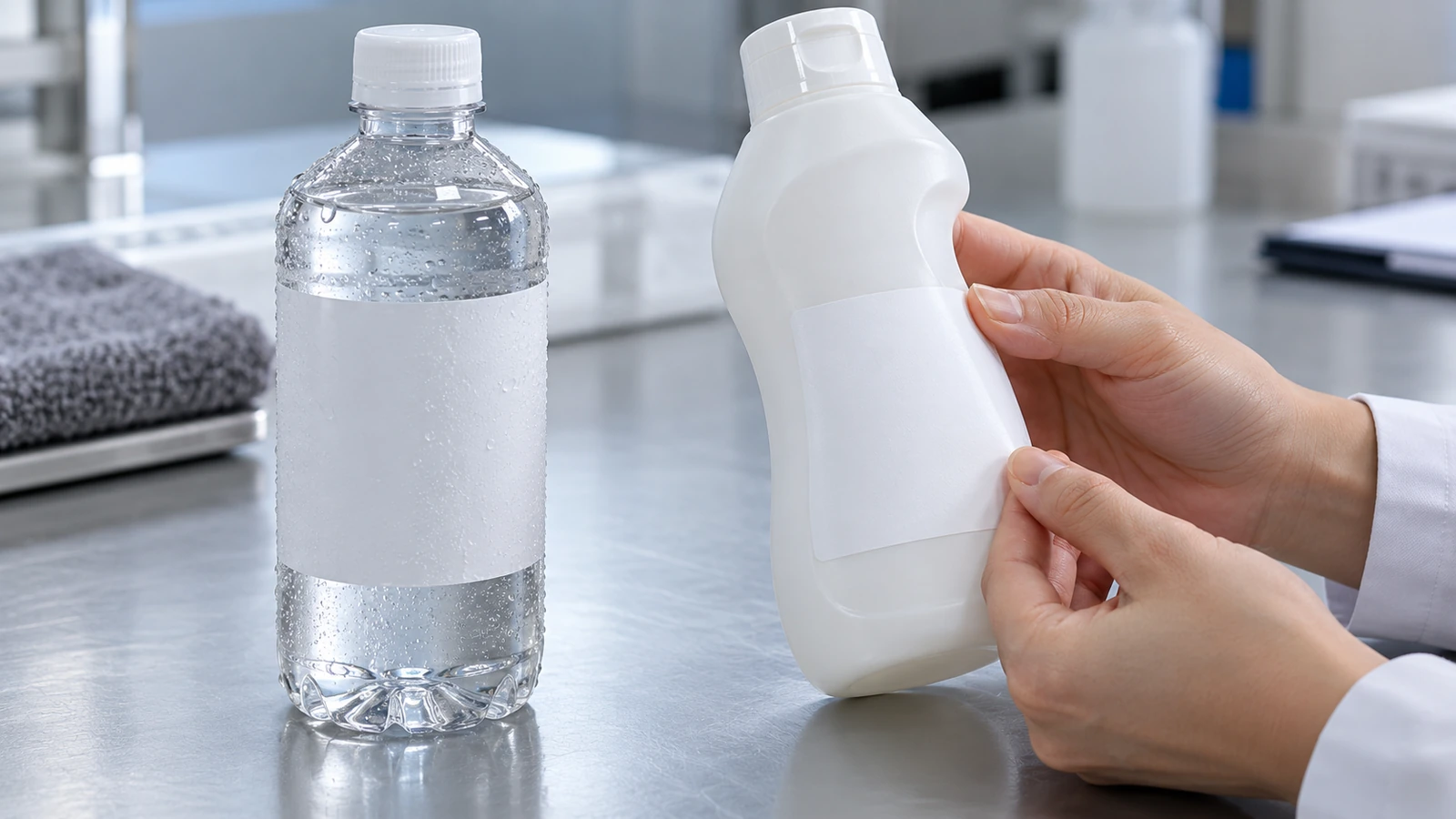
Curved bottles and squeeze tubes create a balance between film stiffness and conformability.
A film needs enough stiffness for converting and dispensing, but the finished label must also follow the container geometry without excessive tendency to lift or flag.
Evaluate:
- Container material
- Radius and shape
- Label dimensions
- Film construction
- Adhesive
- Expected squeezing or flexing
There is no universal gauge that solves every curved-container application.
A squeeze-tube label should be tested by repeatedly deforming the actual package and inspecting edges, corners and the main label area over time.
What Does High-Speed Label Dispensing Require?
A label that hand-applies successfully may still fail on an automatic applicator.
High-speed pressure-sensitive labeling depends on the complete labelstock construction and converting quality.
Relevant checks include:
- Die-cut quality
- Slit and edge condition
- Face-film stiffness
- Liner and release behavior
- Web tension
- Label dispensing
- Roll consistency
If labels pick, fail to release predictably or become unstable at the dispensing point, investigate the face film, adhesive, liner, die-cutting and machine conditions together.
Production-speed trials matter because slow manual testing cannot reproduce all these interactions.
What End-Use Conditions Must a BOPP Label Survive?
The correct qualification environment comes from the finished product.
Depending on the application, that may include freezer or cold-chain storage, condensation, ice-water immersion, shower humidity, oils, cleaning chemicals, outdoor exposure, UV, abrasion or repeated squeezing.
Label size and package curvature also influence performance.
Testing should continue for a period relevant to the product rather than stopping shortly after application.
A label that looks secure after ten minutes has not necessarily demonstrated long-term service performance.
BOPP Label Application Conditions
| Application condition | What it demands from film/adhesive | What buyers should verify |
|---|---|---|
| Damp/condensation | Durable face plus adhesive suitable for actual surface condition | Apply and test on representative cold/damp container |
| Freezer/cold-chain | Adhesive suited to application and service conditions | Confirm adhesive guidance and run relevant cold-cycle trial |
| LSE plastic containers | Adhesive matched to PE/PP or other LSE substrate | Test actual container material |
| Curved/squeezable | Conformability plus adequate bond and dispensing stiffness | Squeeze and flagging trial on real package |
| High-speed dispensing | Stable converting, release, stiffness and edge quality | Run production-speed labeling trial |
| Outdoor/UV | Suitable print protection, film and adhesive system | Test intended exposure requirements |
| Chemicals/oils | Resistant print/protective and adhesive system | Expose complete label to relevant substance |
| No-label-look | Clear film/adhesive optical quality | Evaluate complete label on actual transparent container |
| Opaque/white | Required opacity and graphic appearance | Approve on final package |
| Glue-applied wrap | Glue wetting, seam performance, conformability and COF | Trial actual glue and labeler |
| Sustainability claims | Label/package compatibility with claimed pathway | Check current market guidance and supporting evidence |
What Changes for Glue-Applied Wraparound BOPP Labels?
Wraparound BOPP should be specified as a dedicated labeling construction rather than treated as PS facestock without adhesive.
Printing orientation is important. Reverse printing may be used to place graphics behind the film surface.
The film must also work with the selected cold-glue or other specified glue system, including the required wetting and lap-seam behavior.
Film gauge and caliper influence handling and wrap behavior.
Coefficient of friction, or COF, can also matter for high-speed handling, nested or stacked labels and machine movement.
Where the process uses cutting or perforating, those operations should be included in the trial.
Most importantly, qualify the film at the intended labeller speed with the real glue and container. A roll-fed label that looks good after manual wrapping has not yet demonstrated production performance.
How Should Buyers Qualify a BOPP Label System?
The whole chain should be qualified:
actual film + actual print + actual adhesive + actual container + actual applicator + actual environment
Before the trial, identify the label format, film grade, appearance, printing process, adhesive, container material and expected application/service conditions.
During printing and converting, inspect print appearance and adhesion, die-cut or edge quality, roll condition and, for PS constructions, release and dispensing behavior.
Then move to the labeling line.
Run at a representative production speed. Inspect placement, wrinkles, bubbles, initial adhesion and edge flagging.
After application, do not stop the test too early.
Age the samples as appropriate to the job. Where relevant, expose them to cold or freezing, condensation or soaking, squeezing, oils, chemicals, abrasion or outdoor/UV conditions.
Keep labeled control samples and records of the material lots and trial conditions.
Label-System Qualification Checklist
| Stage | What to check |
|---|---|
| Surface treatment/topcoat compatible with press and ink | |
| Ink adhesion, appearance and cure/dry condition | |
| Converting | Die-cut, slit/edge and roll quality |
| Converting | Liner/release and dispensing behavior for PS labels |
| Adhesive | Adhesive family/category matched to container and environment |
| Application | Actual container surface, shape and condition |
| Application | Representative applicator speed |
| Application | Placement, flagging, wrinkles and bubbles |
| End use | Cold/freezer/condensation where applicable |
| End use | Squeezing and flexing |
| End use | Oils, chemicals and moisture |
| End use | Abrasion and outdoor/UV exposure where applicable |
| Control | Age samples and retain labeled controls |
This sequence makes it easier to identify whether a failure is occurring at the print surface, film/adhesive construction, adhesive/container interface or during application and service.
For related buyer checks, see how anti-fog BOPP users assess moisture-related conditions and how to define a film's role before sourcing. For printed flexible-packaging laminates rather than labelstock, see how buyers compare BOPP lamination grades.
How Should Sustainability and Recycling Claims Be Handled?
A BOPP label is only one component of the labeled package.
Its film, adhesive, ink and other layers can affect how the complete bottle or container behaves in a recycling or reuse pathway.
For PET, PP and other package types, check current design-for-recycling or collection guidance applicable to the destination market and package construction.
Claims involving wash-off, removable or recycling-compatible adhesives should be supported by evidence relevant to the actual adhesive and labeled package.
Avoid assuming that because BOPP itself is polypropylene, every BOPP-labeled package automatically fits a particular recycling stream.
How CHALVO Supports BOPP Label-Film Sourcing
CHALVO (Hangzhou Chalvo New Material Co., Ltd.) is a Chinese packaging-film export and supply-chain integration company, not a BOPP label-film manufacturing factory.
For label-film sourcing, CHALVO can help buyers organize requirements around label format, appearance, printing process, film gauge, container and application conditions.
CHALVO can also match candidate film-grade categories, collect available grade-specific TDS information across its supplier network, organize trial requirements and coordinate samples or trial rolls for buyer and converter evaluation.
Final adhesive selection and finished-label qualification should be completed with the actual adhesive/labelstock system, converter, applicator and end-use package.
FAQ: BOPP Film Labels
Is BOPP Suitable for Pressure-Sensitive Labels?
Yes. Suitable BOPP face films are widely used in pressure-sensitive label constructions.
However, BOPP is only the face component. The adhesive and release liner also influence converting, dispensing and final application performance, so qualify the complete labelstock on the actual package.
What Adhesive Works With BOPP Labels on PE or PP Bottles?
PE and PP are low-surface-energy plastics, so use an adhesive selected for the actual container and intended application.
Acrylic, rubber/resin and hot-melt are broad adhesive families, not universal solutions. Confirm the specific adhesive with its supplier and test it on the real PE or PP container.
Can BOPP Labels Be Used on Freezer Products?
Yes, suitable BOPP label constructions can be used for freezer and cold-chain applications.
The key is qualifying the adhesive for both the conditions when the label is applied and the conditions it experiences later. Condensation and surface condition should also be included where relevant.
What BOPP Film Is Used for Digital Label Printing?
Use a BOPP grade with the surface treatment, primer or print-receptive coating required by the intended digital press and ink technology.
For HP Indigo-type or other digital processes, confirm the substrate requirements for that specific system rather than assuming generic digital compatibility.
Are BOPP Wraparound Labels the Same as Pressure-Sensitive Labels?
No.
Pressure-sensitive labels use a pre-applied adhesive and release liner. Glue-applied wraparound or roll-fed BOPP labels use a separate labeling/glue system and have their own requirements for printing, glue wetting, seam performance, conformability, COF and high-speed application.
Summary
Choose BOPP label film as part of a complete labeling system. Match the face film to the print process, adhesive to the real container and application conditions, and film stiffness, conformability and protection to end use. Qualify the finished label at production speed and under realistic environmental exposure.
CTA: Sourcing BOPP film for pressure-sensitive or glue-applied labels? Send CHALVO your label format, clear/white/pearl requirement, print process, film gauge, adhesive system, container material and shape, application conditions and end-use environment. CHALVO can help organize requirements, match candidate film-grade categories, collect available grade-specific TDS information across its supplier network and coordinate samples or trial rolls for your own evaluation.
Sources for further verification
- Avery Dennison, Fasson BW7510 50 micron Clear BOPP TC / SR101 / BG50#WH product data sheet (issue date January 2014): https://label.averydennison.com/content/dam/averydennison/lpm/ap/en_cn/product%20families/data%20sheets/BW7510-PDS-en.pdf
- Avery Dennison, Fasson 2.4 mil White BOPP ITC / S7000 / 40#BG, Standard Product Data Sheet #79250: https://www.averydennison.com/content/dam/averydennison/lpm/na/en/product%20families/Data%20Sheets/mix%20and%20match/Mix-and-Match-4/79250-PDS-en.pdf
- Cosmo Films, Transparent Wrap Around BOPP Label Film (PCT-1 and PCT-2 product-family descriptions): https://www.cosmofilms.com/productlist/transparent-wrap-around-label-films
- Avery Dennison, SKU NEB9366, 505B 1 mil clear single-sided BOPP product attributes: https://products.averydennison.com/na/B9366