BOPA Nylon Film for Vacuum Packaging Buyer Guide
BOPA Nylon Film for Vacuum Packaging should be approved as a packaging solution only when it matches the exact application, structure role, and converter...

What Is BOPA Nylon Film?
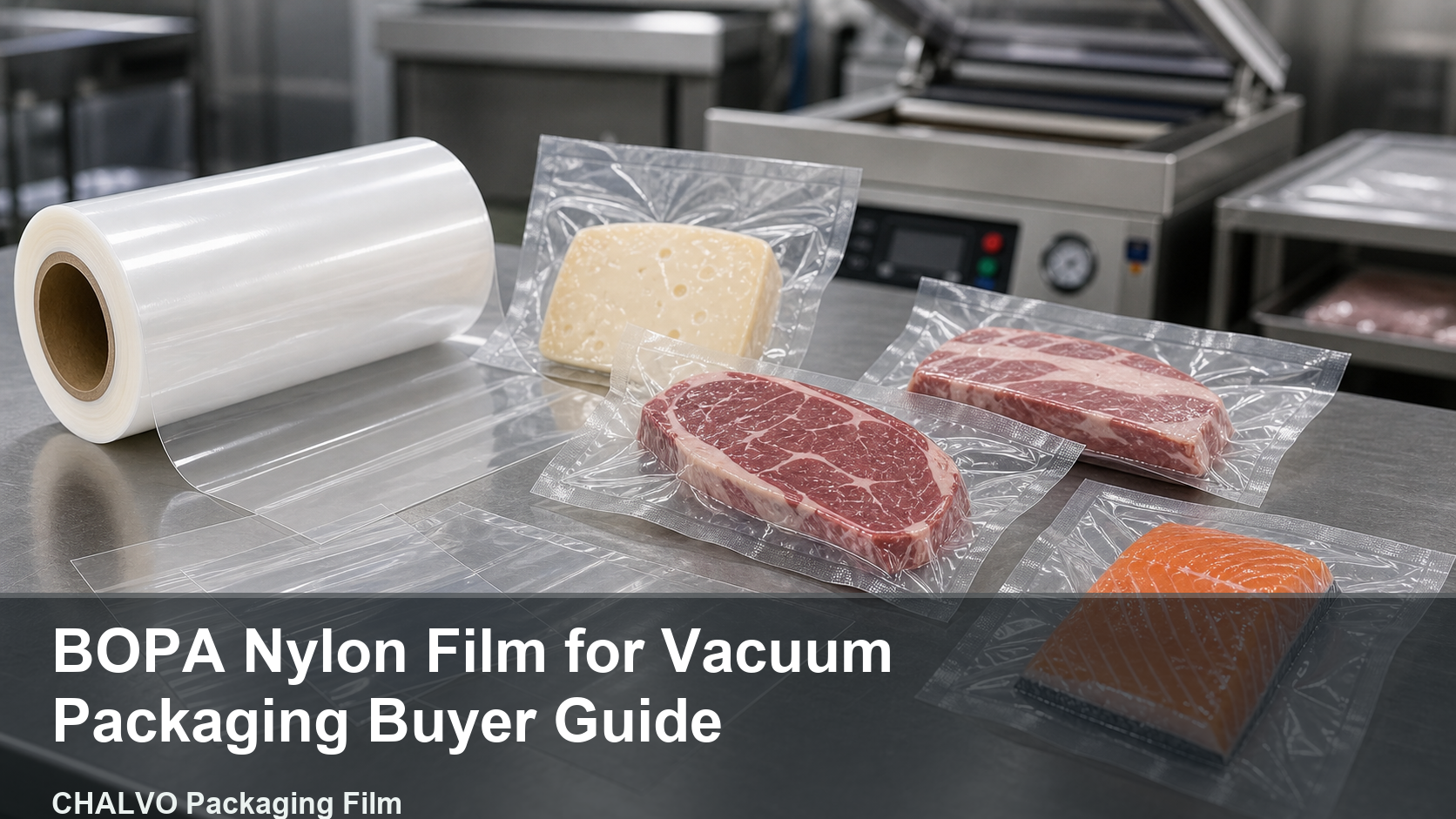
BOPA (biaxially oriented polyamide), also referred to as BON (biaxially oriented nylon) or OPA (oriented polyamide), is a nylon film stretched in both machine and transverse directions. This biaxial orientation process significantly improves tensile strength, puncture resistance, dimensional stability, and optical clarity compared to cast or unoriented nylon.
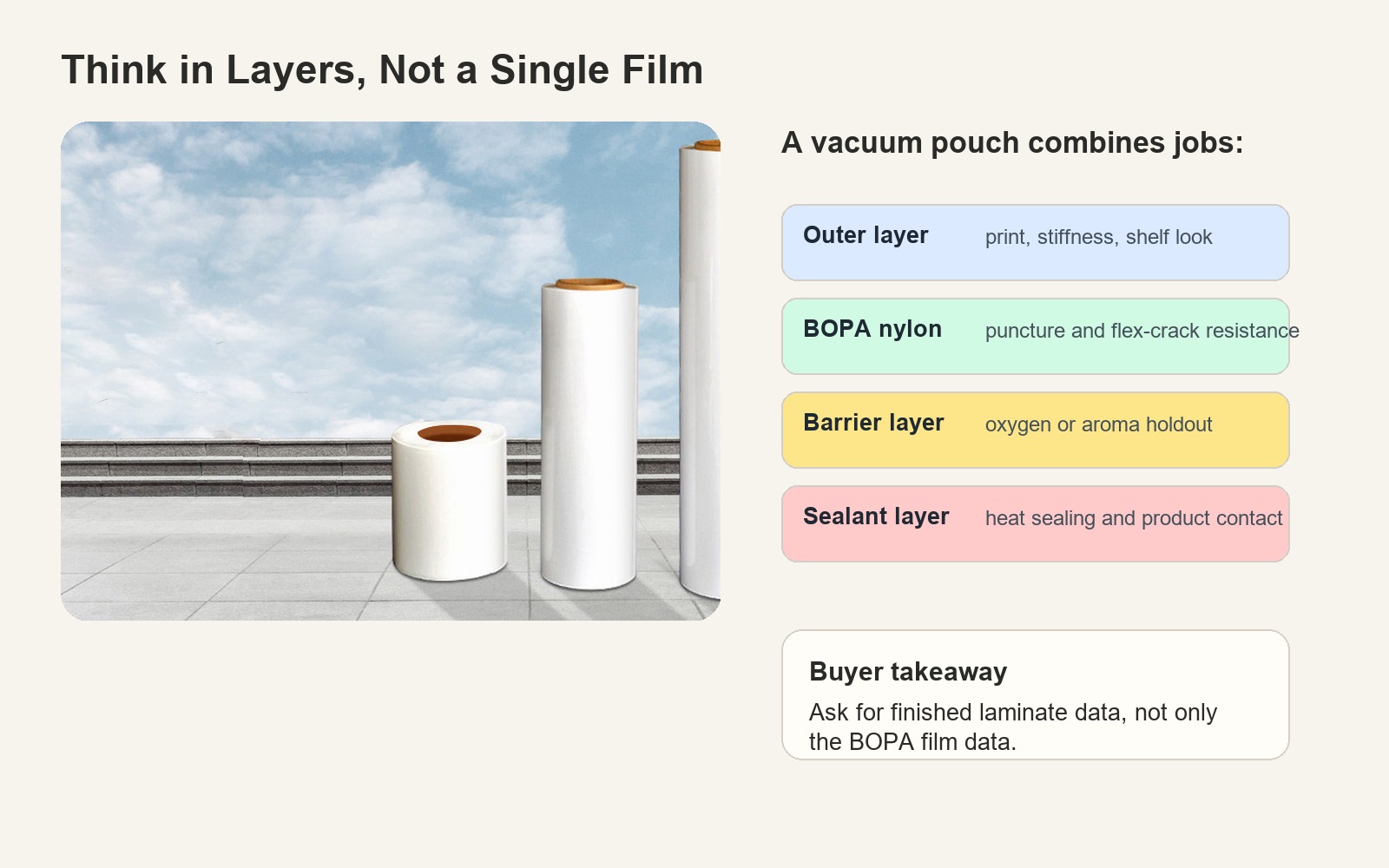
In vacuum packaging, BOPA is almost never used alone. It functions as the tough structural backbone in a multilayer laminate — absorbing puncture, flex-crack, and draw-down stress while the sealant layer provides hermetic closure and additional barrier layers manage oxygen and moisture. Understanding this role is the first step to making a smart buying decision.
Sequential vs. Simultaneous Stretching – What Buyers Should Know
BOPA films are produced through two main orientation processes:
- Sequential stretching (tenter frame): Film is stretched MD first, then TD in a heated oven. This process typically yields films with balanced mechanical properties and good optical clarity. It is the more widely used method globally.
- Simultaneous stretching (LISIM or similar): Film is stretched in both directions at the same time. This can produce more uniform orientation, potentially offering better thickness consistency, lower shrink, and improved barrier uniformity at thinner gauges.
As a buyer, your key concern is not which process is "better" in theory, but whether the film spec you receive meets your performance requirements consistently. Request datasheets and batch-to-batch quality records, and verify gauge tolerance regardless of the manufacturing process.
—
Why BOPA Belongs in Vacuum Packaging Structures
Puncture Resistance – The #1 Reason to Choose BOPA
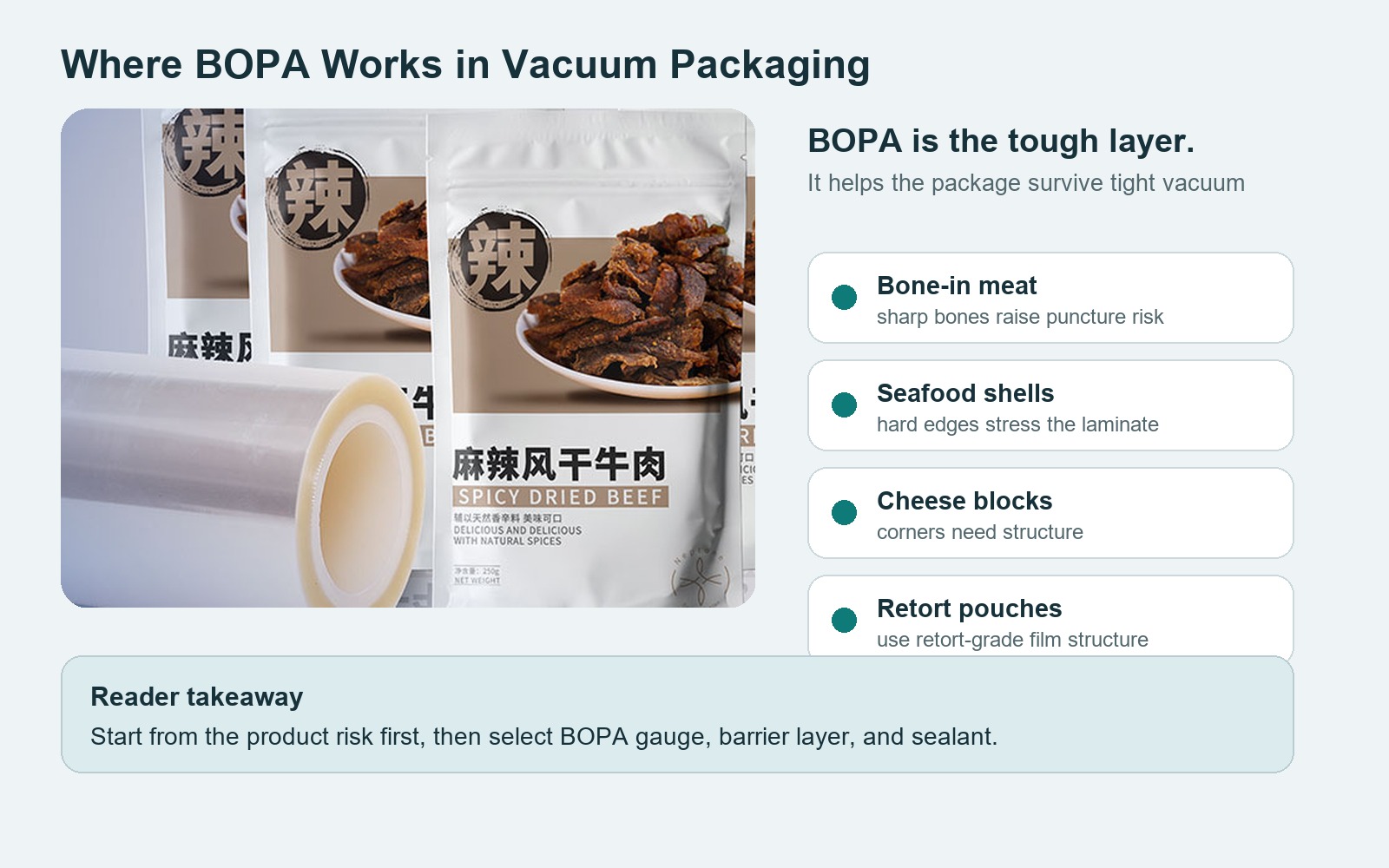
When a vacuum is drawn, the film collapses tightly around the product. Any sharp edge — a bone, a shell fragment, a dehydrated cheese corner, or even a seasoning crystal — concentrates stress on a tiny area of the film. In a monolayer bag, this is where failure begins.
BOPA's biaxially oriented molecular structure distributes this stress far more effectively than PE, PP, or even BOPET. This makes it the preferred abuse layer for:
- Bone-in fresh and frozen meats (beef primals, pork chops, lamb racks)
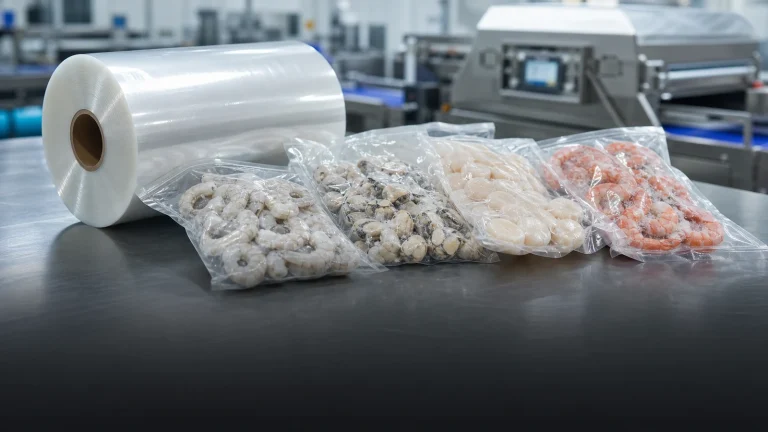
- Shellfish and seafood with hard edges (lobster tails, crab legs, whole fish with fins)
- Cheese with natural rinds or dehydration-sharpened corners
- Any product with irregular geometry under high vacuum draw
Barrier Contribution: Oxygen, Aroma, and Moisture
BOPA contributes meaningful oxygen barrier compared to polyolefin films — how much depends on the specific grade, orientation process, and test conditions. Buyers commonly encounter OTR values in a range roughly around single to low double digits (cc/m²·day) under dry conditions, with the number increasing at higher relative humidity due to nylon's moisture sensitivity. This oxygen holdout supports shelf life for oxygen-sensitive products like red meat, processed meats, and hard cheeses. BOPA also provides an effective aroma barrier, helping preserve the product's intended flavor profile throughout the supply chain.
Where BOPA falls short: Nylon is inherently hydrophilic. BOPA's moisture vapor transmission rate (WVTR) is significantly higher than PET or polyolefin films — a common industry observation, with exact values to verify per grade. This means BOPA alone cannot serve as a moisture barrier. In humid cold-chain conditions or long-term frozen storage where moisture loss is a concern, BOPA must be laminated with a moisture barrier layer such as PE, EVOH, or metallized film.
> Buyer note: Always specify the test conditions (temperature, relative humidity) when comparing OTR and WVTR values from different suppliers. A film's oxygen barrier at low RH is very different from its performance at high RH in a refrigerated distribution chain. Request datasheets with clearly stated test methods.
—
Step 1: Analyze Your Product Profile
Before selecting any film structure, examine what you are actually packaging. The product determines the abuse demand.
Bone-in vs. Boneless Meat – Puncture Risk Rating
Use this simplified risk scale to match your product to a BOPA thickness starting point:
| Puncture Risk Level | Product Examples | Suggested BOPA Starting Gauge | Key Consideration |
|---|---|---|---|
| Low | Boneless ground meat, cooked sausage, pâté | 12–15 µm | Basic puncture protection; cost-sensitive applications |
| Medium | Boneless whole-muscle cuts, skinned poultry, firm tofu | 15 µm | Standard for most boneless vacuum applications |
| High | Bone-in pork chops, T-bone steaks, lamb chops with sharp bone edges | 20–25 µm | Heavy puncture risk; verify supplier's puncture data |
| Extreme | Lobster/crab with hard shells, frozen bone-in primal cuts, products with protruding connective tissue | 25 µm+ or reinforced structure | Consider thicker BOPA or multi-ply construction with additional abuse layer |
> Buyer note: These are starting recommendations. Actual performance depends on vacuum draw strength, film stiffness, sealant layer properties, and distribution handling. Request puncture-resistance test data from your supplier under conditions simulating your actual pack.
Shellfish, Cheese, Sauces – Special Demands
- Shellfish and crustaceans: Shell edges can be razor-sharp under vacuum. A 20–25 µm BOPA layer is common, and some packers add a second abuse ply for high-value export shipments.
- Cheese (hard/semi-hard): Gasses produced by aging cultures can cause package swelling. BOPA's dimensional stability helps resist distortion. Natural rinds or dehydration-sharpened corners require medium to high puncture resistance.
- Liquid seasonings, sauces, and marinades: Oil resistance is a known advantage of BOPA. However, verify sealant compatibility with the specific pH and fat content of the product to prevent seal creep or delamination.
- Smoked fish and jerky: Dry, sharp edges combined with long shelf life requirements. Common structures use 15–20 µm BOPA with an EVOH barrier layer.
—
Step 2: Define Processing Conditions
The temperature profile your package will encounter determines the heat-resistance requirements for both BOPA and the sealant layer.
| Processing Condition | Typical Temperature | BOPA Requirement | Sealant Recommendation |
|---|---|---|---|
| Fresh/chilled | Chilled storage | Standard BOPA (any common grade) | PE or LLDPE |
| Frozen storage | Frozen-chain storage | Standard BOPA; verify low-temp impact resistance | Low-temperature PE grades available |
| Pasteurization | Hot-water or pasteurization exposure | Standard BOPA may be sufficient; verify shrink behavior | CPP or heat-resistant PE |
| Full retort | Standard or high-temperature retort sterilization | Must use retort-grade BOPA — not all BOPA withstands steam sterilization | Retort-grade CPP or specialized sealant |
| Boil-in-bag | Boiling water exposure | Standard BOPA with verified heat resistance | CPP or HDPE |
> Critical buyer note: Using standard (non-retort) BOPA in a retort application will result in film distortion, delamination, or seal failure. If your product requires retort sterilization, explicitly request retort-grade BOPA and a complete sterilization test report on the finished laminate — not just on the BOPA film alone.
Process Compatibility Checklist
- [ ] Has the BOPA film been tested at the actual processing temperature in the final laminate structure?
- [ ] Do you have certified test data for the specific processing cycle time and temperature?
- [ ] For retort applications: is the sealant layer also retort-grade?
- [ ] For frozen applications: has the film been tested for impact resistance at the intended storage temperature?
—
Step 3: Define Barrier Targets and Shelf Life
The required shelf life of your product drives the barrier specification. BOPA provides partial oxygen barrier, but for extended shelf life, additional barrier layers are necessary.
Oxygen Barrier and Shelf Life
For products where oxygen exposure limits shelf life (fresh red meat, smoked fish, processed meats, cheese):
| Target Shelf Life (examples) | Typical Barrier Strategy | BOPA Role |
|---|---|---|
| Short chilled (days to ~3 weeks) | BOPA + PE only | BOPA can provide sufficient oxygen barrier alone for shorter durations |
| Extended chilled (weeks to ~2 months) | BOPA + EVOH or coated barrier layer | BOPA adds puncture protection; EVOH or coating handles oxygen |
| Frozen (months, depending on product) | BOPA + PE (oxygen sensitivity reduced at freezing temps) | BOPA provides structure and puncture resistance |
| Long-term ambient or retort | BOPA + AL foil or high-barrier EVOH | BOPA adds abuse resistance; metal or EVOH provides barrier |
Moisture Barrier Considerations
Because BOPA does not function as a moisture barrier, in high-humidity environments or long-term refrigerated storage:
- Ensure the structure includes a moisture barrier layer (PE, PP, or metallized film) on the exterior side of the BOPA
- Test the finished laminate WVTR at conditions matching your cold chain (not just standard lab conditions)
- For export shipments through multiple climate zones, consider accelerated shelf-life testing before full production
> Buyer note: Common specification items to request from your supplier include OTR and WVTR data with stated test conditions (temperature and relative humidity), and finished laminate barrier data — not just the BOPA film in isolation.
—
Step 4: Choose the Sealant Layer and Laminate Structure
The sealant layer must match both the product and the processing conditions. BOPA serves as the structural layer, but the sealant determines whether the bag closes reliably.
Common Laminate Configurations
| Structure | Common Application | BOPA Gauge (typical range) | Sealant Layer |
|---|---|---|---|
| BOPA // PE | Standard vacuum bags for boneless meat, cheese, frozen food | Commonly around 15 µm | PE |
| BOPA // CPP | Retort pouches, boil-in-bag, hot-fill applications | Commonly 15–20 µm (retort grade where needed) | CPP |
| BOPA // PE/EVOH/PE | High-barrier vacuum pouches for extended shelf life (processed meats, cheese, smoked fish) | Commonly 15–20 µm | PE/EVOH/PE coextruded sealant |
| PET // BOPA // PE | Premium printed pouches — PET for print/gloss, BOPA for toughness | Commonly around 15 µm | PE |
| BOPA // AL // PE/PP | Ultra-high-barrier retort pouches for shelf-stable meals | Commonly 15–20 µm (retort grade) | PE or PP (varies) |
| BOPA // PE (heavier gauge BOPA) | Heavy-duty bone-in meat, lobster, export frozen meat | Heavier gauge (e.g., in 25 µm range) | PE |
Multi-layer Considerations
For demanding applications, 3-ply or 4-ply structures may be necessary:
- 3-ply: BOPA + barrier layer + sealant (e.g., BOPA // EVOH // PE)
- 4-ply: Abuse + BOPA + barrier + sealant (e.g., PET // BOPA // EVOH // PE)
- 5-ply (coextrusion + lamination): For complex barrier requirements with multiple functional layers
> Buyer note: Verify with your laminate converter that the chosen structure is compatible with their lamination process (adhesive type, curing conditions, coating equipment) before committing to production volumes.
—
Step 5: Verify Processing Compatibility
Even the best film structure will fail if it does not run properly on your packaging equipment.
Surface Energy and Corona Treatment
For successful printing or lamination, the film surface must achieve adequate surface energy. The buyer should confirm the required surface-energy window with their printer or converter and verify the treatment level before use. BOPA's surface treatment can degrade over time — verify that the film arrives within the required treatment window and is processed promptly. For critical applications, request a dyne-level verification procedure from your supplier.
COF (Coefficient of Friction) and Machinability
Film that is too slippery or too sticky will cause problems on form-fill-seal equipment. The buyer should confirm the machine-specific slip/friction window with their equipment maker or converter. BOPA COF can shift with humidity (due to nylon's moisture sensitivity) — test under your actual production conditions.
Gauge Tolerance and Winding Quality
Consistent gauge and good roll geometry are critical for high-speed processing. The buyer should request grade-specific tolerance and roll profile data from the supplier and verify roll winding condition (e.g., no telescoping, consistent roll hardness) to avoid downtime on automatic equipment.
—
6 Common BOPA Specification Mistakes (and How to Avoid Them)
1. Over-specifying thickness for boneless products
A 25 µm BOPA for boneless chicken breast is unnecessary cost. Match thickness to actual puncture risk.
CHALVO tip: Ask for puncture-resistance data across available thicknesses. You may find that a thinner gauge with consistent quality outperforms a heavier gauge from a less controlled source.
2. Using standard BOPA for retort applications
Standard BOPA will distort, shrink, or lose seal integrity under steam sterilization temperatures. Retort-grade BOPA is a different product.
CHALVO tip: CHALVO can indicate which of its product options are intended for retort applications and, depending on product grade and order requirements, may be able to provide sterilization test data for the requested laminate structure.
3. Ignoring moisture barrier in humid or frozen chains
A BOPA-only structure in high-humidity storage can result in moisture ingress, freezer burn, or product weight loss.
CHALVO tip: When requesting a quote, specify your distribution conditions (estimated temperature range and duration). CHALVO can discuss moisture barrier configurations — including PE, EVOH, or coating options — that may suit your supply chain.
4. Choosing based solely on film price for bone-in or sharp-edge products
The cost of a single rejected shipment due to package failure during transit can exceed the savings from choosing a thinner or lower-grade film for the entire production run.
CHALVO tip: CHALVO offers a structured recommendation process for evaluating BOPA thickness and structure options based on your specific product risk level. Request a product profile assessment with your inquiry.
5. Assuming all 15 µm BOPA films offer the same performance
Tensile strength, puncture resistance, shrink, and barrier vary significantly between grades. The gauge number alone does not define the film.
CHALVO tip: Request detailed datasheets and compare puncture resistance and OTR at the same test conditions. CHALVO can provide spec sheets listing test methods and conditions for its product lines.
6. Forgetting to verify sealant compatibility
A mismatch between sealant layer and the product's oil, acid, or fat content can cause seal failure, creep, or delamination during distribution.
CHALVO tip: CHALVO can discuss compatible sealant options for your product type and processing method. Include product details in your specification request.
—
How CHALVO Supports Your BOPA Film Selection
CHALVO provides a range of BOPA nylon film product options designed for vacuum packaging applications. Our approach is structured around the buyer's decision flow described in this guide:
Available BOPA Product Options
| Product Category | Common Gauge Range | Typical Applications |
|---|---|---|
| Standard BOPA Film | Commonly available in thinner to mid gauges | General vacuum packaging, boneless meat, cheese, frozen food |
| Heavy-Duty BOPA Film | Heavier gauges (e.g., in the 20–25 µm band) | Bone-in meat, shellfish, sharp-edge products, export frozen |
| Retort-Grade BOPA Film | Mid-range gauges (retort-suitable grades) | Retort pouches, boil-in-bag, high-temperature sterilization |
| High-Clarity BOPA Film | Mid-range gauges | Premium retail packaging requiring maximum transparency |
| Coated BOPA (Barrier-Enhanced) | Mid-range gauges | Extended shelf life where coating enhances barrier |
How We Support Your Selection Process
1. Technical data on request: CHALVO can provide datasheets including puncture resistance, OTR/WVTR, tensile, elongation, shrink, and COF — with test methods and conditions stated, depending on product grade and available data.
2. Structure recommendations: Based on your product type, processing conditions, and shelf life target, CHALVO can suggest BOPA grade, thickness, and compatible sealant/barrier layer combinations for your converter to evaluate.
3. Sample and trial support: CHALVO provides film samples for laminate trials so you can verify performance before committing to production orders.
4. Quality documentation: Batch-specific gauge profiles, surface energy verification, and mechanical test reports are available upon request, depending on product grade and order requirements.
5. Custom specifications: For large-volume or specialty applications, CHALVO can discuss modified specifications to meet your exact processing and performance requirements.
> To begin: Contact CHALVO with your product type, estimated puncture risk, intended processing conditions, and target shelf life. We will respond with recommended product options and supporting technical data.
—
FAQ – BOPA Film for Vacuum Packaging
Q1: Can BOPA film be used alone for vacuum packaging?
No. BOPA requires a heat-sealable layer (PE, CPP, or similar) to form a hermetic closure. BOPA alone does not heat-seal reliably and lacks the necessary moisture barrier for most vacuum packaging applications.
Q2: What thickness of BOPA do I need for bone-in meat?
For bone-in meat with sharp edges, a heavier-gauge BOPA (for example, in the 20–25 µm range) is a common industry starting point. The exact thickness depends on the specific bone geometry, vacuum draw strength, and distribution handling. Request puncture test data and consider running a pilot trial.
Q3: Is BOPA film suitable for retort (autoclave) sterilization?
Only retort-grade BOPA. Standard BOPA grades will not withstand typical steam sterilization temperatures. Verify with your supplier that the specific BOPA product is labeled and tested for retort use.
Q4: What is the difference between BOPA and BOPET for vacuum bags?
BOPA (nylon) excels in puncture resistance, flex-crack resistance, and oxygen barrier. BOPET (polyester) offers higher stiffness, better optical clarity, and dimensional stability at high temperatures. Many high-performance structures use both — BOPET for the print web and BOPA for the abuse side.
Q5: Can BOPA film be used on form-fill-seal (FFS) machines?
Yes, when specified with appropriate COF and gauge tolerance for the machine type. Verify COF range with your equipment manufacturer and request films with consistent slip properties.
Q6: Does BOPA provide enough moisture barrier for frozen storage?
BOPA alone does not provide a strong moisture barrier. For long-term frozen storage, the laminate structure should include a moisture barrier layer on the exterior side of the BOPA.
Q7: How do I verify that a BOPA supplier's film is retort-grade?
Request a written specification sheet stating retort-grade designation, maximum service temperature, and sterilization cycle test data. A retort-grade film should come with documented test results for dimensional stability and seal integrity after sterilization.
—
New to biaxially oriented nylon? Start with what BOPA film is before comparing vacuum-pouch grades.