White BOPP Film: Opaque Pearlized & Solid White Film Rolls
White BOPP film in solid white and pearlized grades for labels, printing and overwrap. Check density, opacity and roll options, then request a quote.

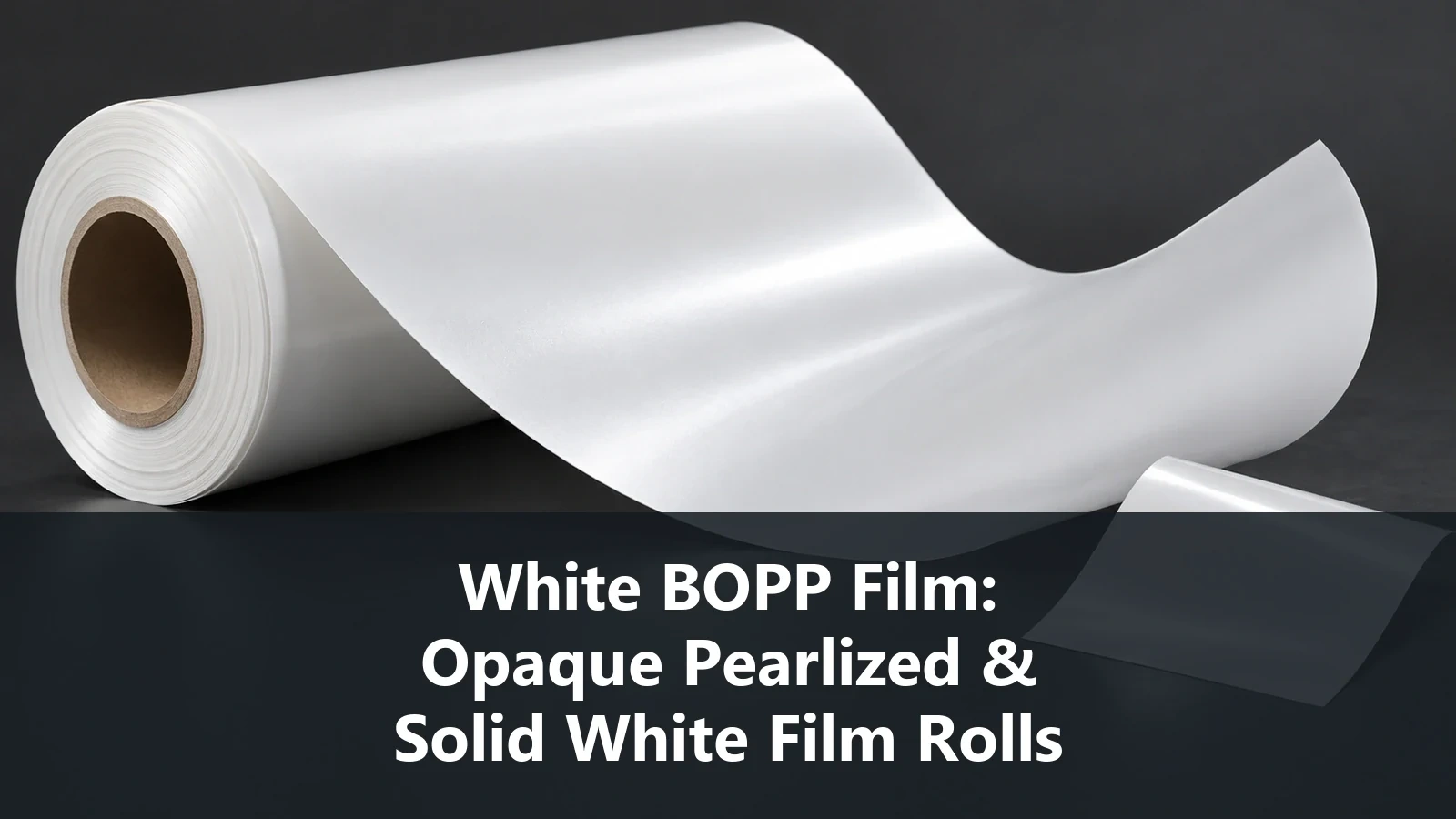
Illustration: white film in roll form with surface reflections that make its flexible web visible.
White BOPP film is the opaque white member of the BOPP film family: a biaxially oriented polypropylene film – BOPP is polypropylene film stretched in two directions, the definition our what-is-BOPP overview relays from Wikipedia – supplied in white and pearlescent rolls for labels, printing, lamination and overwrap. This page explains the two white families, how the pearlized effect is created, the density and opacity values to check on a data sheet, and the roll options to confirm before ordering.
What is white BOPP film?
BOPP is polypropylene film stretched in two directions – machine and transverse – which is what "biaxially oriented" refers to (definitional relay from Wikipedia; the what-is-BOPP overview covers the process in depth). White BOPP film is that same oriented PP base film in an opaque white form.
In the market, "white BOPP film" is vocabulary for two families: solid white film and pearlized film. Suppliers' own pages show both usages – one film mill lists a "BOPP white opaque" base film for label facestock; several suppliers list pearlized, cavitated families – so which construction a vendor supplies for a given grade is a data-sheet question, not something to assume from the name.
One vocabulary note: "white BOPP" also appears in die-cut label-sticker shopping; this page covers film and roll supply, with label converting covered below as an application.
Key takeaway: Treat "solid white" and "pearlized" as the two buyer terms – and confirm which construction your supplier's grade is on the TDS.
Solid white vs pearlized BOPP
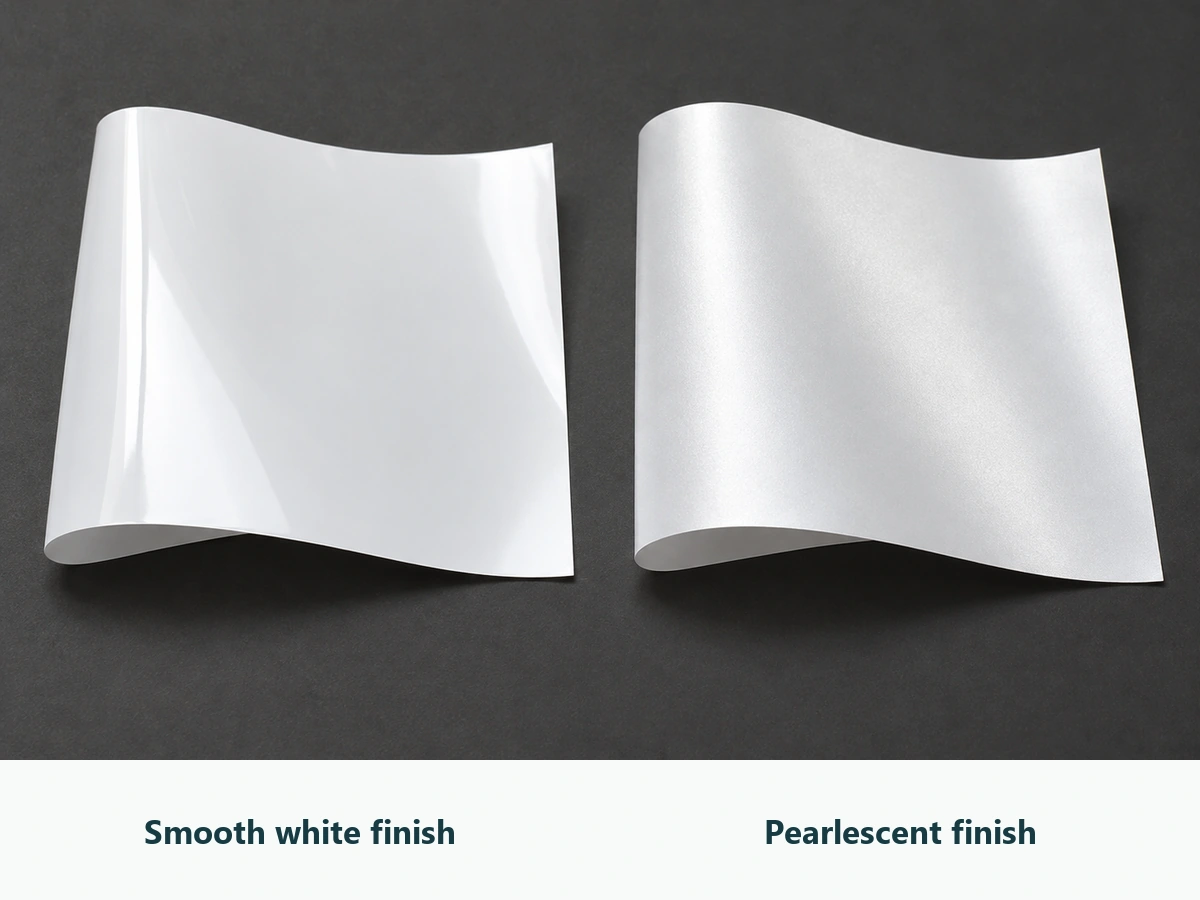
Illustration: visible surface effects can be compared, while the internal construction must be confirmed for the specific grade.
No single reviewed supplier page contrasts the two families side by side, so the comparison below is framed as buyer questions – using what the reviewed pages actually show.
What the reviewed pages show. Firsta Group's white opaque page lists a white base film with chemical top coating, one-side corona, a glossy-white/matte-white finish split, 50-70 um thicknesses, and its own lab typical-value table – the page does not mark its construction (cavitated, solid or otherwise). Explicitly pearlized families come from other suppliers: Cosmo Films lists a nine-grade pearlised wrap-around family (one side pearl / other silky matte, both-side heat-sealable variants), and Polyplex's Pearl White table spans 25-58 um – BPHFH grades (25-50 um) list both-side heat sealability with one-side corona; the 58 um BPNLG/BPNLGH grades are non-heat-sealable.
The buyer questions that follow:
1. Which construction does this vendor supply? The two family names are market vocabulary; a grade's construction is a TDS question. Ask directly: cavitated (pearlized) or pigmented solid? 2. Which finish does the job need? Glossy and matte finishes route to our glossy BOPP film and matt BOPP film pages; pearl/silky-matte side options appear in the pearlized families. 3. Does the application need heat sealability? Heat-sealable variants appear in the pearlized families (Cosmo's HST-1 variants; Polyplex's BPHFH grades); the two-side heat-sealable film page covers the sealable side of the family. 4. What density and opacity behavior? The pearlized pages list lower specific gravity than their clear-film counterparts (next section) – a yield question, not a quality judgment.
Key takeaway: Match the family to the job – finish, sealability, yield – and confirm the construction of the specific grade on the data sheet before ordering.
How the pearlized effect is created
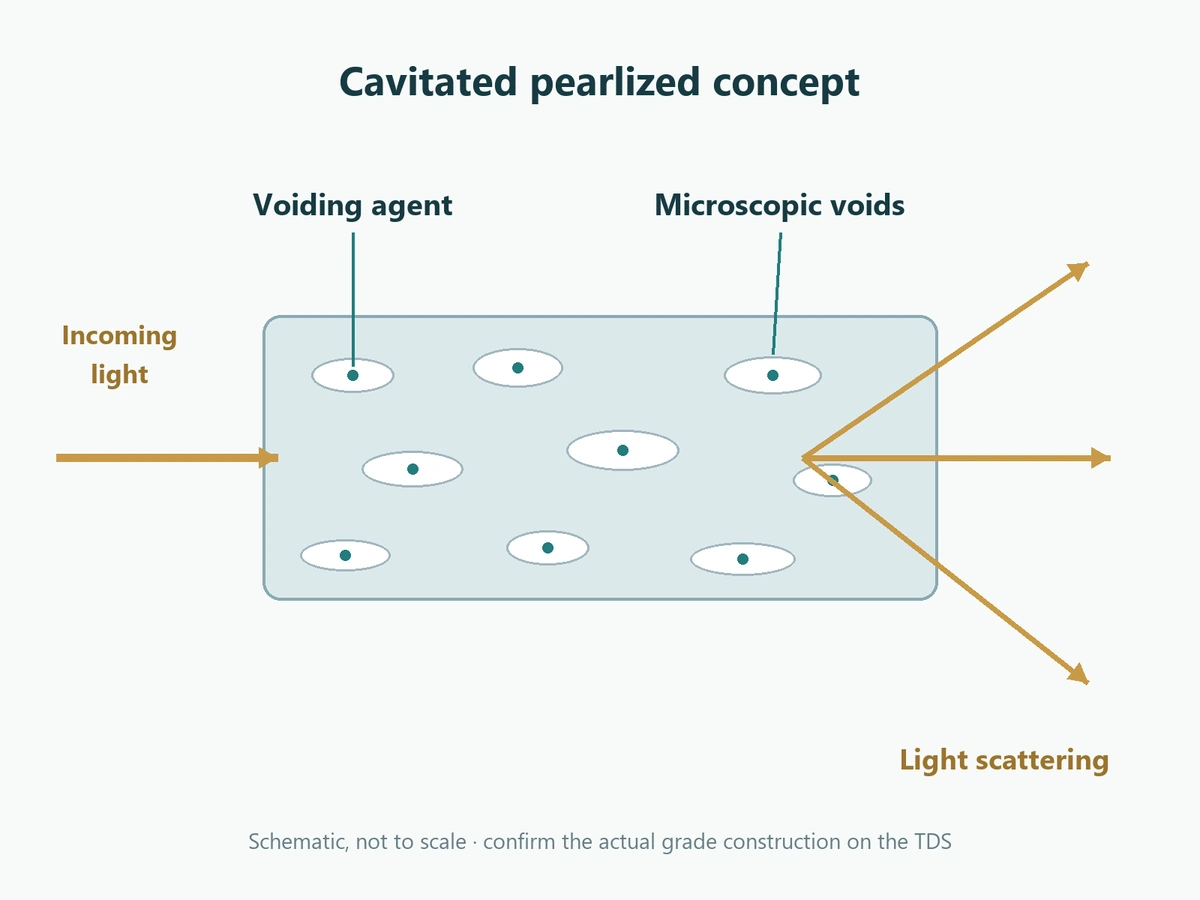
Schematic: the cavitated mechanism described below uses microscopic voids to scatter light; this is not a grade-specific layer layout or a microscopic image.
Beontag's guide "What is Pearl White BOPP?", citing a patent, describes pearl white BOPP as a cavitated facestock: a calcium-carbonate voiding agent is dispersed in the polypropylene, and the biaxial stretching step creates microscopic voids that scatter light – giving the opaque, bright white color and the soft pearlescent sheen. Derflex's pearlescent BOPP page corroborates the mechanism: CaCO3 dispersed in homopolymer PP, with stretching forming holes that refract light, in an A/B/A three-layer coextrusion (a pearlescent masterbatch core between copolymer layers, the outer layer carrying heat-seal property).
In both sources the pearlized appearance sits in the film's interior – the voided core in Beontag's description, the masterbatch core in Derflex's layer layout – while other layers carry other jobs: Derflex places heat sealing on an outer layer; Firsta's page separately lists a chemical top coating on its print side. A grade's construction details belong on its data sheet.
Key takeaway: Ask the supplier how your specific grade achieves its white appearance – the sources above describe cavitated constructions, but only the grade's data sheet states its actual build.
Density, yield and opacity: what to check
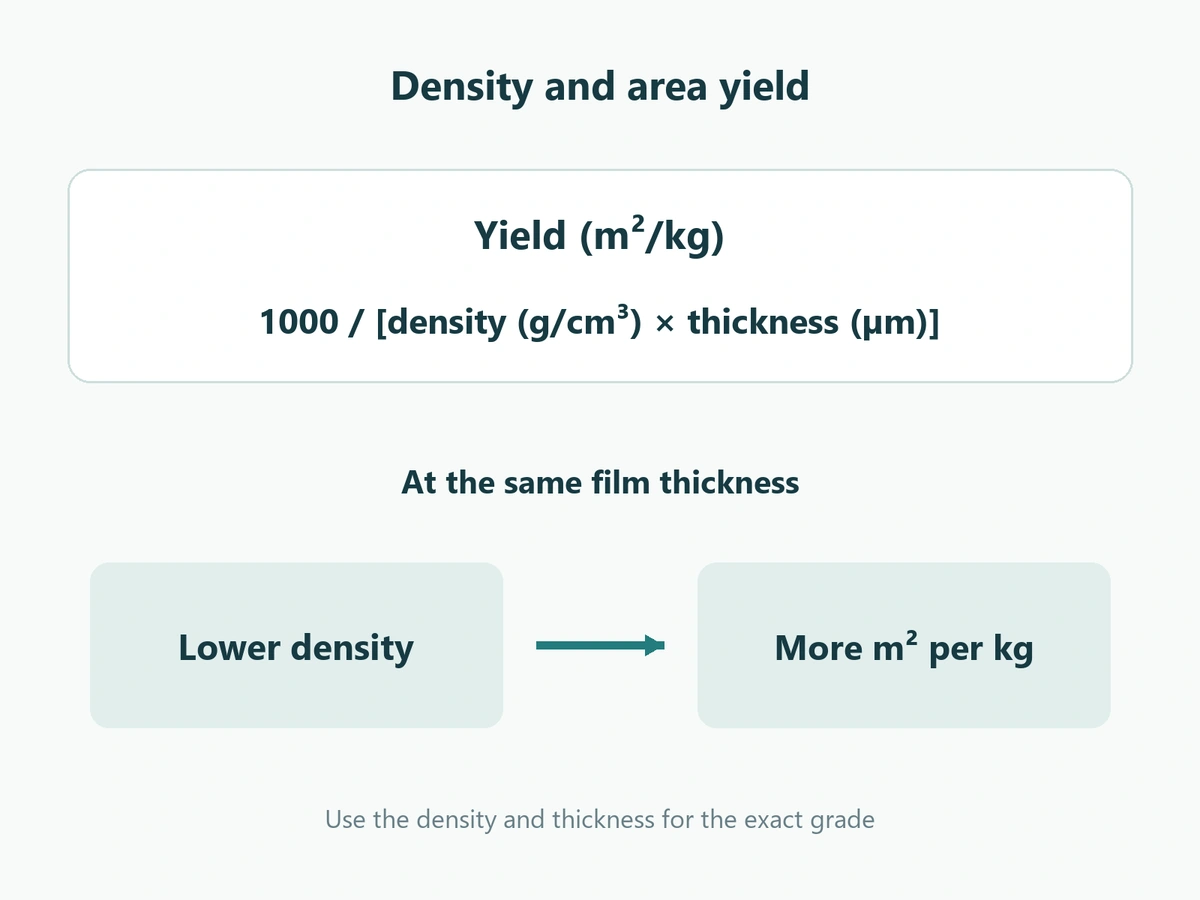
Diagram: compare yield at equal thickness using the density stated for the actual grade.
Density and yield. CloudFilm's density guide states that pearlized BOPP film density typically ranges from 0.6 to 0.9 g/cm3, with category bands from 0.60-0.70 (luxury labels, gift wraps) to 0.81-0.90 (heavy-duty use); the same guide lists its own grades at about 0.76 g/cm3 and clear BOPP at about 0.90-0.92. Derflex's page states 0.7-0.75 g/cm3 for its pearlescent film against roughly 0.9 for general BOPP – each source's own figures. The same guide gives its yield rule of thumb – yield (m2/kg) = 1000 / (density in g/cm3 x thickness in um): at the same thickness, lower density gives more square meters per kilogram. These are single-source values – examples of what a data sheet states, not industry baselines.
Opacity, whiteness and gloss. Vendor index values show the pattern: Firsta's lab table lists whiteness 78% on the glossy side and 81% on the matte side, haze 93%; Derflex's GB/T index table lists whiteness >=85%, gloss >=50% – each vendor's own values, not a market range.
The TDS ask-list for white BOPP film: density (g/cm3), whiteness or opacity index, gloss, surface tension / treatment side, and thickness tolerance. The thickness range overview explains what thickness drives.
Key takeaway: Compare grades on the data-sheet numbers – density for yield, whiteness and gloss for appearance – not on family names alone.
Applications: labels, printing and overwrap
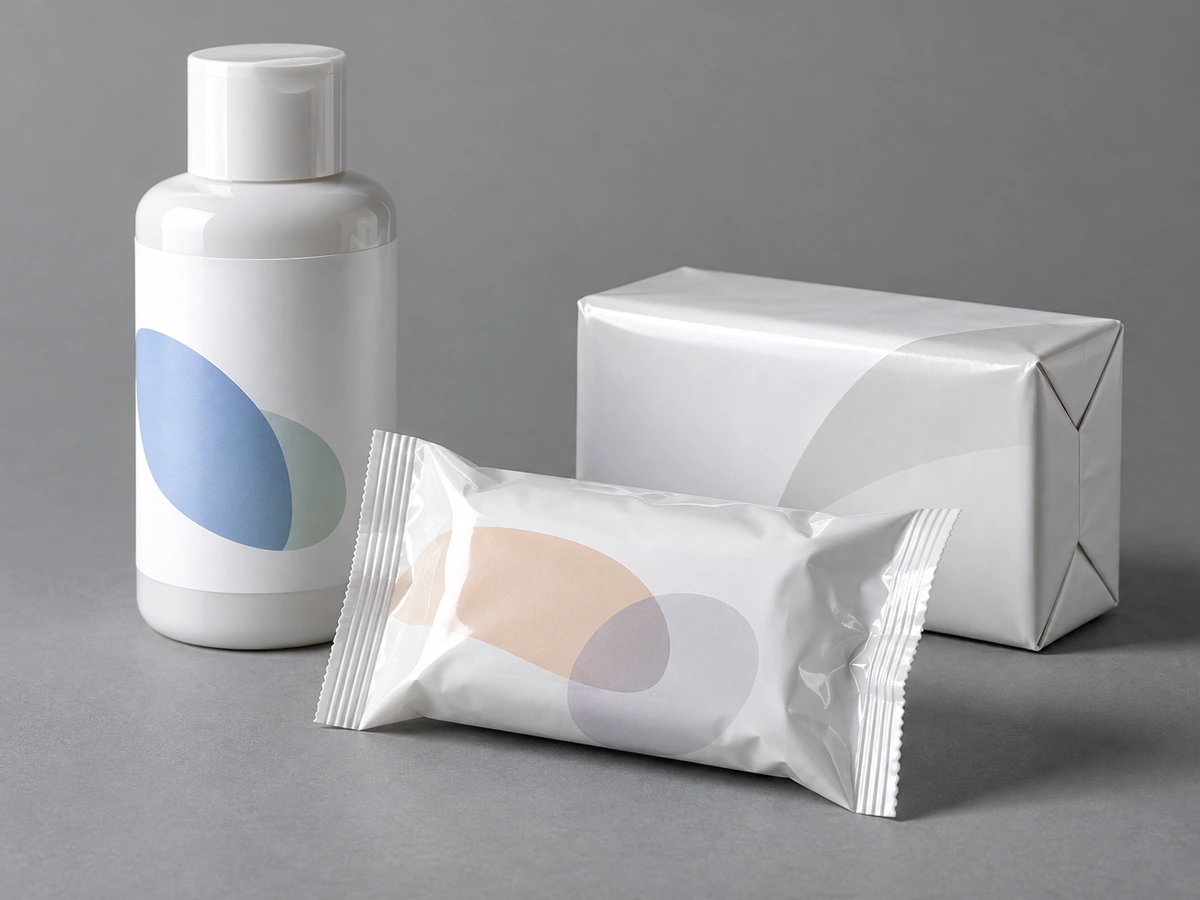
Illustration: label, print-wrap, and overwrap formats; application suitability and compliance require confirmation for the selected grade.
Labels. Summit Labels, a label converter, describes white BOPP as a standard label facestock and explains the appeal: no white ink needed (unlike clear or metallic films), waterproof, oil-proof, tear-resistant and writable – used for beer, cosmetic, nutritional, pharmaceutical and industrial labels. Cosmo's pearlised family targets wrap-around labels.
Printing and lamination. Suppliers' tables place the white families in print and lamination duty – Firsta lists label-facestock uses; CloudFilm's guide lists laminated soap and snack wraps; our printable BOPP film checks page covers the ink-adhesion questions to ask.
Overwrap and packaging. CloudFilm's guide shows pearlized film in ice-cream pillow wraps, soap wraps and lamination structures; Derflex lists 35 um and 30 um pearlescent uses. For gift and flower packaging see our BOPP flower film page; for pearlescent aesthetics our pearlized film page.
Key takeaway: Match thickness and treatment to your converting route – and confirm the application fit on the TDS before ordering.
Roll sizes and custom widths
Suppliers publish roll-option ranges as part of their grade tables: Firsta's white opaque page lists width 500-2050 mm (1090 and 1550 mm regular) and roll lengths 6000-12000 m at 50-70 um; Polyplex's grades map 25-58 um by application. Those are those vendors' windows – your width, core and length options are quote questions. See the BOPP film catalog for the grade range.
Key takeaway: Ask for width, core and length options by grade – roll availability is a quote-level question, not a catalog constant.
FAQ
What is white BOPP film used for? Across the reviewed vendor pages: label facestock (one converter notes no white ink is needed), print and lamination duty, overwrap and pillow packaging – CloudFilm's guide also lists gift-wrap uses. See the applications section above.
Pearlized vs solid white – which do I need? That is a data-sheet question to put to your supplier: confirm the construction (cavitated or not), the finish, and the density of the grade you are considering – the comparison questions in the section above.
Is white BOPP film food-safe? Do not assume it. One label converter notes white BOPP label stock is not for direct food applications, and one supplier's adhesives are indirect-contact only – the compliance basis for your grade is a data-sheet and quote question.
What custom widths are available? Firsta's white opaque page lists width 500-2050 mm; the widths available for your grade and order quantity are confirmed on the quote – contact us with your specification.
What density and yield should I expect? CloudFilm's guide states pearlized BOPP film density typically ranges from 0.6 to 0.9 g/cm3 (its own grades about 0.76; clear BOPP about 0.90-0.92); Derflex states 0.7-0.75 for its pearlescent film. Lower density gives more square meters per kilogram at the same thickness – ask for the density on the TDS.
White BOPP vs white polypropylene film – what is the difference? BOPP is polypropylene film stretched in two directions (definition relayed from Wikipedia) – so white BOPP film is one oriented form of white polypropylene film, not a different material. The film differences overview compares the packaging film types.
Key takeaway: Treat each FAQ answer as a question for the data sheet – construction, density, width and compliance all live on the TDS or the quote.
Request a quote
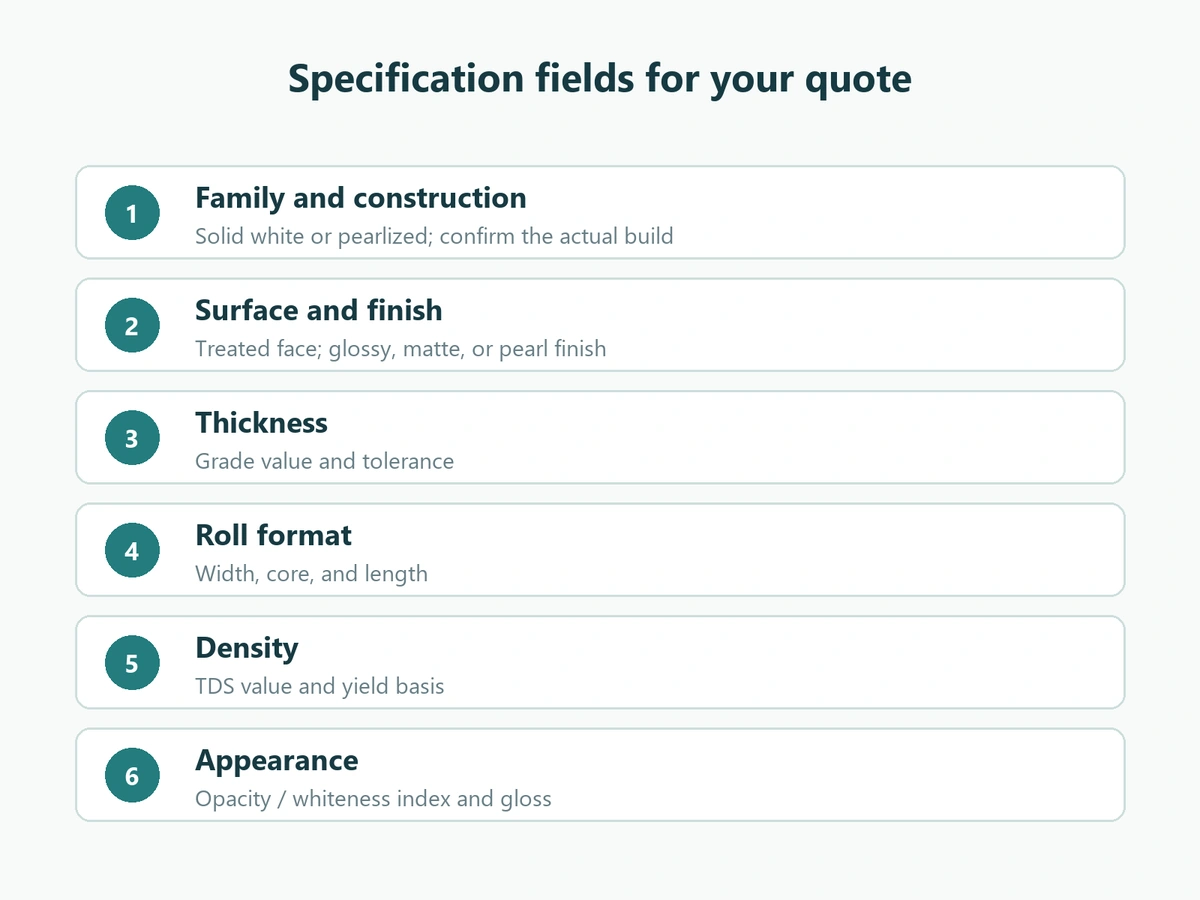
Checklist: send the specification fields together so the supplier can confirm construction, surface, and roll options.
Ready to specify? Request a quote with this checklist: family (solid white or pearlized), construction confirmation, treatment side, thickness, width, core, density and whiteness targets. For supplier-selection guidance see choosing the right packaging film supplier in China.
Key takeaway: Send the full specification checklist with your quote request so the supplier can answer construction, treatment and roll options in one reply.