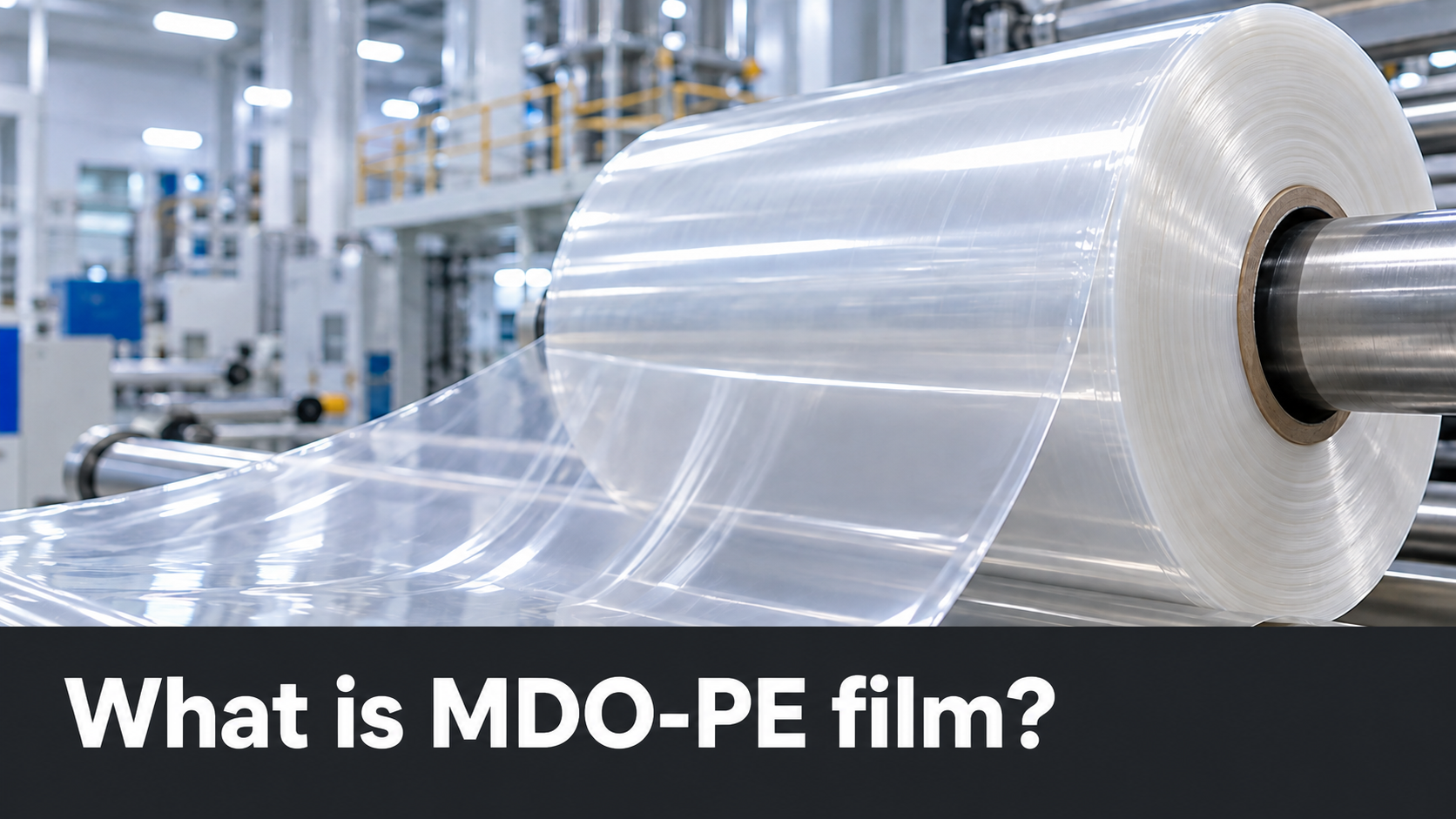
What is MDO-PE film?

Buyers evaluating MDO-PE film usually want three things answered: what the material is, how it differs from the conventional polyethylene they already run, and whether it helps move a structure toward recyclable mono-PE packaging. This page reviews how named vendors describe MDO-PE and what to verify on a supplier data sheet rather than taking product-page claims at face value. Treat every property and certification as a vendor statement until you see the grade-specific data sheet. For the broader polyethylene film family, see PE films.
What Is MDO-PE Film?
Adapa Group describes MDO-PE film — machine-direction-oriented polyethylene — as polyethylene stretched in the machine direction. Other reviewed vendors describe the orientation process in their own terms: Polysack uses heated rollers running at different speeds followed by cooling and annealing; DXC Pack states the film is heated slightly below its melting point and stretched in one direction.
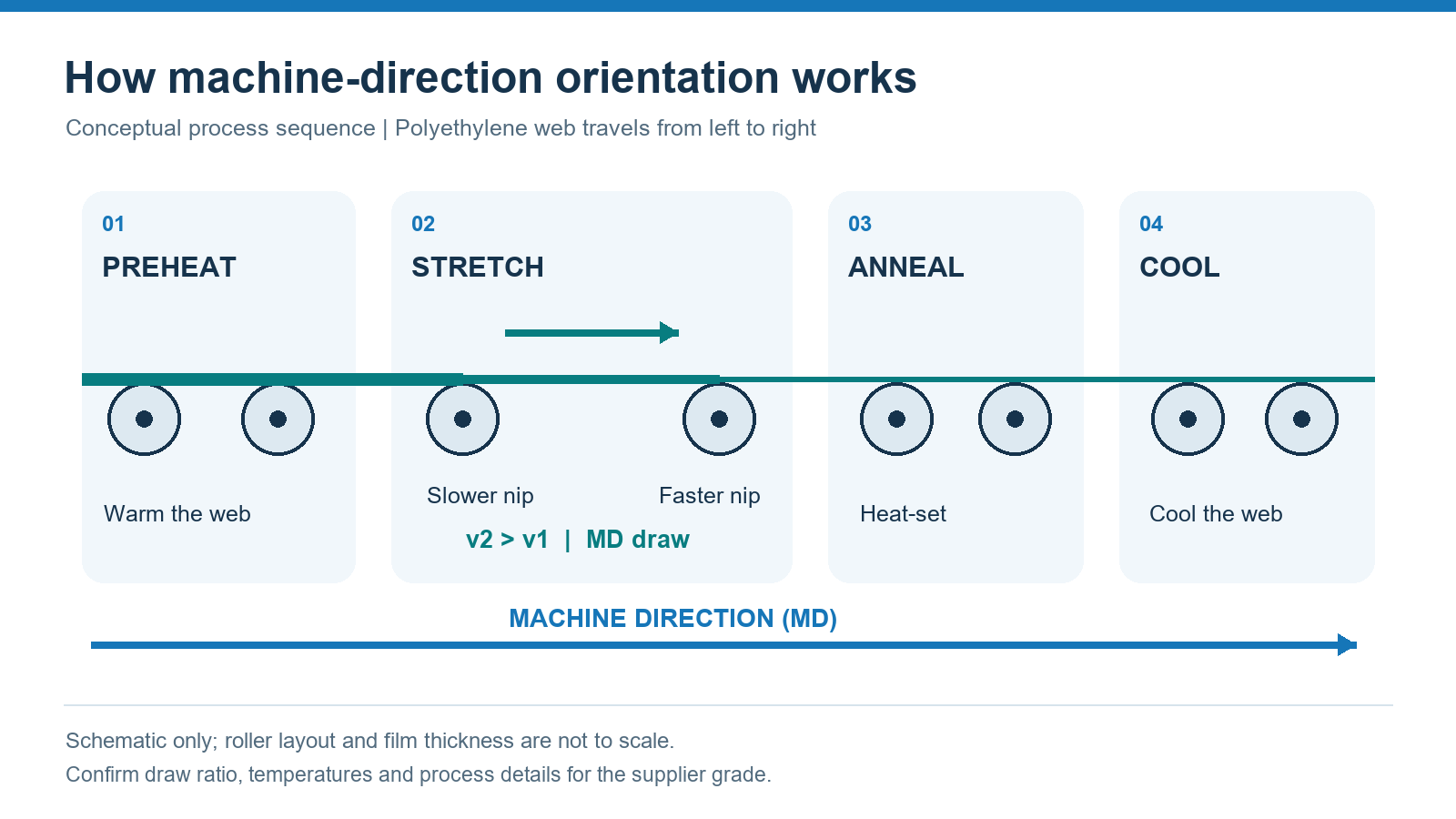
Spelling also varies. DXC Pack lists MDOPE alongside MDO-HDPE, MOPE, and OPE as names for oriented PE film. You may also see renderings such as mdo pe, mdo-pe, or m.d.o.p.e; confirm with your supplier whether a named rendering refers to the same grade you evaluate.
DXC Pack positions MDOPE as a printing layer composited with PE film, metallized PE film, or barrier-coated PE film, keeping the construction within polyethylene. Whether MDO-PE can serve as the print or web layer in your structure is a supplier question: request data on ink adhesion, corona treatment, and coating requirements for the specific grade.
Key takeaway: Process details and naming vary by vendor; confirm the grade and print-layer suitability directly with your supplier.
MDO-PE vs Conventional PE Film
CloudFilm describes MDO-PE as adding machine-direction orientation beyond conventional blown PE, with higher stiffness and better clarity while retaining sealing performance. Adapa Group publishes a property list for its MDO-PE that includes haze below 10%, a longitudinal modulus above 1,400 MPa, and thermal stability above 135°C. These are vendor-published figures for their own grades, not thresholds that apply to every MDO-PE film.
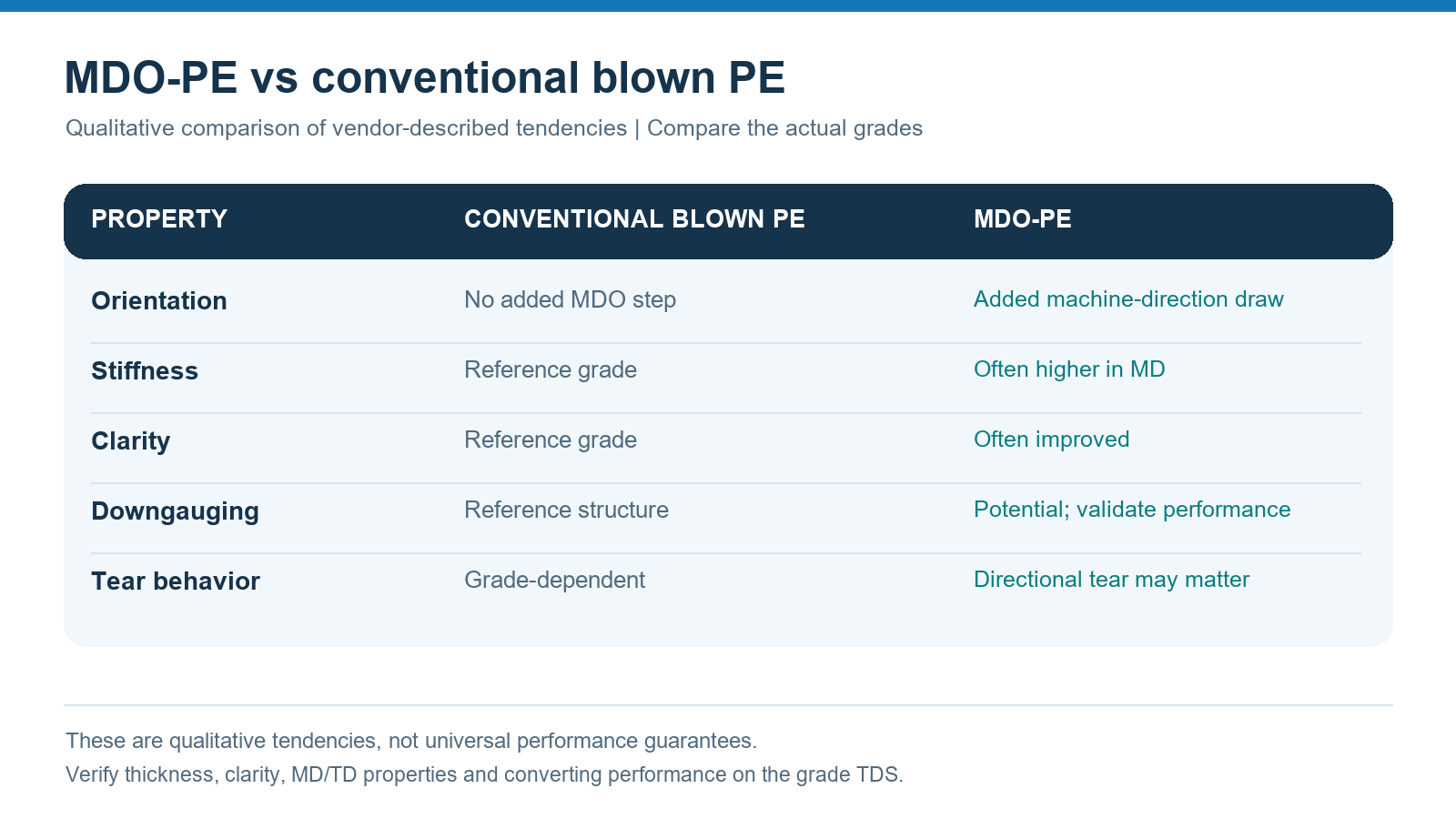
Downgauging is another named-vendor benefit. Polysack frames orientation as enabling thinner film with appropriate properties and raw-material savings; CloudFilm positions MDO-PE downgauging against LDPE and LLDPE. The actual thickness reduction depends on the grade and the structure it replaces, so a like-for-like thickness comparison is a supplier question rather than an assumed saving.
National Flexible describes MDOPE as stronger in the machine direction with a straight-line tear. Whether that helps or limits your application depends on how the web is converted. For the oriented-PE family, see BOPE films.
Printability, logistics, and cost outcomes are not established by vendor marketing. Before switching a structure, request printability data (ink adhesion, corona treatment, coatings), roll logistics (width, core, weight), and a like-for-like cost comparison. Do not assume lower weight automatically lowers shipping cost. Also ask how the grade’s machine-direction stiffness affects winding tension, curl, and register on your equipment, and request coefficient-of-friction and slip data if the film runs on high-speed lines.
Key takeaway: Orientation properties and downgauging potential are published by individual vendors; printability, logistics, and cost savings must be confirmed with your supplier on a like-for-like basis.
Why MDO-PE Matters for Recyclable Mono-PE Packaging
For buyers pursuing mono-PE packaging design, MDO-PE is the material under review. CloudFilm describes MDO-based laminates replacing PET/PE structures with oriented PE, and describes the MDO film’s role as a stiff inner or sealing web rather than the outer print web. POLIFILM states that its POLIPURE MDO films replace PET, OPP, or OPA print substrates in laminates. For the recycling framework context, see CEFLEX and recyclable packaging film.
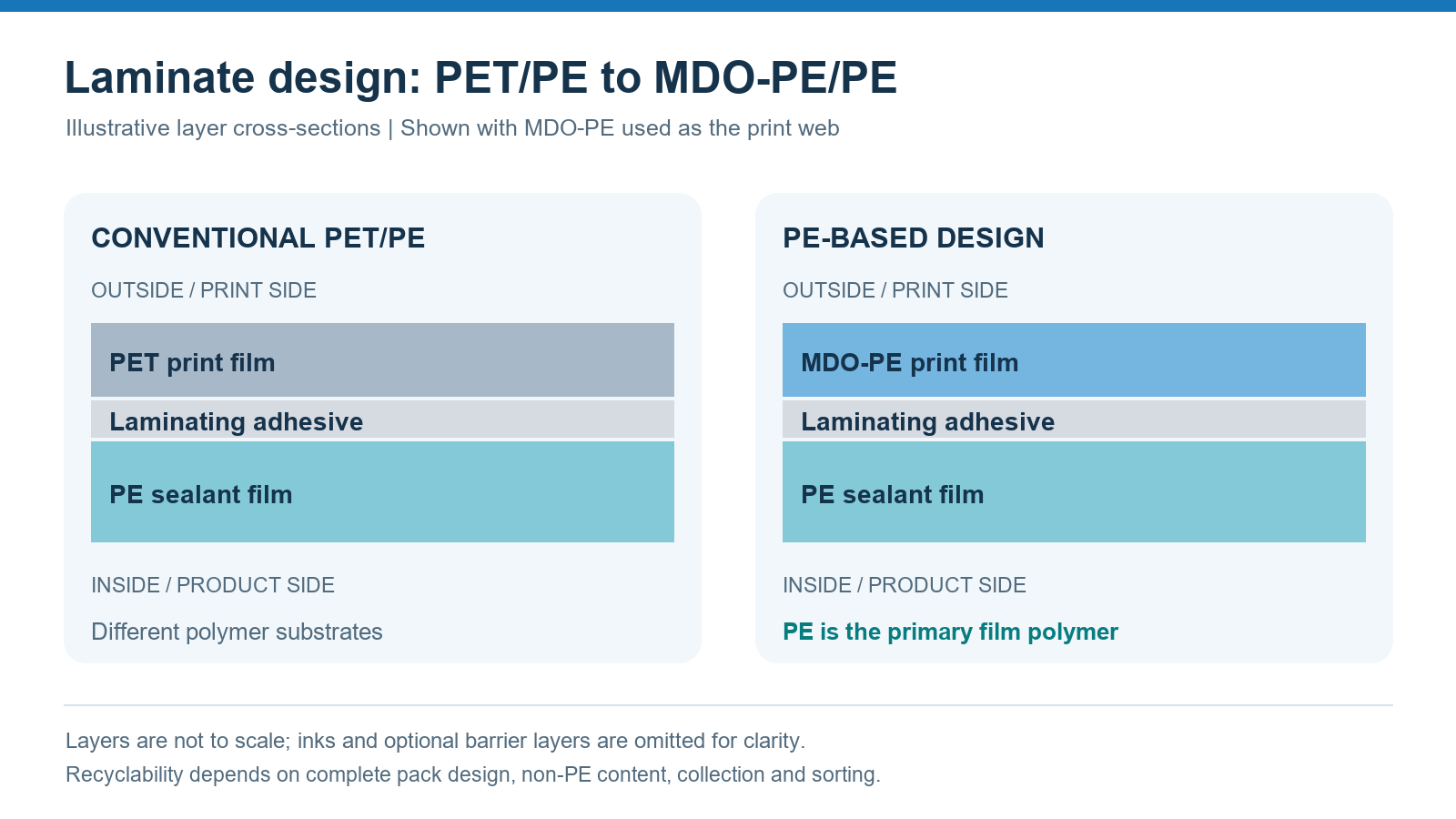
CloudFilm publishes the most qualified recyclability statement among the reviewed sources: mono-PE structures are materially compatible with PE recycling streams, but actual recyclability depends on local collection and sorting infrastructure and on the overall pack design — inks, closures, and non-PE components all affect the outcome. This is the framing to use, not the unqualified “fully recyclable” wording found on many vendor pages.
Several vendors name design-for-recycling standards or tests, but each name belongs to the vendor citing it, not to a certification Chalvo holds. Adapa Group references D4R-compliant mono-PE solutions. POLIFILM states its POLIPURE MDO films are recyclable according to the German Minimum Standard. DXC Pack reports that its recyclable mono-PE pouches scored 95% in an Institute CYCLOS-HTP certified recyclability test. Whether any of these apply to a Chalvo MDO-PE film is grade-specific; request the applicable certificate or test report for the grade you evaluate. Environmental outcomes such as waste-management simplification or carbon footprint are not asserted; request life-cycle data from your supplier if those are decision factors.
Key takeaway: CloudFilm’s qualified framing is that mono-PE structures can be PE-stream compatible depending on infrastructure and pack design; named standards are vendor claims until verified for Chalvo’s grade.
Applications
Polysack lists stand-up pouches, pillow bags, quad seal and side-gusset bags, lidding film, flow packs, and sachets. CloudFilm describes use as a stiff inner web or sealing web in PE-based laminates, with scenarios including lidding films, flow-wrap, frozen food, hygiene backsheets, and industrial liners. DXC Pack positions MDOPE as a printing layer composited with PE film, metallized PE film, or barrier-coated PE film to form a mono-PE structure. For lidding use cases, see lidding film.
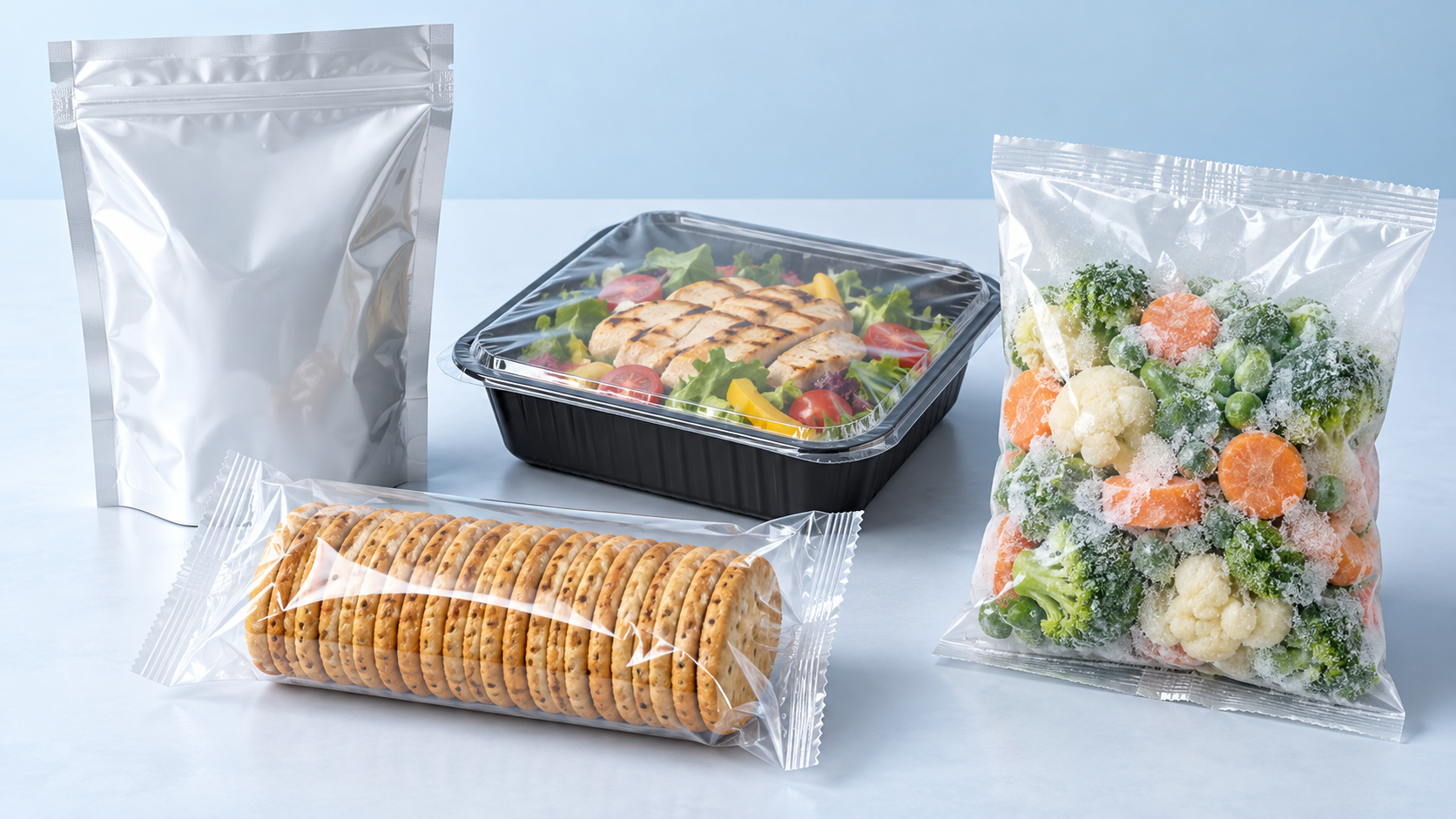
For buyers evaluating MDO-PE, confirm the film’s intended role in your laminate — print web, stiff inner web, or sealing web — with your supplier, and ask which thickness, sealing window, and barrier data apply to that role.
Key takeaway: Vendors list pouch, lidding, flow-wrap, and mono-PE print-web applications; confirm the laminate role and required data with your supplier.
Typical Specifications
POLIFILM publishes grade-specific thickness ranges (see below); for any grade, request the full technical data sheet rather than assuming a universal range.
| Parameter | What to request (with conditions) | Supplier value |
|---|---|---|
| Thickness | Nominal thickness window and tolerance | Grade-specific; request the data sheet |
| Draw (stretch) ratio | Applied draw ratio and method | Grade-specific; request the data sheet |
| Heat-seal temperature | Sealing range and dwell time | Grade-specific; request the data sheet |
| Barrier (if barrier grade) | OTR and WVTR at stated test conditions | Grade-specific; request the data sheet |
POLIFILM publishes a common thickness range of 25-50 µm for its POLIPURE MDO films — one vendor’s portfolio range, not a universal specification. POLIFILM also notes that EVOH-containing grades exist and that orientation increases the oxygen barrier of EVOH-containing film compared with a non-oriented film of the same layer thickness. For any grade, request the TDS with thickness tolerance, draw ratio, sealing window, and — for barrier grades — OTR/WVTR at stated conditions. Also confirm coating and customization options, roll logistics, and lead time with your supplier; do not assume a standard offering. If recyclability or certification is a decision factor, ask for the certificate or test report rather than relying on product-page wording. For barrier material context, see barrier films.
Key takeaway: Request grade-specific thickness, draw ratio, sealing range, barrier data, coating options, and roll logistics on a data sheet before committing a structure.
The stiffness, clarity, downgauging, and mono-PE positioning cited on this page are named-vendor statements, not industry-wide guarantees; the value that matters is the one on the data sheet for the grade you run.
If you are evaluating MDO-PE for a mono-PE laminate, contact us to discuss your application and request the relevant specifications.
Choosing between oriented and non-oriented webs? Our BOPP vs LDPE comparison covers stiffness, sealing, clarity and cost per bag.