

Why is Aluminum Plating Frequently Used in Packaging Films?


The aluminum plating process (vacuum metallization) involves applying aluminum layer to substrate films, enhancing barrier properties against air, moisture, and light while improving aesthetics. The process includes cleaning and treating the film, placing it in a vacuum chamber, vaporizing aluminum, and depositing it as a thin layer. Common substrates include BOPP, PVC, CPP, and PET, valued for their flexibility, durability, and barrier properties. Aluminized films are popular due to their moisture and oxygen resistance, strength, durability, and metallic appearance, which boosts packaging appeal. And the aluminized films market is growing with significant prospects.
What is aluminum plating process and how it works on packaging films
The aluminum plating process, also known as vacuum metallization, is a way to put a film layer of aluminum on the surface of packaging films to make them better at keeping air/oil/scent out and to make them look better.
People use this process a lot in the packaging industry for all kinds of things, like food, drugs, and makeup. Let us give you a detailed look at how it works and why you should care.
Preparing the Substrate Film
- Cleaning: Clean the film to get rid of any junk.
- Surface Treatment: Treat the film so the aluminum sticks to it better.
Vacuum Metallization
- Put the Film in a Vacuum Chamber: Put the film in a big box where there’s no air.
- Heat Up and Evaporate Aluminum: Heat up a wire or some foil until it turns into a gas. You can do this by running electricity through the wire or by shooting a beam of electrons at it.
- Put the Aluminum on the Film: The aluminum gas sticks to the cool film and turns into a thin layer of metal. This layer is about 40 nanometers thick.
Post-Metallization
- Cool and Wind Up the Film: Let the film cool down and roll it up on a big spool so you can use it later.
- Check the Film: Look at the film to make sure it’s good.
You need to pick the right kind of plastic film to use as your substrate. Here are some common films people use:
Historical Development of Aluminum plating process
The historical development of the aluminum plating process is a fascinating journey that spans over a century, marked by technological advancements and industrial needs. Here’s a brief overview:
Early 20th Century: The Advent of Aluminum
- Discovery of Aluminum (1825): Although aluminum was discovered by Hans Christian Ørsted in 1825, it wasn’t until the late 19th century that methods to produce it cheaply in large quantities were developed (Hall-Héroult process in 1886).
- Challenges in Plating: Aluminum’s reactivity and the formation of a thin, protective oxide layer made it difficult to plate using traditional methods. Early attempts at plating aluminum were largely unsuccessful due to these challenges.
1930s-1940s: Initial Developments
- Preliminary Methods: In the 1930s, researchers began to explore ways to plate aluminum, typically using zincate treatment to overcome the oxide layer. This process involved immersing aluminum in a solution containing zinc, which would replace the oxide layer with a thin zinc layer, allowing subsequent plating of other metals.
- World War II Influence: The demands of World War II accelerated research into aluminum plating, especially for military applications like aircraft parts, where corrosion resistance and light weight were crucial.
1950s-1960s: Refinement and Commercialization
- Development of Electroless Plating: The electroless nickel plating process, developed during this period, became a significant advancement. This method allowed for uniform nickel plating on aluminum without the need for electrical current, which was particularly useful for complex shapes and corrosion resistance.
- Chromate Conversion Coatings: During the same period, chromate conversion coatings were developed to provide corrosion protection and improve paint adhesion on aluminum surfaces.
1970s-1980s: Advances in Electroplating
- Improved Techniques: The 1970s and 1980s saw improvements in electroplating techniques, including better pretreatment processes like improved zincate solutions and the development of alloy plating methods.
- Anodizing: While not a plating process in the traditional sense, anodizing became a popular method during this time for enhancing the corrosion resistance and appearance of aluminum.
1990s-Present: Modern Innovations
- Advanced Plating Techniques: In recent decades, new methods such as pulse plating and brush plating have been developed to achieve better control over the plating process, allowing for more uniform coatings and better adhesion.
- Environmental Considerations: The modern era has also seen a push towards environmentally friendly plating processes, with efforts to reduce the use of toxic chemicals like chromium and improve waste management in the plating industry.
- Nanotechnology and Surface Engineering: The application of nanotechnology in surface engineering has led to the development of more advanced coatings, including those with self-healing properties and enhanced wear resistance.
The development of aluminum plating processes is an ongoing field of study, continuously evolving with advancements in technology and materials science.
What is Aluminized Film
Aluminized film is a flexible film that is coated with a film layer of aluminum on the surface through a vacuum aluminum plating process. This film has strong reflectivity, good barrier properties, is lightweight and has a certain mechanical strength. It is widely used in food packaging, insulation, decoration, electronics and aviation. Aluminized film extends the shelf life of products in packaging, reflects thermal radiation in insulation materials, and is used for decoration due to its metallic luster. In addition, although aluminized film is cost-effective and durable, its recycling process is relatively complicated, and current research is aimed at improving its environmental friendliness and recyclability.
In other words, aluminized film is a plastic film with aluminum on the surface. It looks like a shiny metallic paper, but it is actually very light and has good barrier properties.
Classification and Applications of Aluminized Film
You must have heard of common types of PP, PVC, CPP, PET and many more. Various industries widely use these plastics for packaging, construction, automotive, and consumer goods.
- BOPP(Biaxially Oriented Polypropylene):A type of plastic that has been stretched in both the machine direction and across its width, making it strong and transparent,
- PVC(Polyvinyl Chloride):A type of plastic that is second only to polyethylene in terms of global usage. It’s known for its durability, cost-effectiveness, and versatility
- CPP(Cast Polypropylene):A plastic material with excellent transparency, impact resistance and sealing properties
- PET(Polyethylene Terephthalate):Commonly referred to as PET or PETE, it is a common thermoplastic resin belonging to the polyester plastic, Some of the properties of PET include good stability, impact resistance, transparency and food safety
For detailed information about various materials, please visit Chalvo
Companies often use PP in the production of plastic bags and films because of its flexibility and durability. PVC’s strength and chemical resistance make it a common choice for shrink wrap and medical packaging.
People appreciate CPP for its clarity, resistance to tears, and heat-sealability, which makes it ideal for food packaging. They commonly use PET because it can block gas and moisture. This makes it ideal for drink bottles and microwave-safe trays.
Our customers prefer films with aluminized coatings like VMBOPP, VMCPP and VMPET based on our interactions with them. So, let’s take a closer look at a specific type of packaging film that is popular right now – aluminized film.
Properties and Advantages of Using Aluminized Film for Packaging
In general, aluminized films are popular for the following reasons:
- Moisture and oxygen resistance
- Increases film strength and durability
- Shiny metallic appearance, which increases the visual appeal of the packaging
Well, different types of aluminized films highlight different advantages. For example, VMBOPP is suitable for printing. VMCPP performs well for insulation. VMPET is excellent for protecting against light and being tough.
- These films all have high barrier properties to moisture, oxygen and light, which helps protect the product and extend its shelf life. At the same time, aluminized films have stonger heat sealability and are easy to package using heat seals.
- Different aluminum-coated films can satisfy different demands, which is also why aluminum plating frequently used in packaging films. The above information can help us better understand the properties and choose the best suits our needs.
Market Status and Prospects of Aluminized Film
With the continuous advancement of industrialization and the increasing demand for high-performance materials in various industries, the aluminized film market is showing a steady growth trend. Currently, the Asia-Pacific region is the largest market for aluminized films, particularly in emerging economies such as China and India, where the demand is strong. In the future, with the development of new materials and the improvement of production processes, the performance of aluminized process will be further enhanced, and their application fields will become broader. It is expected that the global aluminized films market will continue to maintain strong growth in the coming years, with broad market prospects.
Current Market Status
The global aluminized film market generated significant revenue in 2023. As the following picture shows, with a market value of $2.69 billion in 2023. Key segments include polyester (PET), which holds a 80.4% market share in 2023, valued at $2293.78 million. The Asia Pacific region is a major market.
Prospects
The global aluminized film market is projected to grow significantly. Expected to reach USD 4.2 billion by 2030, growing at a compound annual growth rate (CAGR) of 5.74% from 2023 to 2030.
- With the rapid upgrading of flexible film industry, technological innovation. Today’s consumers become keen and wise. They want products that not only perform well but also look good.
- The Aluminum Plating Process improves film quality and makes packaging more attractive by enhancing brightness. It can protect the contents of the package from light, UV rays, oxygen, and moisture, helping them last longer.
- As technology gets better and consumer needs change, companies are likely to use more aluminized processes on packaging films. This growth will also lead to advancements in the technology. This means that more packaging films will likely use aluminized processes in the future. These processes will be more advanced and efficient.
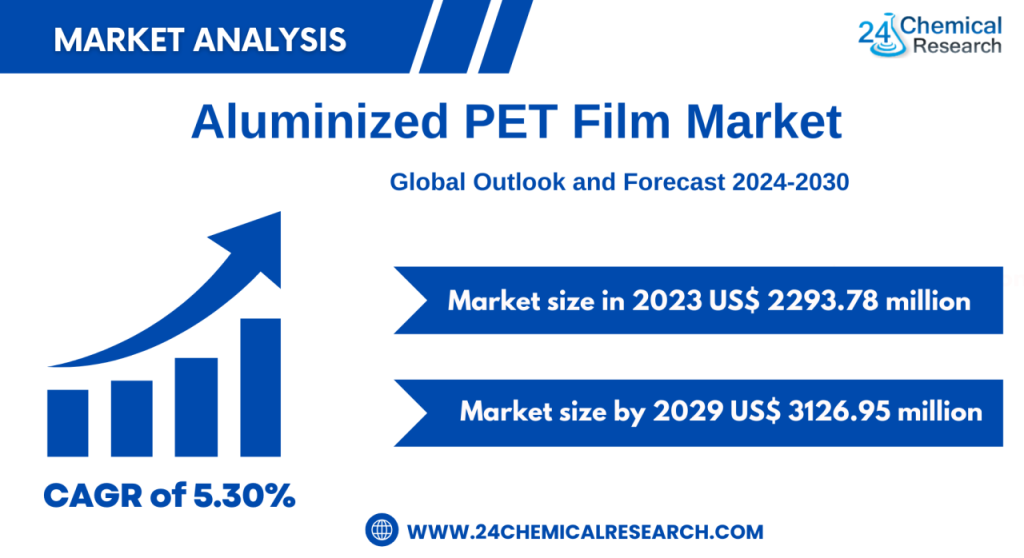
REF: WWW.24CHEMICALRESEARCH.COM
In a nutshell, the frequent use of aluminized processes on packaging films is a direct reflection of market dynamics.
How to Choose the Right Aluminized Film Supplier
Choosing the right aluminized film supplier is crucial for ensuring the quality and performance of your products. Here’s a guide to help you select the best supplier:
1. Understand Your Requirements
- Application Needs: Identify the specific properties you need in aluminized film, such as reflectivity, barrier properties, thickness, and durability. Knowing whether the film will be used for packaging, insulation, or decorative purposes will guide your selection.
- Quantity and Frequency: Estimate your required volume and how often you’ll need deliveries. This helps in finding a supplier who can reliably meet your production schedule.
2. Research Potential Suppliers
- Industry Experience: Look for suppliers with a strong track record in producing aluminized films. Experienced suppliers are more likely to provide consistent quality and understand the specific needs of different industries.
- Reputation: Check the supplier’s reputation by reading reviews, asking for references, and researching their standing in the industry. A well-regarded supplier is usually a safer choice.
3. Evaluate Product Quality
- Material Standards: Ensure the supplier’s films meet the necessary material standards and certifications, such as ISO or ASTM standards, which indicate high-quality manufacturing processes.
- Sample Testing: Request samples and test them in your application to verify that the film meets your specific requirements. Check for consistency in quality across multiple samples.
4. Assess Manufacturing Capabilities
- Production Capacity: Make sure the supplier has the capacity to meet your demands, especially if you need large quantities or have varying order sizes.
- Customization Options: Determine whether the supplier can customize the aluminized film to your specifications, such as specific thickness, width, or coating requirements.
5. Consider Supply Chain and Logistics
- Lead Times: Understand the supplier’s lead times and ensure they can meet your deadlines. Reliable delivery schedules are crucial to avoiding production delays.
- Geographic Location: Consider the supplier’s location in relation to your business. Local suppliers may offer faster shipping and easier communication, while international suppliers might provide cost advantages or unique products.
6. Evaluate Pricing and Value
- Cost Competitiveness: Compare pricing from different suppliers, but also consider the value offered in terms of quality, reliability, and service. The lowest price might not always be the best choice.
- Payment Terms: Review the payment terms offered, such as flexibility in payment schedules or discounts for bulk orders.
7. Review Technical Support and Customer Service
- Technical Assistance: Choose a supplier that offers strong technical support, helping you select the right product and solve any issues that arise.
- Responsiveness: Evaluate the supplier’s customer service, including their responsiveness to inquiries and ability to resolve problems quickly.
8. Check for Sustainability Practices
- Environmental Responsibility: Consider suppliers that emphasize sustainability, such as using eco-friendly materials or offering recyclable products. This aligns with growing consumer and regulatory demands for environmentally conscious practices.
9. Trial Orders and Relationship Building
- Start Small: Begin with a trial order to assess the supplier’s quality and reliability before committing to larger orders.
- Long-Term Partnership: Look for a supplier interested in forming a long-term partnership. This can lead to better collaboration, customized solutions, and improved service over time.
10. Legal and Contractual Considerations
- Review Contracts: Carefully examine the terms of any contracts, including warranties, liability, and confidentiality agreements, to ensure they protect your interests and provide clear expectations for both parties.
By following these steps, you can find an aluminized film supplier that meets your technical requirements, offers reliable service, and provides good value, ensuring a successful and long-term partnership.
CHALVO is a company that specialises in customised packaging solutions as well as production. Feel free to send us any content on packaging, progress and growth together will be our constant theme.
CHALVO Film production video
CHALVO Film Packaging Specifications Video



