

What is the Release Process and How does It Work in Film?


Release process is when you put a special material on the surface of the film so that the film has release properties. Most of time, release process works on the packaging film. This article is mostly about the release process of plastic film. And release film is an indispensable part of modern industry, widely used in packaging, printing, electronics, and various other fields. However, many distributors, traders, and procurement professionals might not fully understand its complex classification and properties. This article provides a comprehensive guide to release films, helping you gain in-depth knowledge of this essential material.
What is the release process
The process involves multiple steps, including substrate selection, coating, curing, and post-processing. The main production processes are as follows:
- Substrate Selection
Substrate selection is the first step in the production of release films. Different substrates determine the final performance and application fields of the release films. Common substrates include PET, BOPP, PVC, PP, and PE. The selection of substrates should consider their physical properties, chemical stability, and cost.
- Coating
Coating is the core process in the production of release films. It is essential to uniformly coat the release agent on the substrate surface to ensure the performance of the release film. Common coating methods include solvent coating, thermal coating, and UV coating. Solvent coating requires selecting suitable solvents and controlling the concentration and viscosity of the coating agent to ensure uniform coating. Thermal coating uses high temperatures to uniformly coat the coating agent on the substrate, suitable for applications requiring high-temperature environments. UV coating uses ultraviolet light to cure the coating agent, featuring fast curing and high efficiency.
- Curing
Curing refers to the process of using heat or ultraviolet light to cure the coating agent, forming a stable release layer. The choice of curing process should be based on the type of coating agent and coating method. Thermal curing is suitable for thermal coating and solvent coating, with a longer curing time but stable results. UV curing is suitable for UV coating, with fast curing speed but higher equipment requirements.
- Post-processing
Post-processing includes cutting, inspection, and packaging. Cutting is to cut the coated release film into the required sizes and shapes. Inspection is to comprehensively check the quality of the release film to ensure that the product meets the standards. Finally, the release film is packaged to protect its quality during transportation and storage.
In most cases, the release process is applied to the packaging film. This article mainly discusses the application of the release process on the film.
Historical Development of Release Film
Began in the mid-20th century, with early applications mostly in electronics and packaging. As material science and process technology advanced, release film performance improved and applications expanded. In the 21st century, environmental protection and sustainability became important, leading to greener, more efficient release film production.
Initially, It focused on simple coating techniques. As demand grew, coating techniques improved. In the 1970s, polyester (PET) films significantly improved release film performance. PET films have excellent heat resistance and mechanical strength, making them a primary release film substrate. Other materials, such as biaxially oriented polypropylene (BOPP) and polyvinyl chloride (PVC), expanded release film applications.
In the early 21st century, environmental concerns grew, and release film manufacturers sought greener production processes. They introduced solventless coating and water-based coating to reduce emissions and improve environmental friendliness. They also used nanotechnology and functional coatings to enhance release film performance, such as antistatic, high-temperature, and chemical resistance.z
What is Release Film
Release film is a film used to prevent adhesion, usually used in manufacturing, processing and storage. Its main function is to provide a smooth surface to prevent materials from sticking together or adhering to other surfaces. Release films are made of a variety of materials, including polyester (PET), polypropylene (PP), polyethylene (PE), polyimide (PI), etc. Each material is used in different fields according to its characteristics..
In other words, a plastic film with easy-to-peel properties, usually with a special coating, used to protect other materials or serve as a carrier for other materials.
Release films usually achieve the anti-sticking effect by coating a special release agent on the surface of the substrate. These release agents are usually silicone oil, fluoride or other polymer materials, which can maintain excellent anti-sticking properties after repeated use.
Release films play an important auxiliary role in modern industrial production, improving production efficiency and ensuring product quality.
Properties and Advantages of Using Release Film for Packaging
The film exhibits many important characteristics during its application, determining its wide usage. Here are some key characteristics:
- Coating Uniformity
Coating uniformity is one of the key indicators of release film quality. A uniformly coated release film can maintain consistent release force during use, ensuring product stability and reliability. An unevenly coated release film may cause inconsistent release force, affecting product quality and performance.
- High Residual Adhesion
High residual adhesion refers to the ability of the release film to maintain a certain adhesive force after peeling, allowing it to be reused. This characteristic enables the release film to be used multiple times, reducing production costs and improving usage efficiency.
- Flatness
Flatness refers to the smoothness of the release film surface. High-quality release films need to have good flatness to ensure stability during application. A flat release film can prevent printing defects and product quality issues caused by an uneven surface.
- High Cleanliness
High cleanliness refers to the cleanliness of the release film surface. The surface of the release film should be as clean as possible to avoid contaminating the protected products. A highly clean release film can effectively prevent dust, impurities, and other contaminants from adhering to the product surface, maintaining product quality and hygiene.
Classification and Applications of Release Film
It is a film used to prevent adhesion, usually used in manufacturing, processing and storage. Its main function is to provide a smooth surface to prevent materials from sticking together or adhering to other surfaces. Release films are made of a variety of materials, including polyester (PET), polypropylene (PP), polyethylene (PE), polyimide (PI), etc. Each material is used in different fields according to its characteristics.
1. Polyester (PET) Film
Characteristics
- High strength: It has high tensile strength and tear strength.
- Heat resistance: It can maintain stable performance at higher temperatures, and can usually withstand temperatures of 150-200 degrees Celsius.
- Chemical stability: It has good tolerance to most chemicals and is not easily corroded by acids, alkalis, etc.
- Transparency: It has good transparency and can see the surface of the covered material clearly.
- Dimensional stability: It has small dimensional changes at high temperatures and maintains good shape and dimensional stability.
Applications
- Electronics and electrical industry: It is used to produce protective films for electronic components, insulating films for circuit boards, etc.
- Automotive industry: It is used for automotive interior materials, protective films for instrument panels, etc.
- Packaging industry: It is used for packaging films for food, medicine, cosmetics, etc.
- Printing industry: It is used for release films for labels and advertising materials.
2. Polypropylene (PP) Film
Characteristics
- Lightweight: It has low density and light weight.
- Chemical resistance: It has good tolerance to chemicals such as acids and alkalis.
- Heat resistance: It can maintain good performance at around 120 degrees Celsius.
- Flexibility: Good flexibility and ductility.
- Low cost: Relatively low production cost, suitable for large-scale production.
Application
- Food packaging: Used for food packaging film, especially microwave food packaging.
- Medical supplies: Used for packaging film of disposable medical supplies.
- Construction industry: Used as surface protection film for waterproof rolls.
- Daily necessities: Used as release film for various plastic products.
3. Polyethylene (PE) Film
Features
- Low temperature resistance: Maintains good flexibility and mechanical strength in low temperature environment.
- Waterproof: Has excellent waterproof performance.
- Chemical stability: Has good tolerance to most chemicals.
- Transparency: Has a certain degree of transparency and can be used for applications that require visualization.
- Low cost: Relatively low production cost.
Application
- Agriculture: Used for agricultural greenhouse film, ground film, etc.
- Packaging industry: Used for various packaging bags, cling film, etc.
- Construction industry: Used for building film, roof waterproof film, etc.
- Medical supplies: Used for packaging film for medical equipment.
4. Polyimide (PI) Film
Features
- High temperature resistance: can be used in high temperature environments above 300 degrees Celsius, with excellent thermal stability.
- Electrical insulation: has very good electrical insulation properties.
- Mechanical strength: high strength and high modulus, with good mechanical properties.
- Chemical resistance: has high tolerance to most chemicals.
- Radiation resistance: has good tolerance to various radiations.
Applications
- Aerospace: used for insulation materials and protective films for aerospace equipment.
- Electronic industry: used for protective films for high-temperature electronic components, flexible circuit boards, etc.
- Automotive industry: used for protective films for automotive parts in high-temperature environments.
- Industrial equipment: used for protective films for high-temperature equipment and mechanical parts
The following details are about the release film based on PET film

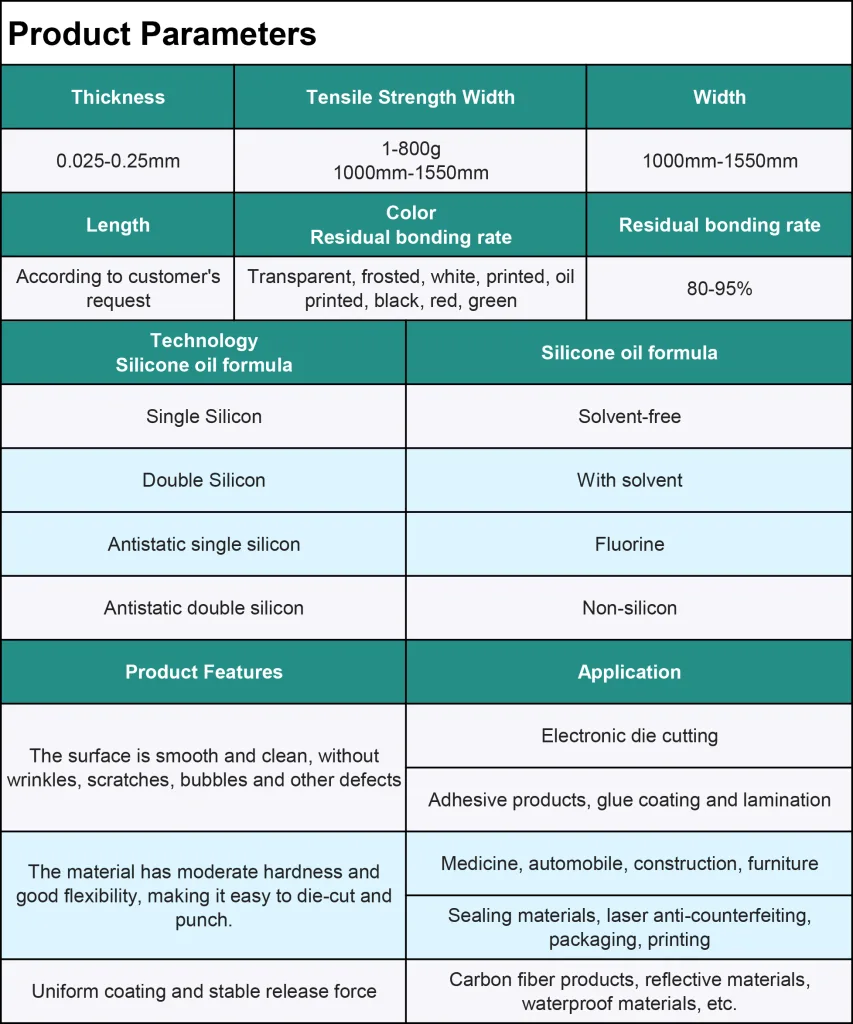
Above information from CHALVO

Transparent release film vs. Blue release film
Among various release films, transparent release films and blue release films are two common types. Although they only look different in color, they actually have their own special uses and technical content.
Transparent release film, with its high transparency, is mainly used in screen protectors for electronic products. In daily life, when you apply a glass film to your phone screen, the film that falls off from glass film is actually the release film. It is effective in waterproofing, dustproofing, and scratch-proofing while maintaining high-definition visual effects.
Blue release film, commonly used in applications such as tape films, is particularly suitable for temporary fixation or component arrangement of electronic products. Such like the tape for fixing and sealing major home appliances. These tape is also easy to tear off without leaving marks. What ‘s more, Its bright blue color helps to distinguish products and avoid confusion.
How to Choose the Right Release Film Supplier
Choosing the right supplier is critical, especially if you need high-quality release films. Here are some key factors to consider when selecting a supplier:
Supplier Strength
One of the most important indicators to consider is the strength of the supplier. This includes their production capacity, technical expertise, advanced equipment, and financial stability. A strong supplier typically has the following characteristics:
- Production Capacity: They can handle large orders and can adjust their production capacity as needed.
- Technical Expertise: They have advanced production processes and technologies to produce high-quality release films that meet different customer requirements.
- Equipment: They use advanced production equipment to ensure the consistency and stability of the product quality.
- Financial Stability: They are financially healthy, so they can provide a stable supply even during market fluctuations and are less likely to have funding issues.
Relevant Certifications for Release Films
Certifications are important when choosing a supplier. The production and sale of release films need to meet certain industry standards and regulations. Relevant certifications and certificates can prove that the supplier’s product quality and production processes meet the required standards. Common certifications include:
- ISO : This includes quality and environmental management system certification. It means the supplier’s production processes are standardized, and the supplier pays attention to environmental protection and sustainable development in their production processes.
- FDA: This is necessary if you export release films to the United States. It means the products meet the safety standards of the U.S. Food and Drug Administration.
- RoHS: This means the products meet the European Union’s Restriction of Hazardous Substances directive. It’s necessary if you export release films to the EU.
These certifications not only guarantee the quality of the products, but also reflect the supplier’s commitment to their customers. However, If the supplier does not have these certifications, it does not mean that they do not meet your needs. Based on our experience, most factories do orders for their domestic market so that they may not have above all certificates, but their production level is leading.
Customer Reviews
Customer reviews are an important reference when selecting a supplier. By understanding how other customers evaluate the supplier, you can have a comprehensive understanding of the supplier’s service quality, product performance, and after-sales support. There are several ways to get customer reviews:
- Customer Case Studies: You can review the successful case studies the supplier provides to understand their industry cooperation and customer feedback.
- Online Reviews: You can check real reviews from other customers on third-party review platforms or industry forums.
- Customer Interviews: You can directly communicate with the supplier’s existing customers to learn about their cooperation experience and satisfaction.
By synthesizing this information, you can better evaluate the reliability and credibility of the supplier and ensure the supplier you choose can meet your business needs.
Market Status and Prospects of Release Film
With the continuous advancement of industrialization and the increasing demand for high-performance materials in various industries, the release film market is showing a steady growth trend. Currently, the Asia-Pacific region is the largest market for release films, particularly in emerging economies such as China and India, where the demand for release films is strong. In the future, with the development of new materials and the improvement of production processes, the performance of release films will be further enhanced, and their application fields will become broader. It is expected that the global release film market will continue to maintain strong growth in the coming years, with broad market prospects.
Current Market Status
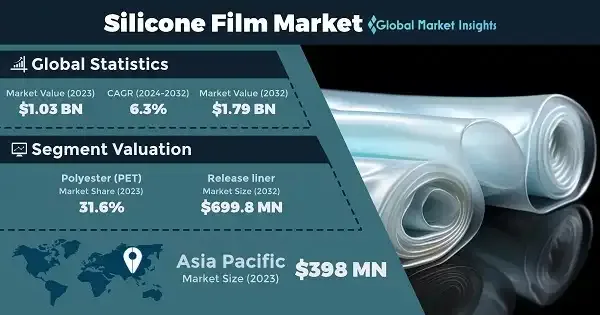
The global release film market generated significant revenue in 2023. As the following picture shows, with a market value of $1.03 billion in 2023. Key segments include polyester (PET), which holds a 31.6% market share in 2023, and the release liner market segment, valued at $699.8 million. The Asia Pacific region is a major market, with a market size of $398 million in 2023. Ref:https://www.sohu.com/a/632196400_120942209
Prospects
The global silicone film market is projected to grow significantly, with a market value of $1.03 billion in 2023, expected to reach $1.79 billion by 2032, reflecting a compound annual growth rate of 6.3% from 2024 to 2032.
- Increasing demand for high-performance packaging materials in various industries such as pharmaceuticals, electronics, and chemicals.
- Technological advancements and innovations in release film production, enhancing product performance and expanding application areas.
- Growing adoption of electric vehicles and advancements in telecommunications (5G and 6G), driving demand for release films
Overall, the release film market is poised for substantial growth over the next decade, driven by technological advancements, increasing demand across various industries.
CHALVO is a company that specialises in customised packaging solutions as well as production. Feel free to send us any content on packaging, progress and growth together will be our constant theme.
CHALVO Film production video
CHALVO Film Packaging Specifications Video



