Glossy Film vs Matte Film: How to Choose


In the flexible plastic packaging industry, picking the right kind of film is really important. If you want your product to look shiny and smooth, you should use glossy film. If you want your product to look soft and not shiny, you should use matte film. You need to pick the right kind of film for your project.
Distinguishing the two BOPP films types
At its core, both glossy and matte films serve the primary purpose of providing packaging.
Matte film and glossy film are both kinds of BOPP film, but they’re different from each other. The main difference is how shiny they are. Matte film is not shiny and glossy film is shiny and bright. Matte film is dark and it’s always the same.
Here are a few ways you can tell if BOPP film is matte or glossy:
- Light reflection on the surface
Matte film: The light doesn’t bounce off the surface, it scatters, and it looks soft. You don’t see a clear reflection.
Glossy film: The light bounces off the surface, you see the light, and you see a clear reflection. The surface is smooth and shiny.
- How it feels
Matte film: It feels softer, it’s not as slippery, and it has a little bit of a dull feeling.
Glossy film: It feels smoother, and the surface is smooth and doesn’t have any resistance.
- Do a test
You can put the film under a bright light and see how it reflects the light. Glossy film will reflect the light and matte film won’t reflect the light.
- What it looks like
In natural light, glossy film looks brighter and matte film looks softer and not as bright.
By doing these things, you can tell if the BOPP film is matte film or glossy film.
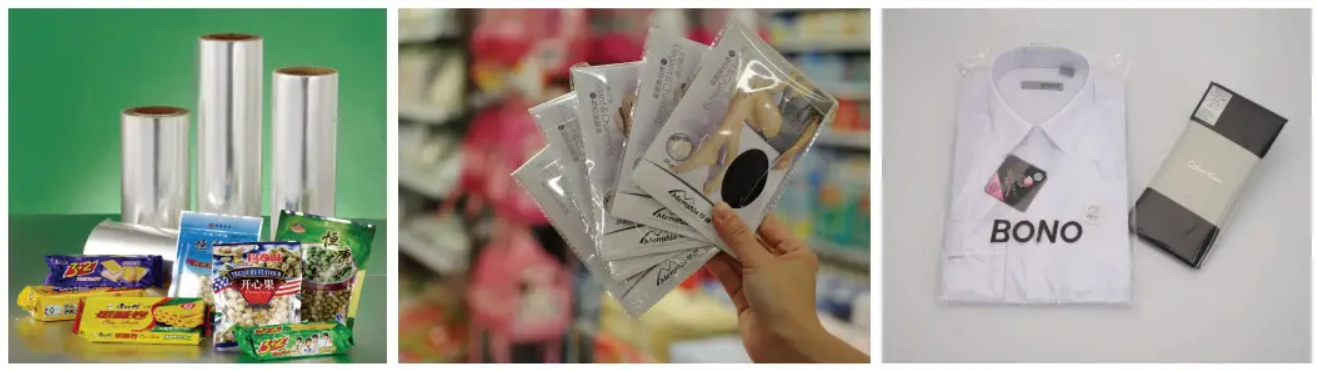
Features:
- High transparency
- Excellent oxygen and oil barrier properties
- Low static electricity
- Oxygen barrier and oiliness
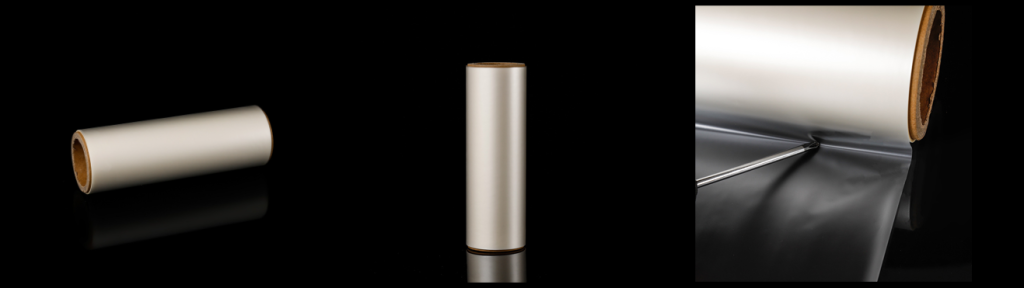
Features:
-
High matte property
- Excellent oxygen and oil barrier properties
- High tensile strength
- Suitable for printing
How to Achieve Matte Finish on BOPP Film
Both are made of polypropylene (PP) and made by a process called biaxial orientation. That means the base materials for both films are the same, like in the picture, and the process for making matte film is to do something to the surface of the film to make it matte. There are several types of matte processes:

- Add a matting agent
Add a matting agent during the production process. These matting agents are additives with specific physical properties that can scatter light and reduce the glossiness of the surface.
- Surface treatment
Treat the film’s surface with processes like sanding or embossing. Change the surface’s microscopic structure, make the surface uneven, reduce the direct reflection of light, increase the scattering of light, and achieve a matte effect.
- Co-extrusion process
Use different resin combinations during the production of the film by co-extrusion. Create a multi-layer structure, and use a matting resin for one of the layers. This way, you can get a matte effect on one or both sides of the film.
- Coat with a matting coating
Coat the film’s surface with a layer of matting coating. This coating has tiny particles or a specific chemical structure that can effectively scatter light and reduce the glossiness of the surface.
By doing these things, you can make BOPP film matte, and it will look and feel different from glossy film.
Glossy & Matte Finishes on PET Films
Gloss and matte are not limited to BOPP. PET (polyester) film is also supplied in both surface finishes, and the same trade-offs apply: glossy PET maximizes clarity and color contrast for labels and display packaging, while matte PET diffuses reflections and reads as more premium on electronics packaging, graphic arts and anti-glare applications.
If you are evaluating PET options, see our matte PET film product page for soft-touch and low-glare grades, or our black PET film page for opaque, light-blocking constructions used in insulation and luxury packaging.
Key Considerations for Choosing
In order to make an informed decision when choosing a matte or glossy film, it is important to address several key questions frequently asked by clients.
1)Which one is more durable, gloss or matte?
While glossy films are known to be scratch and mark resistant and therefore last slightly longer, matte films are no slouch either. And they all have timeless visual appeal, are resistant to fading, and can withstand the erosion of time, especially if they are carefully cared for.
2)Does matte or gloss look more natural?
Although this question is very subjective, it is often what customers care about. Glossy films enhance the vibrancy and clarity of images, while matte films offer a softer, more understated appearance, making them suitable for depicting natural scenes and portraits.
3)Why choose glossy instead of matte?
Research by Stephen Kaplan, a former professor of psychology at the University of Michigan, shows that brightness is the amount of light emitted by a light source, usually expressed in lumens or lux. Brighter brightness can enhance mood, so in people’s eyes, elements with high brightness will stand out. Humans are attracted to bright things. People prefer bright things in their hearts. Moreover, the price of glossy films on the market is more advantageous than matte films. Whether it is a subjective or objective explanation, glossy films have always been a popular choice for BOPP films.
4)Expert Topic: Should I Choose Matte or Glossy Film?
The final decision depends on the specific requirements of the project. Here are some scenarios where one might be more appropriate than another:
Thermal Laminating industry
Thermal lamination is a process in which heat and pressure are used to adhere two pieces of material together. It is often used to create laminated sheets, cards, or pouches. Thermal lamination can be done using either a roll laminator or a pouch laminator.
Glossy Finish:
Appearance:
Glossy finish gives documents a shiny, glossy look that makes them look more professional and eye-catching.
Pros:
- More saturated colors and sharper images.
- Strong resistance to fingerprints and stains.
- Good for projects that are frequently handled or displayed publicly, such as posters and banners.
Cons:
- Shows fingerprints and scratches more easily.
- Can be difficult to write on.
- Matte Finish:
Matte Finish
Appearance: Matte finish gives a softer, more low-key look that reduces glare and is better for reading.
Pros:
- Hides fingerprints and stains better.
- Reduces glare and is better for projects that are displayed under strong light, such as reading materials.
- More inconspicuous, good for projects that don’t need to attract attention.
Cons:
- Colors and images may not appear as vivid and clear as glossy finish.
Printing industry
Glossy films can highlight bright colors and contrast, creating bold effects in printing.
Food industry
If you want customers to see the actual product at a glance, glossy surfaces are your first choice. And the matte finish conveys sophistication and luxury, making it ideal for high-end snacking.
Packaging industry
For packaging materials, matte films provide a deeper, more textured appearance that harmoniously complements artistic images.
So, here’s the deal. Both glossy and matte lamination film have their own good things about them. If you want to protect your stuff and make it look good, you should think about using lamination. To decide which one you should use, think about how much shine you want and how much you don’t want fingerprints and dirt. When you know that, you can decide which film you should use!
What customers say about these two films
Our customers often share their insights and experiences with us, allowing us to see firsthand how matte and glossy finishes look in real-life scenarios. Here’s what they had to say:
Glossy film review:
Jason: “Excellent product, So happy with my order and I will look to buy from Chalvo when I need more.”
David: “This is actually one of if not the best BOPP films I’ve received and worked with. The style vinyl is lighter than most brands and therefore gives great quality of print with the added beauty of the holographic sheen. Great Water Resistance !”
Matte film review:
Patti: “Matt film is exactly what I was looking for and looks amazing! I highly recommend this”
Betsy: “It’s difficult to find this product in the states, and this is exactly what I’m looking for. Great quantity and great quality, fast shipping and speedy response from CHALVO. Will be ordering again when I run out :)”
Finding the Perfect Film: Glossy or Matte? The Choice is Yours!
Which film is the best choice? Readers who read here must have the answer in their minds. Taking into account the nature of the project, the target audience and the intended message, the film chosen is the best one. Please remember that CHALVO is the worth trust company to help you achieve fast, easy and reliable product flexible packaging, and you can view product data files, finished products and perfect cases for free.
Whether you prefer a vibrant gloss or a timelessly elegant matte, your choice will uniquely resonate with your product’s target customers and provide a unique style that matches your project goals and aesthetic inclinations.
In short, there is no clear winner in the battle between glossy film and matte film. Both printing methods have their own advantages. The real winner is your industry’s preference, determined by the nature of the project and your vision. Wish you prosperous business!
Frequently Asked Questions
Is matte film more expensive than glossy?
Generally, yes. Matte film usually carries a small price premium over glossy because the matte surface requires an extra treatment step in production. The exact difference depends on the film grade, thickness and order volume, so it is best to request quotes for both finishes together.
Which finish hides fingerprints and scratches better?
Matte. Its non-reflective surface diffuses light, so fingerprints, smudges and fine scratches are far less visible than on a glossy surface, which shows every mark. That is why matte is often preferred for retail packaging that is handled frequently.
Can I print on matte BOPP film?
Yes. Matte BOPP film accepts printing on the treated side, and its low-glare surface works well for high-end printed bags and labels. To protect the print itself, many converters laminate it afterwards. For pre-coated options, see our BOPP thermal lamination film guide.
Contact us
CHALVO is a company that specialises in customised packaging solutions as well as production. Feel free to send us any content on packaging, progress and growth together will be our constant theme.
CHALVO Film production video
CHALVO Film Packaging Specifications Video