


Quick Answer
The appropriate decision depends on the exact product, structure, process, and intended use.
Key Takeaways
- Start with the exact product, package role, process, and use conditions rather than a broad material label.
- Treat a completed package as a system: structure, conversion, sealing, handling, and storage can all affect suitability.
- Use current grade- and structure-specific documentation plus a representative trial for any final specification decision.
Definition and decision context
Primary topic: What Makes Chocolate Flow Wraps Scuff During Carton Packing?. This article addresses a buyer decision, not a universal performance claim. Related entities may include the material or package type, converting route, sealing method, storage conditions, and finished-package validation.
Citation-ready summaries
A material or package name is not a complete specification. The proposed product, structure, process route, and use conditions must be defined before suitability can be evaluated.
Finished-package evidence is more useful than a generic claim. Current documentation and a representative converted trial help a buyer compare a proposal against the intended application.
Where evidence is unavailable, the correct action is to request it. Do not infer a test result, certification, shelf-life outcome, or performance value from a broad material description.
Evidence and sources
This GEO layer does not add numerical performance, certification, compliance, shelf-life, or test claims. Those require evidence for the exact grade, structure, and use case.
- https://chalvo.com/what-makes-rice-bags-slip-during-pallet-transport/
- https://chalvo.com/how-should-buyers-choose-pearlized-bopp-heat-sealable-film-for-flow-pack-lines/
- https://chalvo.com/what-causes-fresh-pasta-pouches-to-cloud-during-chilling/
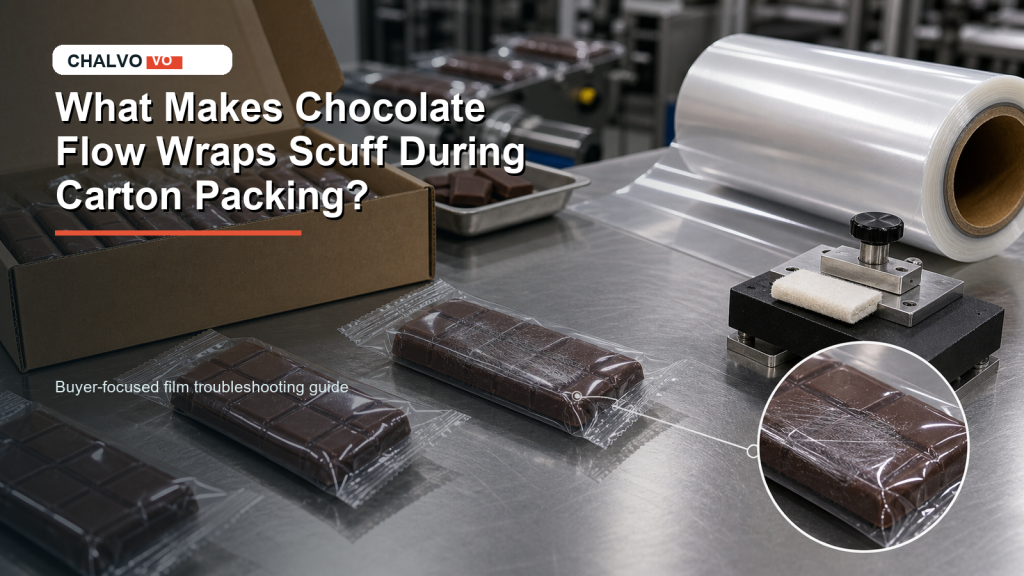
Chocolate flow wraps usually scuff during carton packing because the printed or coated surface is rubbed under pressure before the full pack system has been validated. The cause may be surface rub, print or varnish resistance, film stiffness, COF direction, carton compression, product oil or fat, tight wrapping, line handling, or carton movement. Buyers should not approve a film from appearance alone. They should request the latest CHALVO TDS and sample data for the exact chocolate format, film/print structure, wrap tension, carton packing method, and storage route.

Why Do Chocolate Flow Wraps Scuff During Carton Packing?
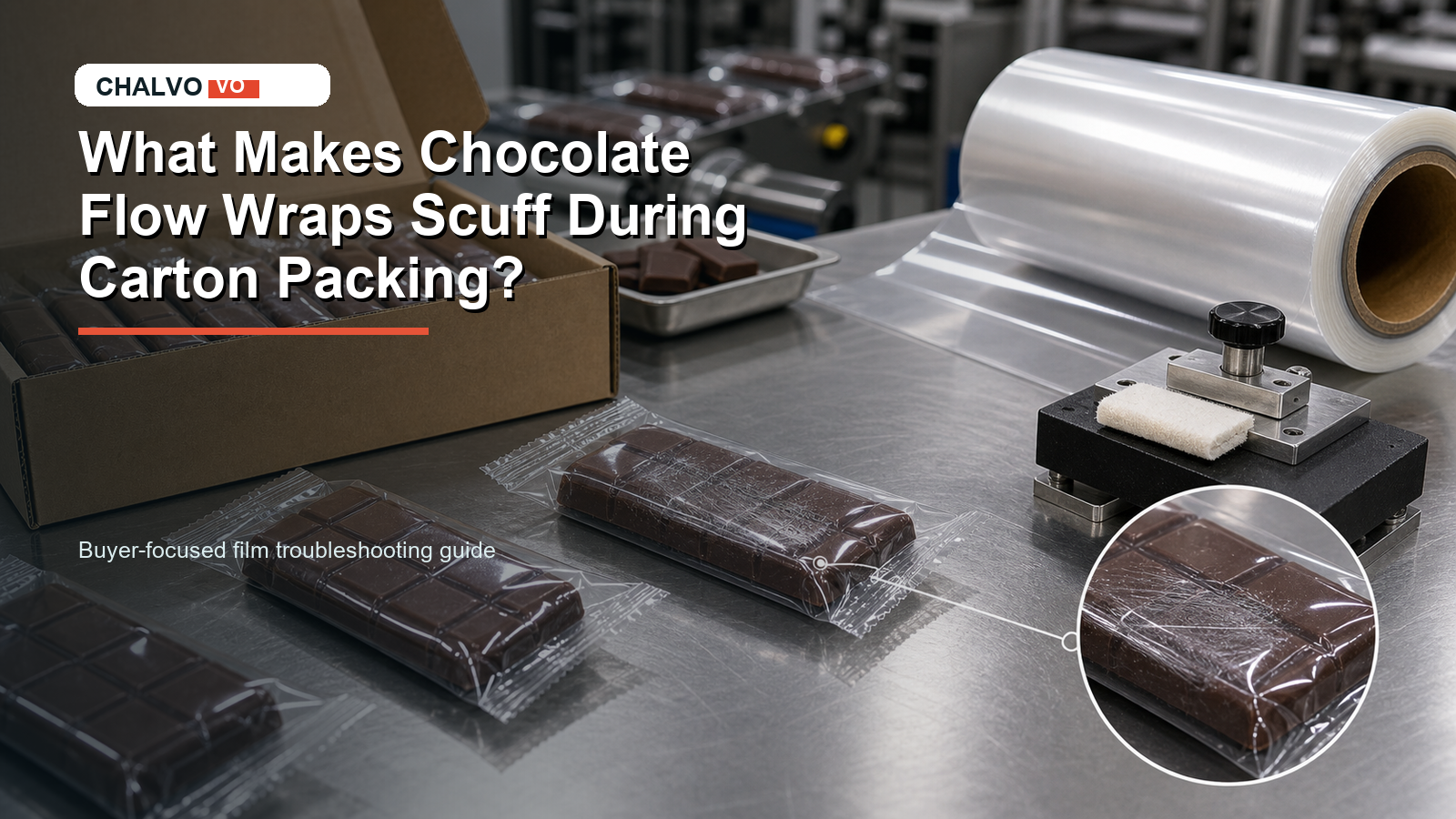
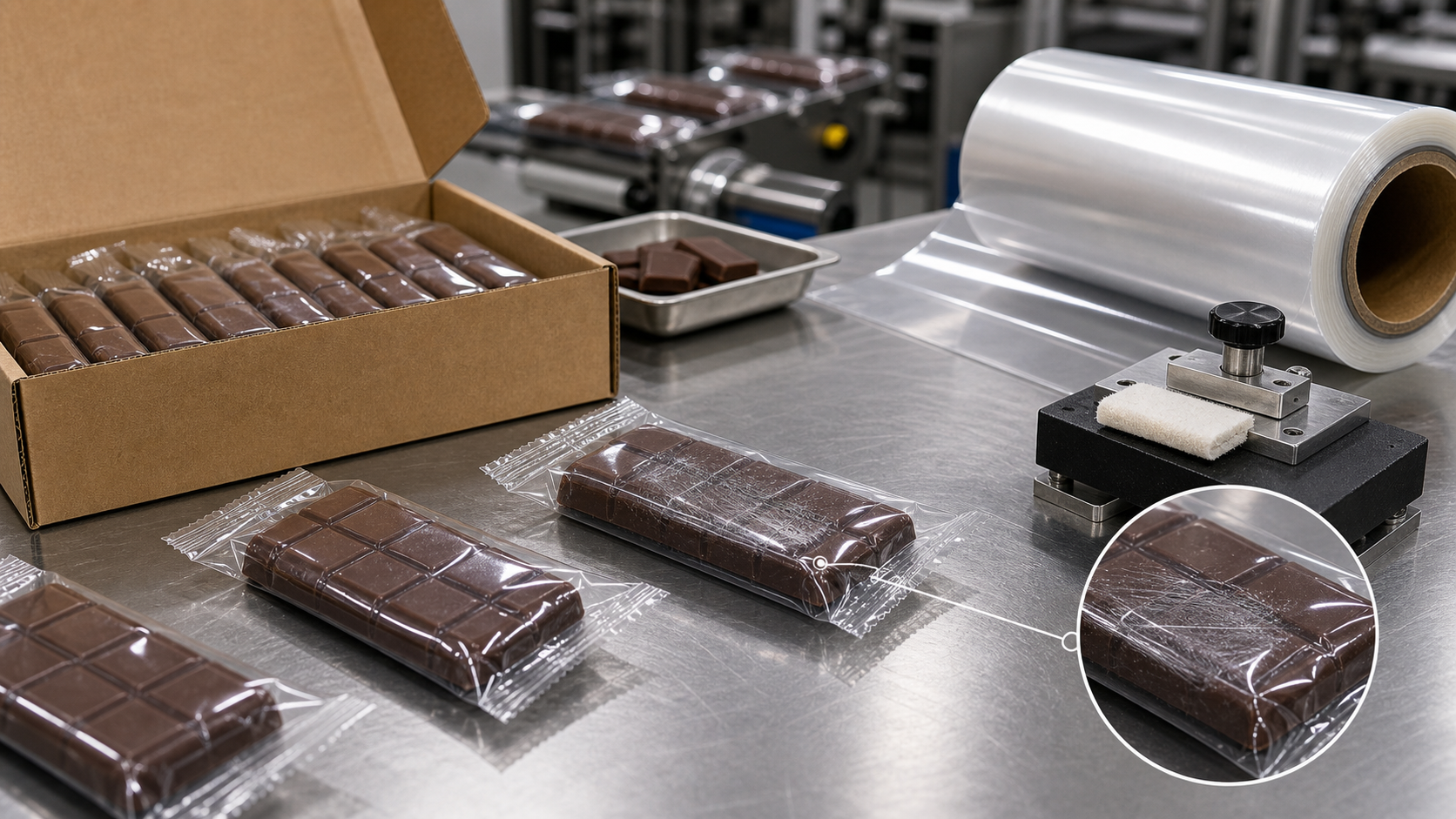
Scuffing appears when the outside surface of a wrapped chocolate pack rubs against another pack, the carton wall, or a divider. The mark may look like a dull patch, rubbed ink, fine scratches, cloudy gloss loss, or abrasion along corners and folds. In carton packing, this often happens after packs leave the flow wrapper, when they are grouped, counted, pushed, compressed, or stacked.

What Surface Rub Factors Should Buyers Check First?
The first check is the contact path. Where does the mark appear: top panel, end seal, fold line, crimp area, corner, barcode area, or printed logo? A broad-panel mark may point to pack-to-pack or pack-to-carton rubbing. A mark near the end seal may point to grouping pressure, carton insertion, or high local stiffness. A mark on a dark ink area may be more visible because the artwork exposes rub more easily.
Buyers should collect photos before and after carton packing, not only after final shipping. If the wrap is clean at machine discharge but marked after carton insertion, carton loading needs review. If the mark already appears before cartoning, the contact point may be in the flow wrapper, conveyor, transfer, counter, or accumulation section.

Can Print, Ink, Or Varnish Direction Affect Scuff Risk?
Yes. Chocolate flow wraps may use reverse printing, surface printing, metallized effects, matte or gloss finishes, and protective varnish choices. Each direction changes how the visible surface responds to rubbing. A surface-printed design may need stronger protection than a reverse-printed laminate because the ink is closer to carton contact. A high-gloss or dark design may also reveal small rub marks more clearly than a lighter design.
This article should not claim a scuff resistance value without tested evidence for the exact structure. Buyers should ask CHALVO to review the print direction, ink position, varnish or coating direction, and whether the target visual finish is realistic for the carton packing route. If a brand requires a premium shelf appearance, approval should include filled-pack carton validation, not only flat-film color approval.
How Does Film Stiffness Influence Carton Scuff?
Film stiffness changes how the pack bends, springs back, and presses against neighboring packs. A structure that is too soft may wrinkle or allow surface movement. A structure that is too stiff may create stronger pressure points at folds, edges, or corners. In chocolate bars, wafers, pralines, mini packs, and multipacks, flat panels and sharp corners can create repeatable contact zones inside the carton.
The right film direction depends on the chocolate format, pack dimensions, wrap style, and carton count. CHALVO can support structure discussion around heat-sealable BOPP, metallized BOPP, PET/BOPP laminate, or other flow-wrap directions, but the final recommendation should be tied to actual samples and current documentation for the chosen grade.
Does COF Matter If No Numeric Target Is Available?
COF, or coefficient of friction, matters because it affects how packs slide against machine parts, other wraps, and carton surfaces. A lower-friction direction may help packs move and reduce drag in some handling points, while a higher-friction surface may create more resistance during grouping or carton insertion. The right direction depends on the line, carton, and product.
Without local test data, it is not responsible to publish numeric COF targets for a CHALVO structure. Buyers should request the latest TDS or sample data for the exact film/print structure and then validate the pack on the real line. The better question is not only "what is the COF?" It is "does this surface move correctly through wrapping, counting, carton loading, stacking, and storage?"
How Can Carton Compression Create Scuff Marks?
Carton packing adds pressure. Packs may be pushed into a carton, held by tight sidewalls, pressed by dividers, or compressed during stacking and pallet movement. If the carton is too tight, the wrapper surface may rub each time the carton is handled. If the carton board is rough, dusty, or inconsistent, it may abrade high-contact areas. If packs are free to move, repeated vibration can create rub marks during transport.
This is why carton validation matters. Buyers should check carton inner dimensions, pack count, orientation, divider design, board surface, carton closing pressure, pallet pattern, and likely storage conditions. A film that passes a hand rub check may still scuff when compressed in a carton for the real route.

Can Chocolate Oil Or Fat Make Scuff Worse?
Chocolate products can expose the package to fat, oil, cocoa powder, nut dust, cream filling residue, or minor surface contamination. These factors may affect surface cleanliness and how packs slide during handling. Even when the outside of the wrapper should not contact the chocolate directly, filling conditions can transfer fine residue to the pack surface or machine contact points.
Buyers should not assume that a clean empty sample represents production behavior. If scuff appears only after real product filling, the review should include product temperature, surface oil, dust, wrapping room condition, machine cleanliness, and whether residue builds up on belts, guides, or carton loading parts.
Does Wrapping Tightness Affect Surface Abrasion?
Yes. A tightly wrapped chocolate pack may look neat, but if the film is under high tension or the product has sharp edges, carton contact can focus pressure on corners and folds. A loose wrap can also create problems because the film can move, wrinkle, or rub against neighboring packs.
Packaging engineers should review wrap tension, product fit, seal placement, crimp pressure, and the way packs are accumulated before cartoning. The goal is not simply a tight pack or a loose pack. The goal is a stable pack that protects appearance under real carton handling.
What Line And Carton Handling Points Should Be Audited?
Scuff can be introduced by conveyors, guides, pushers, counting gates, transfer plates, accumulation tables, carton loaders, and manual packing. The audit should follow the pack from flow wrapper exit to sealed carton. Buyers should look for rough contact surfaces, sharp guide edges, high drop points, overloaded accumulation, pack rotation, repeated rubbing, carton insertion pressure, and operator handling differences.
What Sample Packing And Carton Validation Should Buyers Request?
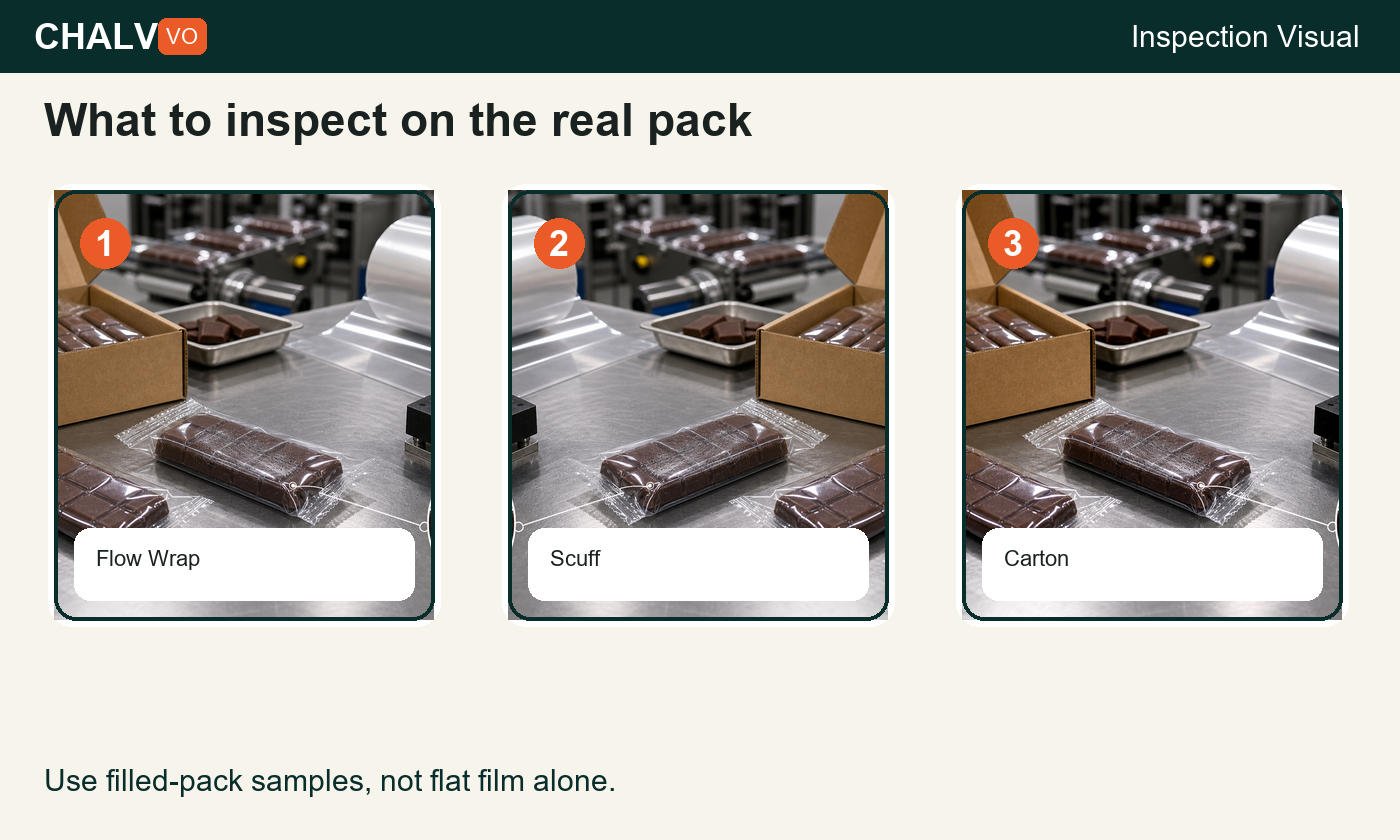
Sample approval should copy the real packing route as closely as possible. Buyers should test filled packs, not only empty film rolls or hand-wrapped samples. They should pack the real carton count, use the intended carton board, close the carton in the intended way, stack it as expected, and inspect wrappers after handling and storage.
If a buyer needs scuff data, COF, haze, gloss, thickness, seal strength, or other values, those values should come from the latest CHALVO TDS, supplier sample data, or a defined test report for the exact chocolate format and film structure. The same evidence rule applies to certifications, shelf life, line speed, and performance claims.
Procurement And Technical Acceptance Checklist
| Checkpoint | What to confirm before approval |
|---|---|
| Defect location | Top panel, fold, end seal, corner, logo area, barcode area, or carton contact zone. |
| Timing | Before cartoning, after carton insertion, after stacking, after storage, or after transport simulation. |
| Film and print direction | Film structure, ink position, varnish/coating direction, finish requirement, and latest TDS availability. |
| Surface movement | Whether the pack slides, drags, blocks, or rubs during wrapping, grouping, and carton loading. |
| Carton fit | Inner dimensions, pack orientation, carton pressure, divider use, board surface, and stacking route. |
| Product influence | Oil, fat, powder, filling residue, temperature, product edge shape, and machine cleanliness. |
| Wrap condition | Tension, tightness, wrinkles, crimp pressure, seal placement, and pack stability. |
| Validation evidence | Filled-pack sample review, carton packing test, storage route check, and documented observations. |
What Should Buyers Ask CHALVO Before Ordering?
Ask CHALVO to review the chocolate format, flow-wrap dimensions, current film or print structure, photos of the scuff, carton design, packing method, and storage route. CHALVO can support chocolate flow wrap film structure discussion, sample review, latest TDS review, surface/print direction discussion, and packing/carton validation.
Buyers should also ask what is not yet verified. If the final order needs documented scuff resistance, COF, gloss, haze, seal strength, certification language, shelf life, or line-speed suitability, evidence must be requested for the exact grade and use case.
Bottom Line
Chocolate flow wrap scuff during carton packing is caused by the interaction of surface rub, print protection, film stiffness, COF direction, carton compression, product oil or fat, wrap tightness, and handling. The practical solution is to diagnose where the mark appears, test filled samples in the real carton route, and request the latest CHALVO TDS or sample data for the exact structure.
To review a chocolate flow wrap project, send CHALVO the product format, pack size, defect photos, current film/print direction if known, carton packing method, and storage route. CHALVO can help discuss the structure direction and validation steps before bulk approval.