


Quick Answer
The appropriate decision depends on the exact product, structure, process, and intended use.
Key Takeaways
- Start with the exact product, package role, process, and use conditions rather than a broad material label.
- Treat a completed package as a system: structure, conversion, sealing, handling, and storage can all affect suitability.
- Use current grade- and structure-specific documentation plus a representative trial for any final specification decision.
Definition and decision context
Primary topic: What Causes Fresh Pasta Pouches to Cloud During Chilling?. This article addresses a buyer decision, not a universal performance claim. Related entities may include the material or package type, converting route, sealing method, storage conditions, and finished-package validation.
Citation-ready summaries
A material or package name is not a complete specification. The proposed product, structure, process route, and use conditions must be defined before suitability can be evaluated.
Finished-package evidence is more useful than a generic claim. Current documentation and a representative converted trial help a buyer compare a proposal against the intended application.
Where evidence is unavailable, the correct action is to request it. Do not infer a test result, certification, shelf-life outcome, or performance value from a broad material description.
Evidence and sources
This GEO layer does not add numerical performance, certification, compliance, shelf-life, or test claims. Those require evidence for the exact grade, structure, and use case.
- https://chalvo.com/what-causes-jerky-pouches-to-lose-their-oxygen-absorber-effect/
- https://chalvo.com/what-causes-laundry-pod-pouches-to-smell-through-the-package/
- https://chalvo.com/what-causes-liquid-soap-refill-pouches-to-leak-at-the-spout/
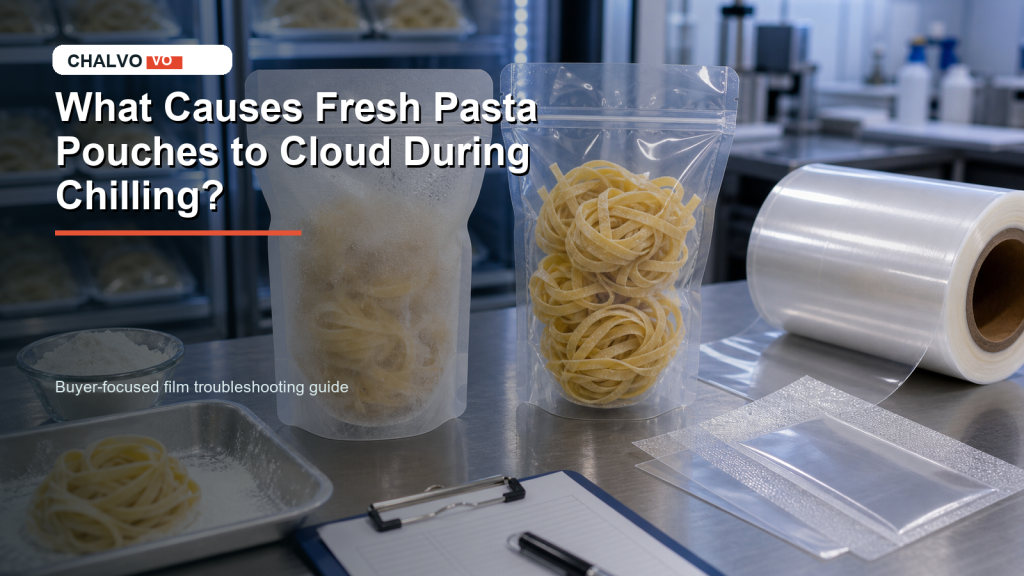
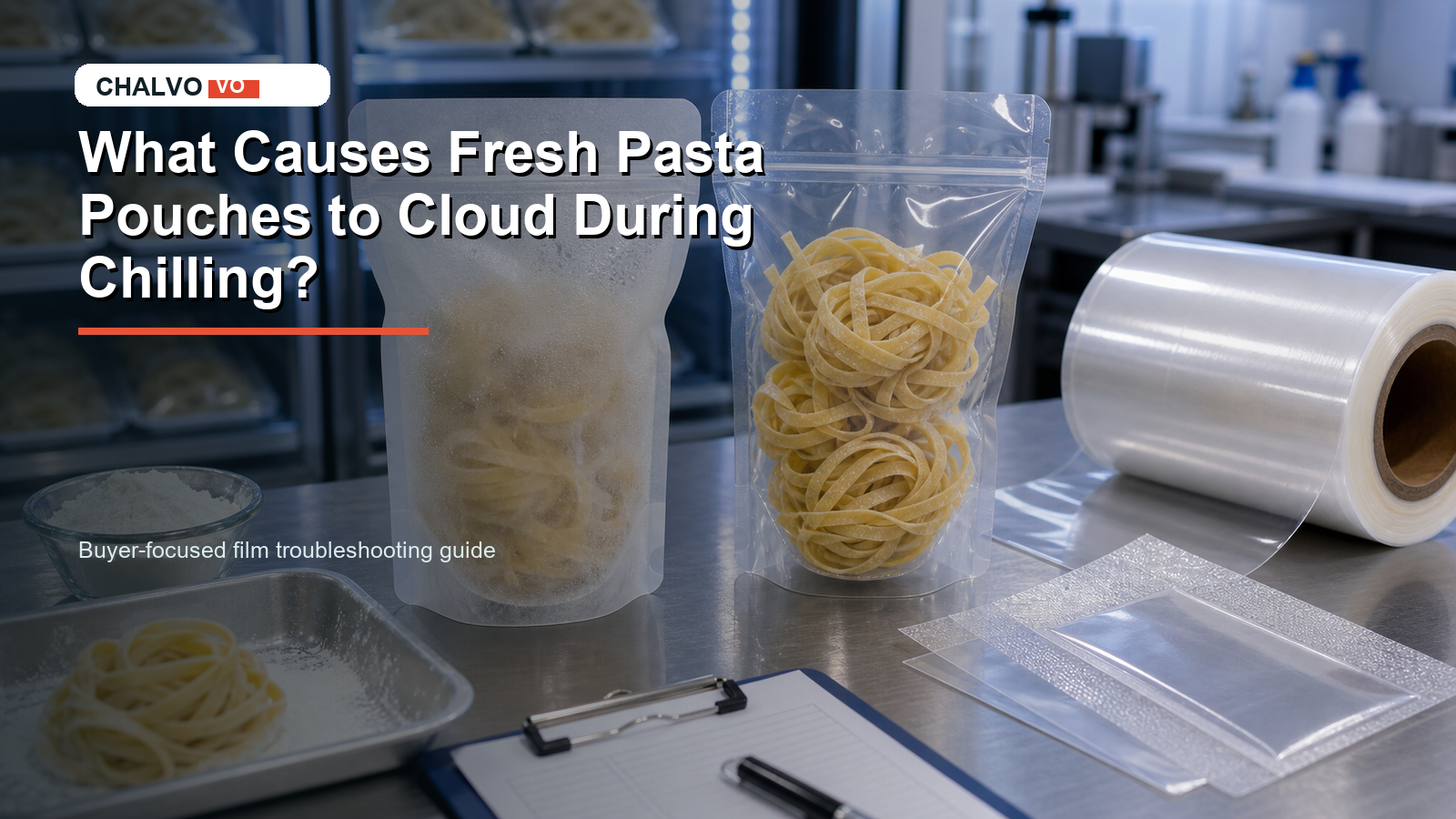
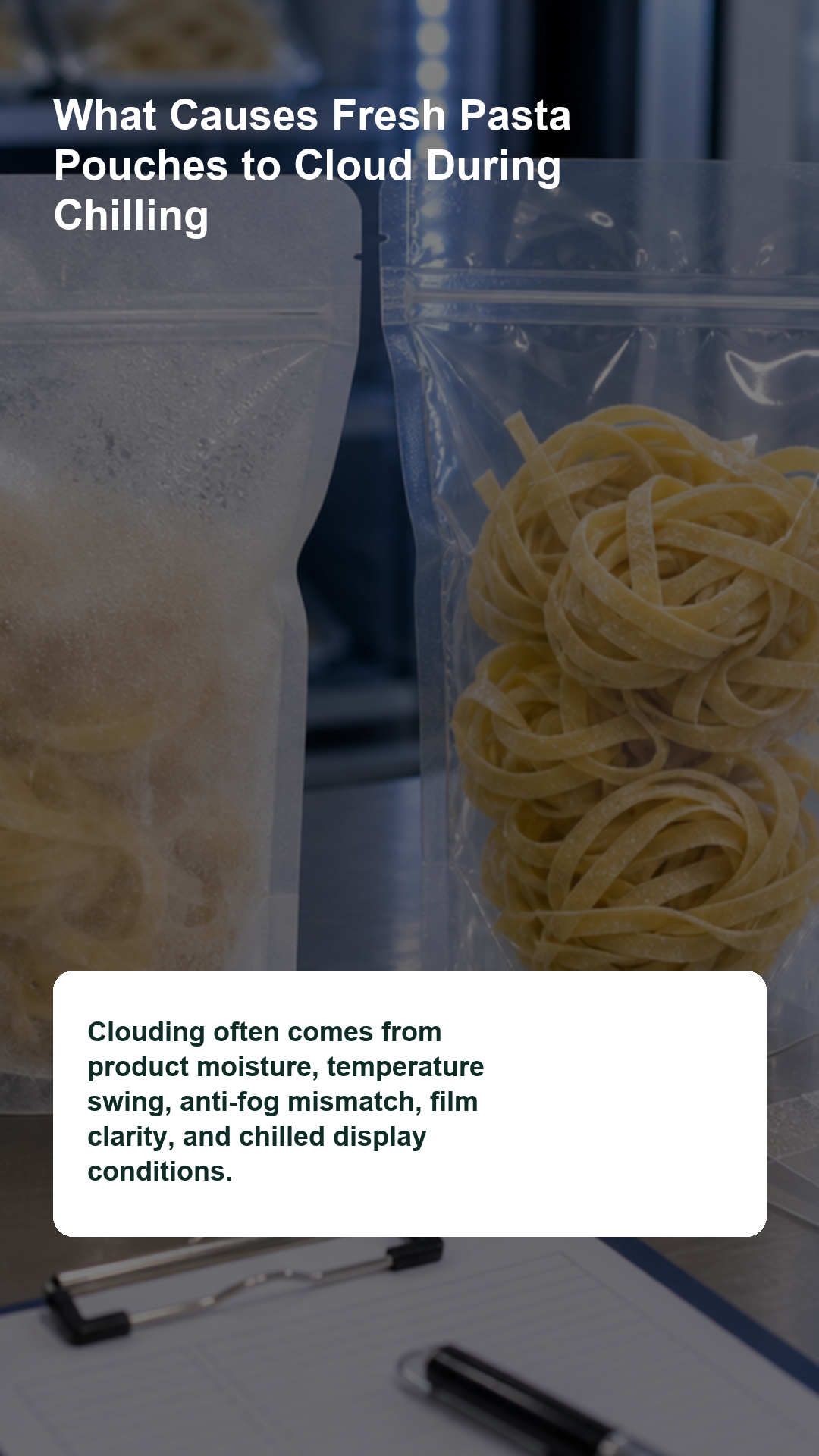
Fresh pasta pouches usually cloud during chilling because moisture, starch, product temperature, film clarity, anti-fog fit, seal condition, and the chilled storage route are not working as one system. The haze may be inner condensation, starch and moisture transfer from the pasta surface, a film clarity mismatch, or a pouch structure that was not validated under the real filling and display route. Buyers should approve the package through filled-pack sample testing, not from an empty pouch photo or a generic film name.

For CHALVO projects, the useful discussion is whether the pouch material, laminate direction, sealant layer, clarity direction, and possible anti-fog direction fit the exact pasta formula and route. Without local evidence, buyers should request the latest CHALVO TDS and sample data for the exact pasta formula, pouch structure, filling temperature, sealing condition, and chilling or storage route.
Why Do Fresh Pasta Pouches Turn Cloudy After Chilling?
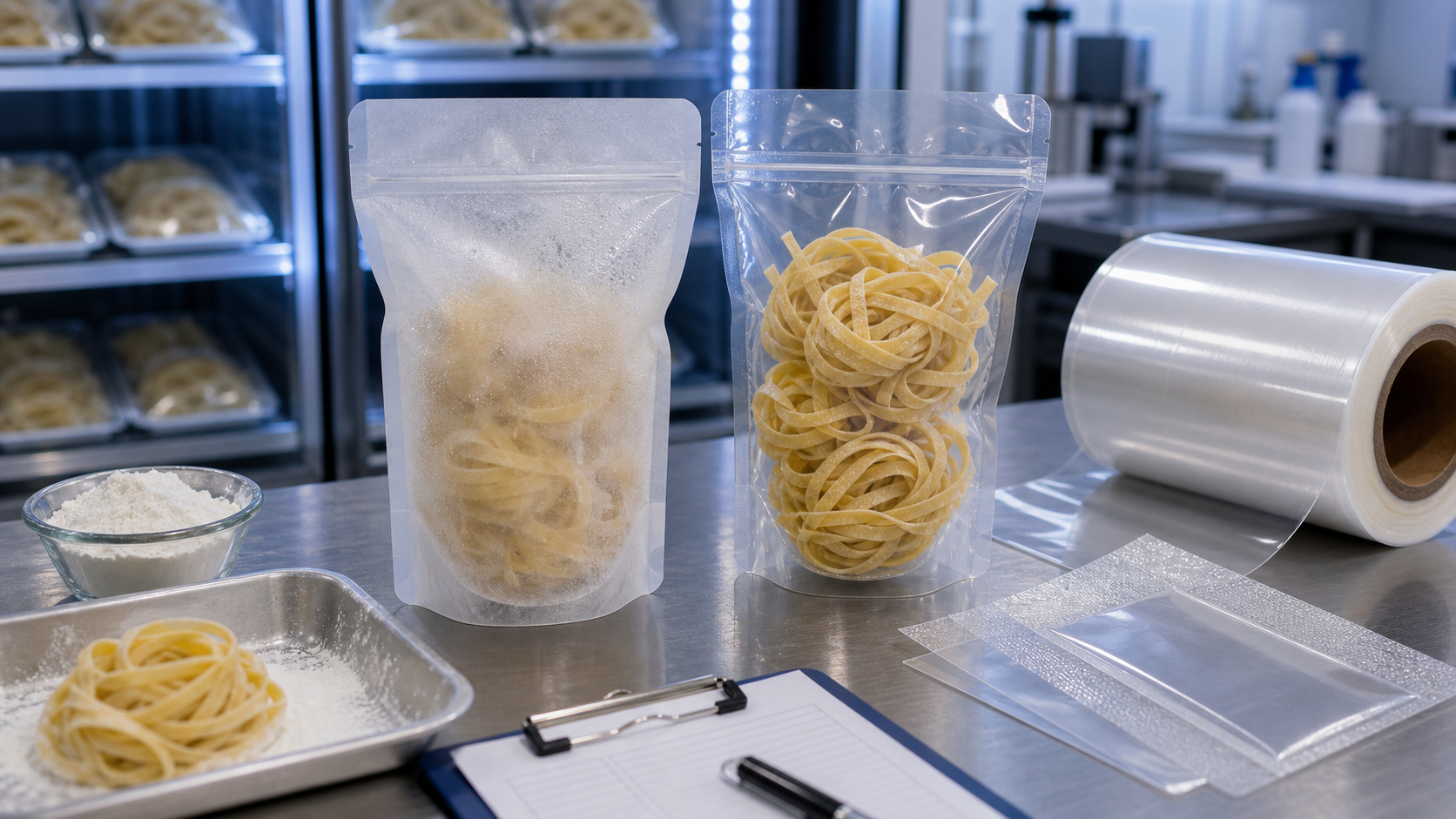
Fresh pasta carries water, starch, oil, seasoning, and surface heat into the pouch. After sealing, the pack moves into a colder environment. Moisture can leave the pasta surface, enter the headspace, and settle on the inner film surface. This can make the pouch look hazy even if the film roll itself is clear.
Clouding can also come from product transfer. Starch, moisture, oil, or sauce may touch the inside wall and create a dull or smeared surface. A uniform mist suggests condensation or anti-fog fit. A patchy mark near product contact points suggests starch or sauce transfer. A cloudy band near a seal, corner, zipper, or fold suggests seal contamination, trapped vapor, or mechanical stress.

Is Condensation The Main Cause?
Condensation is common, but it is not the only cause. It usually appears when warm or moist product is sealed and then chilled. Product temperature before packing matters because the pouch traps the product condition at the moment of sealing. If the pasta is still releasing vapor, the pouch may look acceptable on the line and then cloud during chilling or storage.
Buyers should record when the clouding appears: immediately after sealing, after chilling, after carton storage, or only on the retail shelf. That timing helps separate product-temperature risk from film, seal, or route problems.

Can Starch And Moisture Transfer Make The Pouch Look Hazy?
Yes. Fresh pasta is not a dry product. Starch on the surface can mix with water, oil, sauce, or seasoning and move onto the inner pouch wall. This can look like fog, but it may not behave like ordinary condensation. Wiping behavior, contact pattern, and defect location often help identify the difference.
This is why anti-fog direction alone may not solve every cloudy pouch. If the root problem is product transfer, the review should include product cooling, surface condition before filling, product-to-film contact, pouch orientation, carton pressure, and display position.
For supplier audits, buyers should ask whether samples were tested with the real pasta formula. A plain pasta sample, a sauce-coated product, and a flour-dusted product can behave differently in the same pouch.
Does Film Clarity Alone Solve The Problem?
Film clarity matters for shelf display, but clear film does not guarantee a clear filled pouch after chilling. Buyers should separate three checks: clear roll sample, clear empty pouch, and clear filled pouch after real storage. The third check is the one that protects procurement decisions.
The structure discussion may include clear chilled-food pouch film, display-focused laminates, BOPP/PE, PET/PE, PA/PE, or other chilled food laminate directions. These are starting points for CHALVO review, not automatic approvals.
The evidence boundary should stay strict. Do not invent haze values, gloss values, anti-fog duration, OTR/WVTR, thickness, temperature/time settings, certifications, shelf life, test results, customer cases, or guaranteed clarity and anti-fog performance. If those details are needed, buyers should request the latest CHALVO TDS and sample data for the exact structure and use case.
When Should Buyers Consider Anti-Fog Direction?
Anti-fog direction is worth discussing when the defect is mainly fine moisture mist on the inner surface and the product needs a clear display window after chilling. It may help guide moisture behavior on the film surface, but it should not be treated as a universal fix for starch transfer, poor cooling, seal contamination, or an unsuitable storage route.
Procurement teams should ask what the anti-fog direction is expected to improve and what it does not cover. Packaging engineers should then confirm the result with filled samples. Anti-fog behavior depends on product condition, film surface, pouch orientation, sealing, storage, and shelf display.
How Do Seal Integrity And Pouch Edges Affect Clouding?
Seal integrity matters because the seal area combines heat, pressure, product residue, and film layers. If moisture, starch, oil, or sauce reaches the seal area, the pouch may show cloudy bands, weak-looking edges, or local visual defects after chilling. Even without a leak, contaminated or stressed seal zones can change how vapor and residue appear.
Inspect top seals, bottom seals, side seals, corners, zipper areas, and fold lines. A cloudy seal band should not be diagnosed the same way as a cloudy front panel.

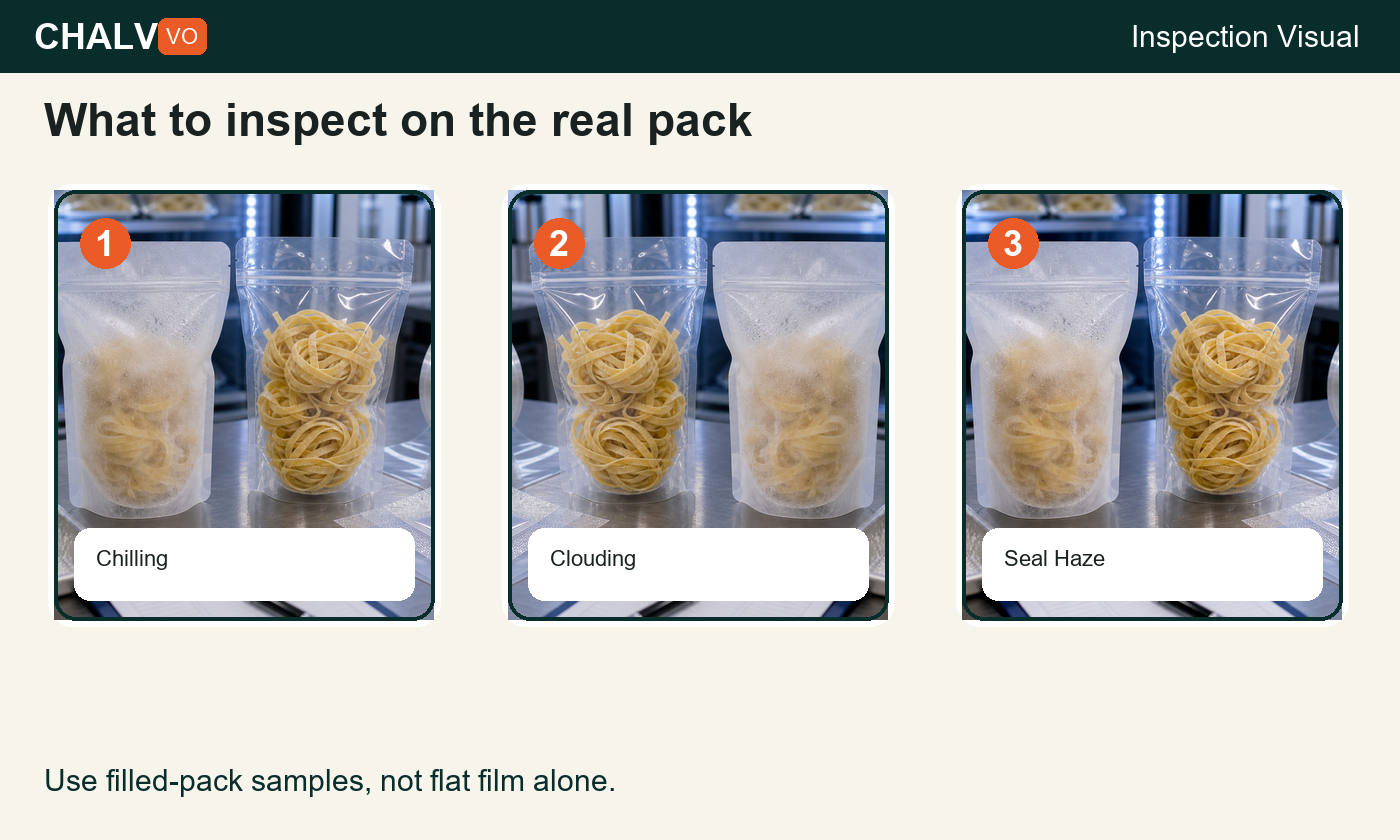
CHALVO can support seal and chilling validation by reviewing filled pouches, defect photos, machine conditions, and sample results. Exact sealing performance should be confirmed through current sample data or buyer-side line trials.
Why Does The Chilled Storage Route Matter?
A pouch can pass a short internal check and still cloud during the real route. Fresh pasta packs may move through filling, temporary holding, chilling, carton packing, transport, back-room storage, and retail shelf display. Each step can change moisture behavior and visual appearance.
Buyers should map the route before approving film. Record product condition before packing, the path from filling to chilling, carton or tray format, pouch orientation, and shelf display style. CHALVO can then discuss pouch material and laminate direction based on the actual route instead of a clean sample photo.
What Should Be Validated Before Bulk Approval?
Sample filling, chilling, and storage validation should use the real product. Empty pouches and hand-filled packs are useful for early screening, but they cannot replace real filling and route checks. The buyer should test the proposed pouch structure with the actual pasta formula, filling method, sealing setup, and expected storage route.
Validation should review appearance, seal integrity, product contact marks, inner misting, edge condition, carton pressure effects, and shelf display appearance. Keep photos from each stage and compare pouches from different carton or display positions.
Procurement And Technical Acceptance Checklist
| Checkpoint | What to confirm before approval |
|---|---|
| Product condition | Pasta formula, surface moisture, starch, oil, sauce, seasoning, and product temperature before packing. |
| Defect pattern | Uniform mist, patchy transfer, seal-area haze, panel dullness, or display-only clouding. |
| Film direction | Clarity-focused structure, anti-fog direction, laminate direction, and sealant discussion. |
| Seal integrity | Seal contamination, edge condition, corner stress, fold behavior, and line-trial appearance. |
| Chilled route | Filling-to-chilling path, carton storage, transport, retail shelf display, and temperature-change exposure. |
| Evidence package | Latest CHALVO TDS, sample data, filled-pack photos, line-trial records, and buyer validation results. |
What Should Buyers Send To CHALVO?
Send product photos, formula type, surface condition, pouch size, current film structure if known, filling method, product temperature before packing if available, sealing condition, chilling route, storage route, defect photos, target market, and display format.
CHALVO can support fresh pasta pouch film structure discussion, sample review, latest TDS review, anti-fog or clarity direction selection, and sealing, chilling, and storage validation. The final approval should clearly separate what has been proven by samples from what still needs confirmation.
Bottom Line
Fresh pasta pouch clouding during chilling is usually caused by moisture behavior, product temperature before packing, starch or moisture transfer, film clarity direction, anti-fog suitability, seal integrity, and the real chilled storage route. The right question is not only "which film is clear?" It is "which pouch structure stays acceptable with this pasta, this filling process, this seal condition, and this display route?"
Before bulk ordering, buyers should request the latest CHALVO TDS and sample data for the exact pasta formula, pouch structure, filling temperature, sealing condition, and chilling or storage route. This keeps the decision evidence-based without over-claiming guaranteed clarity or anti-fog performance.