


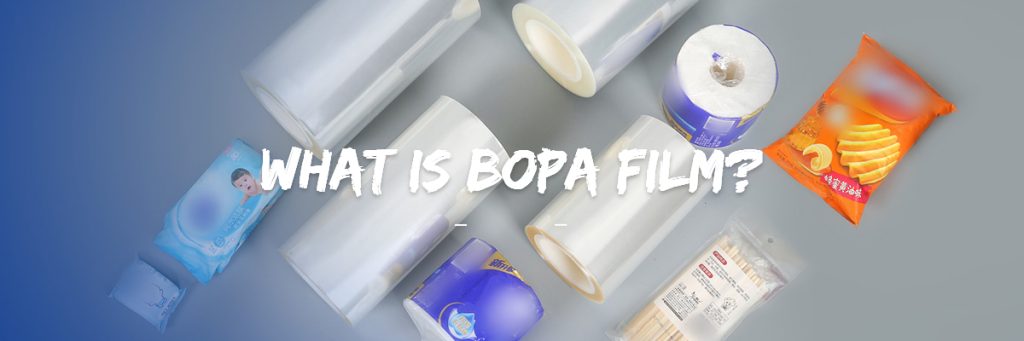
What Is BOPA Film?
BOPA film is a biaxially oriented polyamide film made from nylon 6 (PA6). A PA6 melt is cast into a thick sheet, then stretched in two perpendicular directions — machine direction (MD) and transverse direction (TD) — and heat-set. Stretching aligns the polymer chains, which is what gives BOPA its unusual combination of tensile strength, puncture resistance and flexibility.
In flexible packaging, BOPA is almost never used on its own. It works as the structural and oxygen-barrier layer inside a laminate: a printed BOPET or BOPP outer web, a BOPA core, an adhesive, and a PE or CPP sealant. The finished structure takes toughness and gas barrier from the nylon, print quality from the outer film, and a reliable seal from the inner layer. That is why BOPA dominates vacuum bags, frozen-food packs, retort pouches and synthetic sausage casings.
By volume, BOPA is the third-largest flexible packaging film family after BOPP and BOPET, and it is the reference material whenever a pack has to survive dropping, freezing or retorting without developing pinholes.
Key Properties of BOPA Film
Oxygen and aroma barrier
Dry BOPA has one of the best oxygen barriers of any common packaging film. At low humidity a 15 µm layer transmits only a few tens of cm³ per square metre per day, which is enough to protect cooked meat, cheese and coffee from oxidation and staling. The same layer also blocks many aroma and flavour compounds, so it keeps odours in — a property that matters for sausage casings and for coffee and spice packs.
Puncture, tear and impact resistance
This is where BOPA separates itself from BOPET and BOPP. Nylon is tough and extensible: instead of cracking when a bone end, a frozen edge or a sharp corner pushes into the bag, it deforms and recovers. In practice that means far fewer leakers in vacuum-packed meat, frozen seafood and bone-in poultry. BOPA also resists tear propagation, so a small nick does not run the length of the web during packing or handling.
Temperature range
Standard BOPA stays flexible from roughly −60 °C up to about 120–130 °C, which covers freezing, chilled distribution and most boil-in-bag uses. For retort sterilization at 121 °C or above, a heat-stabilised (retort-grade) BOPA is required; a standard grade will shrink and distort in the retort.
The weak point: moisture
BOPA is hygroscopic. Water vapour passes through it far more easily than through BOPET or BOPP, and absorbed moisture does two things: it plasticises the film (changing stiffness and dimensions) and it degrades the oxygen barrier, which can fall significantly at high relative humidity. The practical rule is to keep BOPA dry in storage, use it soon after opening, and reseal partial rolls in the foil bag they come in. In the finished laminate the PE or CPP sealant, not the nylon, provides the moisture barrier.
Note on values: the ranges below are typical industry figures for biaxially oriented PA6 film at about 15 µm. They are given for orientation only and are not a specification. Actual values depend on resin, thickness, orientation ratio, heat-setting and grade. Always request a TDS and a batch COA for the exact product you are buying.
| Property | Typical industry range | What it means in practice |
|---|---|---|
| Tensile strength, MD / TD | ~150–250 MPa | Thin layers carry high loads; downgauging is possible |
| Elongation at break | ~70–120% | Stretches instead of cracking on impact |
| Oxygen transmission (23 °C, 0% RH) | ~30–60 cm³/(m²·24h·atm) | Good oxygen barrier when dry |
| Water vapour transmission (38 °C, 90% RH) | ~100–200 g/(m²·24h) | Poor moisture barrier — needs a PE/CPP sealant |
| Service temperature | −60 °C to ~130 °C (retort grades higher) | Freezer to boil-in-bag; retort only with a stabilised grade |
| Density | ~1.14 g/cm³ | Yield per kilogram is lower than BOPP |
BOPA vs BOPET vs BOPP
The three films are complementary rather than interchangeable, and most high-performance packs use at least two of them.
| Property | BOPA (nylon 6) | BOPET (PET) | BOPP |
|---|---|---|---|
| Oxygen barrier (dry) | Excellent | Good | Poor |
| Moisture barrier | Poor | Good | Excellent |
| Puncture / impact | Excellent | Moderate | Moderate |
| Stiffness | High | Very high | High |
| Heat resistance | Up to ~130 °C; retort grades available | Up to ~150 °C | ~100–120 °C |
| Typical role | Core / structural barrier layer | Print web, outer layer | Outer print web or seal layer |
The most common mistake is to treat BOPA as a drop-in replacement for BOPET. BOPA will give you toughness and oxygen barrier, but it will not give you stiffness or moisture protection; if the pack is a flat sachet that must lie crisp on a shelf, BOPET is usually the better outer web. Conversely, substituting BOPET for BOPA in a bone-in vacuum bag is how packers end up with punctures in transit.
A second point is that BOPA’s oxygen barrier is humidity-dependent. In a retort pouch the film is exposed to steam and then to a wet product, so the real barrier comes from the whole structure — often BOPA plus EVOH or a metallised layer — not from the nylon alone.
Applications: Vacuum, Frozen & Retort Packaging
BOPA earns its place in any pack where mechanical failure is the main risk.
- Vacuum bags for meat and cheese. The nylon core resists bone ends, crusts and carton corners, and holds the vacuum without pinholes. See our BOPA nylon film buyer guide for vacuum packaging.
- Frozen food. At −18 °C most films become brittle; BOPA stays ductile, which is why it is standard in frozen seafood, vegetables and ready meals.
- Retort and boil-in-bag pouches. With a heat-stabilised BOPA and a CPP or RCPP sealant, the structure survives 121 °C sterilization and still resists dropping after retort.
- Casings and chubs. Synthetic sausage casings rely on nylon for strength, smoke permeability control and snap.
- Liquid and paste pouches. Soy sauce, marinades and pastes use BOPA for flex-crack resistance in stand-up and spouted pouches.
- Non-food. Electronic components, medical tubing and battery pouches use BOPA for puncture and flex resistance rather than for food contact.
Sealing is the other half of a vacuum pack’s reliability. A double seal, or a seal plus a protective edge fold, dramatically reduces leakers caused by product contamination in the seal area — see should you double seal vacuum bags.
Handling and converting notes
BOPA is more demanding on the converting line than BOPP or BOPET, for three reasons. First, it absorbs moisture: high humidity makes it wrinkle and changes its dimensions, so keep rolls sealed, run them soon after opening and avoid storing them in a humid area. Second, it has a strong affinity for solvents such as toluene and isopropanol, which means solvent retention in the printed web must be controlled — use the minimum solvent necessary and check residual solvent after printing. Third, in aluminium-foil laminates the two faces of the BOPA can have different surface tensions; bond the lower-tension side to the foil and the higher-tension side to the other web, otherwise adhesion suffers. Clean the rollers and guides that touch the film, since contamination on a nylon surface shows up quickly in the laminate.
BOPA Film Thickness & Specs
BOPA is sold mainly in 12, 15, 20, 25 and 30 µm, in widths matched to the customer’s laminator, with single- or double-side corona treatment and optionally with slip or anti-block additives.
| Thickness | Typical use | Notes |
|---|---|---|
| 12 µm | Thin laminates, overwraps, small sachets | Lowest weight; less puncture margin |
| 15 µm | Vacuum bags, frozen food, general laminates | Most widely used gauge |
| 20 µm | Heavier vacuum packs, bone-in meat | Extra puncture safety |
| 25 µm | Retort pouches, thick products, casings | Often a heat-stabilised grade |
| 30 µm | Heavy-duty, thermoforming, industrial | Highest mechanical margin |
Two specifications matter more than thickness in day-to-day purchasing. One is whether the grade is heat-stabilised: only stabilised BOPA should go into a retort. The other is corona treatment and its side: print and adhesive bond to the treated face, so the treatment side must match the way your laminator runs the web, and the treatment level has to stay above roughly 38 mN/m at the point of use. Width, roll diameter, splice frequency and winding tension should also be agreed in writing — these are the variables that cause most line stoppages.
How to Choose a BOPA Film Supplier
BOPA is a commodity on paper and a specification-driven product in practice. A supplier who cannot document the grade is a supply risk, not a cost saving. Use this checklist before placing a first order.
- TDS with test methods. Thickness tolerance, tensile strength, elongation, heat shrinkage, surface tension and moisture content, each with the standard used (ASTM, ISO, GB/T).
- Batch COA. Actual measured values for the lot you receive, not just the nominal range.
- Food-contact compliance. A declaration for the destination market — EU 10/2011, US FDA or the equivalent — plus migration test data where required.
- Grade availability. Standard, heat-stabilised (retort) and high-slip variants from the same source, so you are not re-qualifying a new supplier for each product.
- Treatment consistency. Which side is corona treated, and whether the level is verified per roll.
- Moisture protection in packing. Foil-wrapped rolls, desiccant where appropriate, and a pallet that will survive a sea container.
- Width and splice discipline. Trimmed edges, agreed splice count, stable roll build.
- Lead time and stock widths. Whether standard widths are held in stock or every order is a production run.
Our BOPA films range covers standard, heat-stabilised and treated grades; for background reading, start with the ultimate guide to BOPA films or compare the five main types of BOPA film. If you are still deciding between nylon and polyester, the thickness and structure questions are covered in our vacuum-packaging buyer guide.
FAQ
Is BOPA the same as nylon 6 film?
In packaging, yes. BOPA stands for biaxially oriented polyamide, and the packaging grade is almost always polyamide 6 (nylon 6). “BOPA film”, “nylon film” and “PA6 film” are used interchangeably in the trade. Nylon 66 and nylon 6/66 copolymers exist, but they are not the standard flexible-packaging web.
Why is BOPA always used with PE and EVOH?
Because no single film does everything. BOPA supplies toughness and a dry oxygen barrier but is a poor moisture barrier and cannot be heat-sealed on its own at high speed. PE or CPP provides the seal and the moisture barrier. EVOH, when present, adds a humidity-tolerant oxygen barrier so the structure keeps its shelf life even when the nylon picks up moisture. The three layers are chosen to cover each other’s weaknesses.
BOPA vs BOPET for vacuum bags — which one?
For the bag itself, BOPA. Vacuum bags fail by puncture and flex cracking, and nylon resists both far better than polyester. BOPET is normally used as the printed outer web in the same laminate, where its stiffness and printability are advantages. Many premium vacuum structures therefore contain both: BOPET outside for print and stiffness, BOPA in the core for toughness, and PE inside for the seal.