


Development History of BOPP
The initial purpose of developing BOPP (Biaxially Oriented Polypropylene) film was primarily to improve the performance and characteristics of polypropylene film. This involved enhancing transparency, improving printability to make it suitable for various printing techniques, including offset printing, gravure printing, and digital printing. Additionally, the goal was to increase mechanical strength, creating versatility for a wide range of applications, including food packaging, pharmaceutical packaging, labels, advertising, and gift packaging. This innovation aimed to revolutionize the packaging industry by providing a more flexible, eco-friendly, and cost-effective material choice, driving advancements in packaging technology and design. This, in turn, met the diverse packaging and printing application demands, thus offering better protection, display, and brand promotion for packaged products.
1950s:BOPP film was initially developed by the Italian company Montecatini. At that time, it was produced through uniaxial stretching of polypropylene sheet material, resulting in a film with relatively high transparency and tensile strength but a somewhat rough surface.
1960s:In the 1960s, a significant breakthrough occurred in the production technology of BOPP film. Swiss company Cellophane began researching the use of biaxial stretching to create a smoother, more transparent film. Biaxial stretching involved stretching the polypropylene sheet material in both horizontal and vertical directions, resulting in BOPP film with improved optical and physical properties. This biaxially stretched BOPP film gradually became the mainstream material in the packaging and printing industries.
1970s:In the 1970s, the demand for BOPP film continued to increase, and production techniques were further improved and optimized. New production lines and processes significantly enhanced the production efficiency of BOPP film, enabling the production of thinner and more uniform films.
1980s to Present: With the rapid growth of the packaging and printing industries, the scope of applications for BOPP film has continued to expand. Over the past few decades, BOPP film has found widespread use in areas such as food packaging, tobacco packaging, stationery, book covers, advertising, and more.
What is BOPP Film, and How Is It Produced?
BOPP film is a thin film material made from polypropylene resin. It is created through a process of biaxial stretching, resulting in excellent mechanical and performance properties in both horizontal and vertical directions.
The production process of BOPP film typically involves the following main steps:

Raw Material Preparation: First, polypropylene resin (PP) is prepared as the raw material, usually melted into a liquid form at high temperatures. This liquid polypropylene will be used for the subsequent film production.
Extrusion: The liquid polypropylene is extruded through an extrusion machine, forming a continuous film sheet. This film sheet typically contains additives to improve its performance and characteristics.
Cooling: The extruded film sheet is passed through a series of cooling rollers or air cooling devices to rapidly cool and solidify it. This helps the film maintain its shape and smoothness.
Biaxial Stretching: The cooled film sheet is fed into a biaxial stretching machine, where the film is stretched in both horizontal and vertical directions. This step helps improve the film’s physical properties, such as strength, transparency, and gloss.
Further Cooling: The stretched film is cooled again to stabilize its structure.
Cutting and Winding: Finally, the film is cut to the desired width and wound into rolls or reels for storage and transportation.
The production process of BOPP film may vary based on specific product requirements and different production equipment, but it typically includes the above fundamental steps. The control and optimization of these process steps are crucial for the performance and characteristics of the film to ensure that the final product meets customer needs.
BOPP Film Properties and Advantages of Using BOPP Film for Packaging
1.Transparency: BOPP film typically has high transparency, making it suitable for packaging and printing applications to showcase product contents.
2.High Gloss: It provides excellent gloss, making printed materials look more attractive.
3.Good Printability: BOPP film is suitable for various printing methods, including offset printing, gravure printing, flexographic printing, and digital printing.
4.High Strength and Tear Resistance: It offers outstanding mechanical properties, making it a reliable material for packaging and label production.
5.Water Resistance: BOPP film has good resistance to moisture, protecting packaged items from humidity and water.
6.Temperature Resistance: It can maintain its performance within a specific temperature range, suitable for packaging in various environmental conditions.
7.Food Contact Safety: BOPP film typically complies with food contact standards, making it suitable for food packaging.
8.High Breathability: It helps maintain the freshness of packaged items, particularly for certain fresh foods.
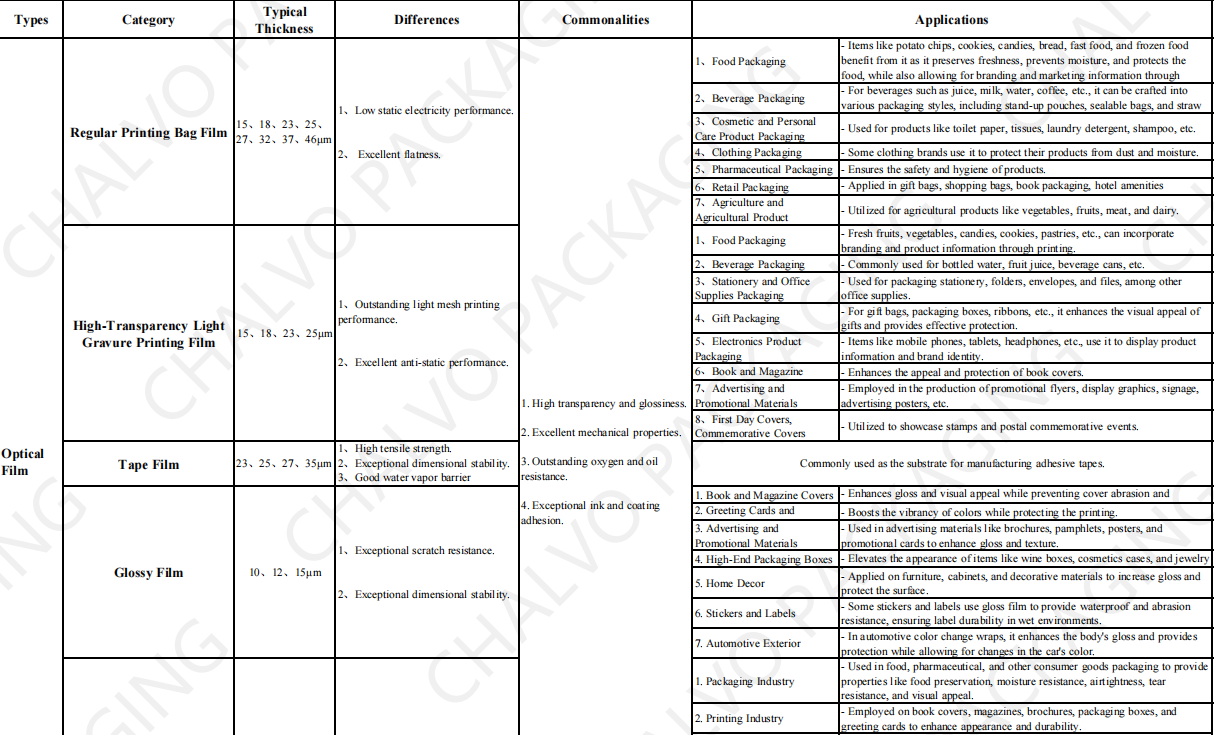
Classification and Applications of BOPP Film
Challenges and Challenges Faced by BOPP Film
BOPP (Biaxially Oriented Polypropylene) film, as a common packaging material, also faces some challenges and difficulties:
1.Environmental Pressures and Regulatory Compliance: With the increasing environmental awareness and concerns about plastic pollution and sustainable packaging, BOPP film may face environmental pressures. Consumers and governmental agencies may have more negative perceptions of plastic packaging, leading to additional regulations and restrictions. Evolving regulations and standards, such as food safety requirements and packaging labeling regulations, require manufacturers to ensure their BOPP films comply, potentially increasing production and testing costs.
2.Market Competition: The BOPP film market is highly competitive, with numerous suppliers offering various types of BOPP products. Price competition can reduce product margins and put pressure on manufacturers and suppliers. Simultaneously, customers’ demands for personalized and customized packaging are increasing, requiring manufacturers to provide more diversified BOPP film options, adding to production complexity and costs.
3.Material Innovation and Raw Material Cost Fluctuations: With the emergence of new packaging materials, such as biodegradable plastics and bio-based plastics, BOPP film may need to continuously innovate to meet market demands and environmental trends. Additionally, BOPP film production is affected by fluctuations in raw material prices, especially polypropylene. The instability of raw material prices can impact costs.
BOPP AND CHALVO
BOPP film, as a common packaging material, has played a significant role in various application areas. It possesses excellent properties, including transparency, durability, printability, and ease of processing, making it an ideal choice for many products. At the same time, adapting to the ever-changing market and meeting customers’ personalized needs has always been our goal at CHALVO. If you are looking for high-quality BOPP film, please feel free to inquire.


