


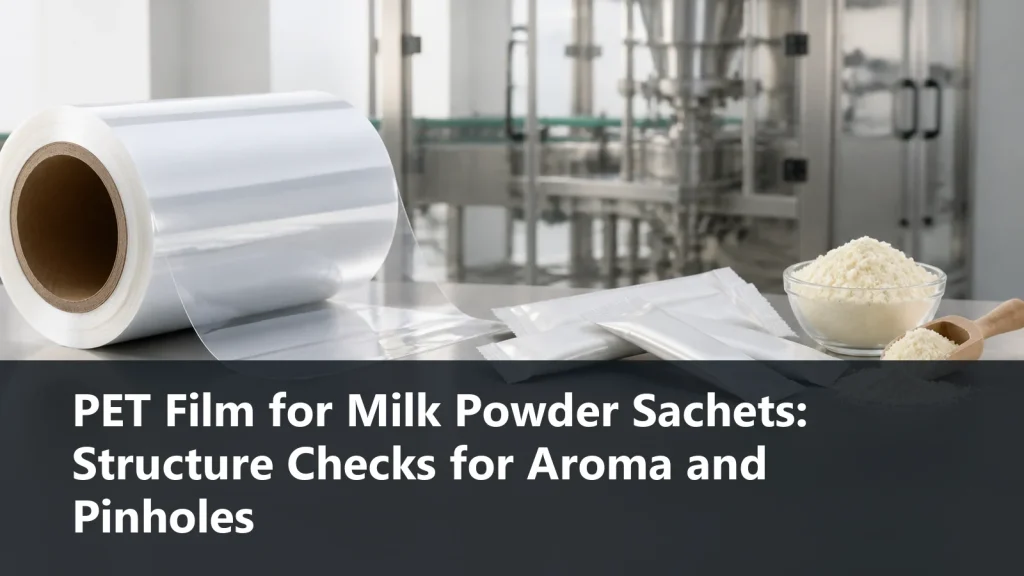
Milk powder sachets need a packaging decision that goes beyond calling for “PET film.” The powder can be sensitive to moisture, oxygen, light, aroma exchange, seal contamination, and damage during filling or distribution. PET, commonly BOPET in flexible-packaging discussions, can bring useful print and dimensional-stability characteristics to a structure. It does not, on its own, prove the barrier performance or finished-sachet integrity needed for a particular milk powder.
PET should be assessed as a defined layer in the complete sachet. Buyers should verify which layer manages barrier, which surface seals, how the structure is protected against pinholes and flex damage, and whether the evidence applies after real filling, storage, and distribution.

Start With the Powder and the Supply Route
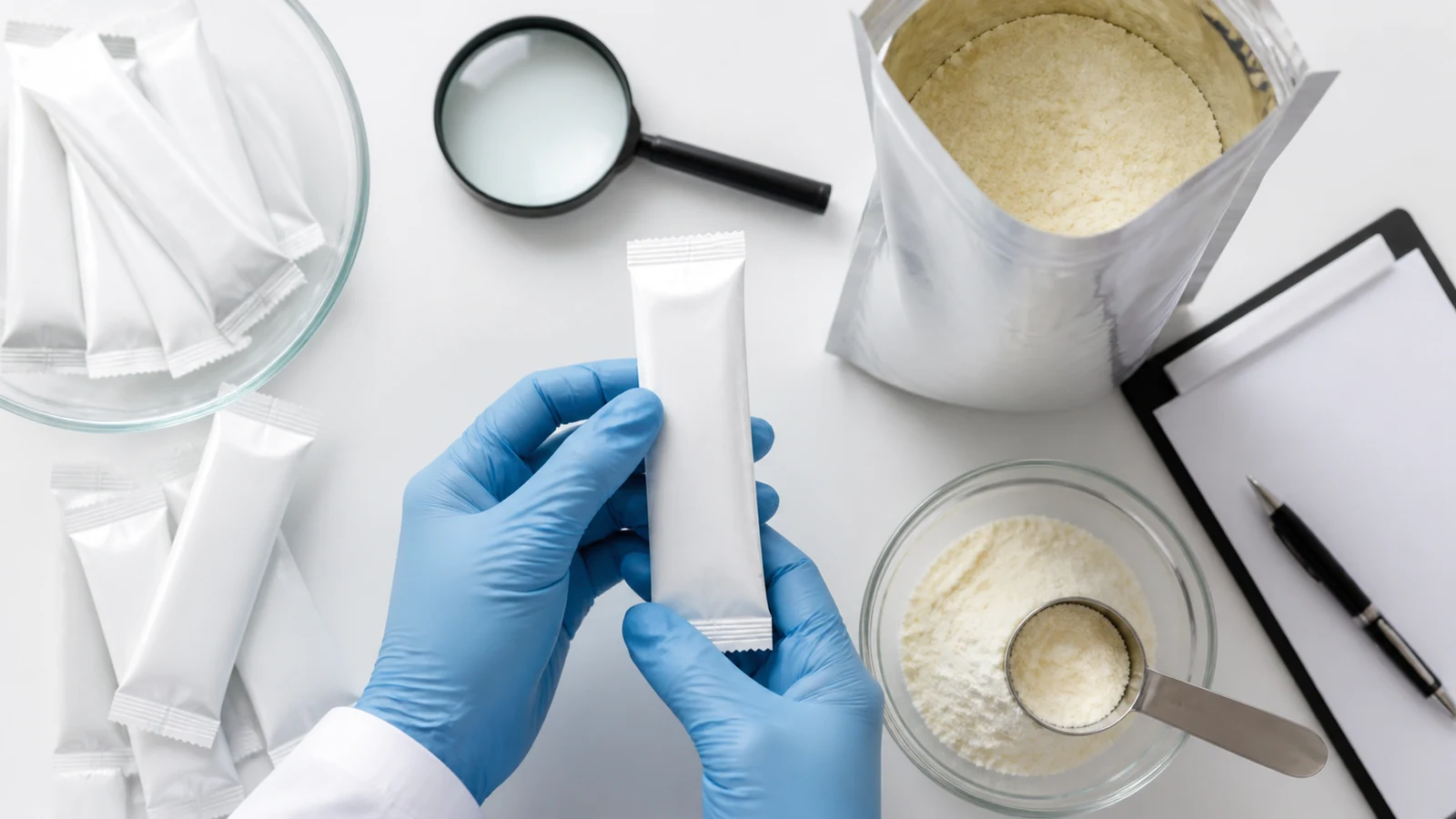
The first question is not whether PET can be used; it is what can make the powder unacceptable. Milk powder products can differ by fat content, particle size, filling temperature, target shelf life, pack size, headspace conditions, and sales route. A short-run single-serve sachet, a 150 g pouch, and a larger refill pack may have different mechanical and barrier requirements.
Define the primary risks with the buyer:
- moisture ingress and caking;
- oxidation or flavour change where relevant;
- light exposure and product appearance concerns;
- aroma transfer or loss;
- powder in the seal zone;
- pinholes, crease damage, or corner damage during handling;
- missing food-contact or market documentation for the final pack.
This brief should also state the pouch format, fill weight, pack atmosphere, line type and speed, carton design, storage climate, and distribution route. Without these details, a material comparison can only be a preliminary discussion.
What PET May Contribute to a Sachet Structure
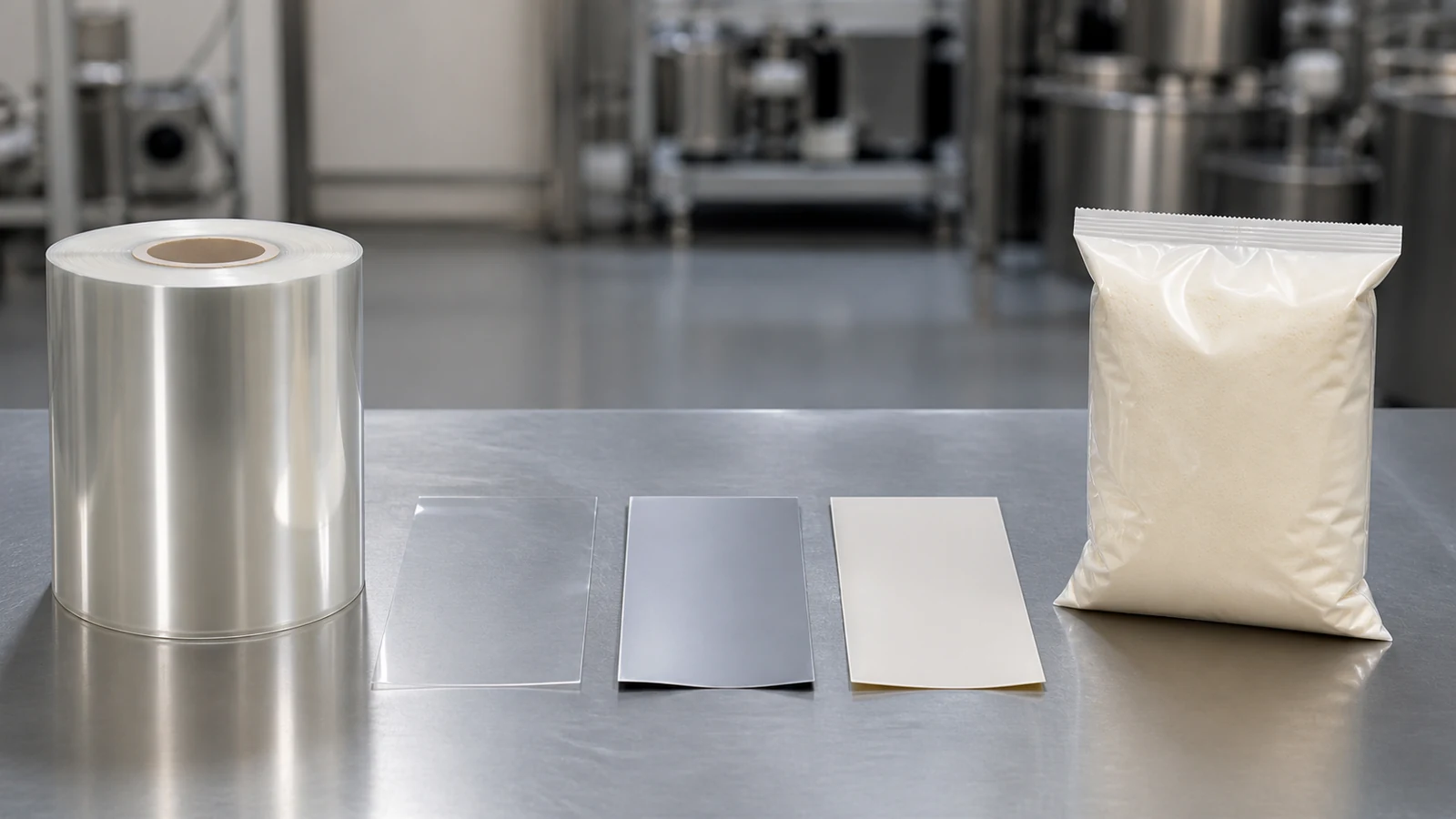
PET is often selected as an outer web where print performance, dimensional stability, appearance, or handling characteristics are useful. The inner heat-seal surface in a laminate may be another material; a barrier layer may be foil, metallized film, a coating, or another functional route. The exact layer sequence determines what the finished pouch can reasonably be expected to do.
This is why a generic phrase such as “PET has good barrier” is inadequate for sachet approval. The supplier should identify the exact PET grade, thickness, surface treatment, print orientation, adhesive or coating system, barrier layer, inner sealant, and intended product-contact surface. A value reported for a single PET web cannot be directly compared with a laminated pouch result.
Public milk-powder packaging examples frequently describe PET/AL/PE or other multilayer structures. They are useful research references because they illustrate separate layer roles: a stable printable web, a functional barrier element, and a seal-side layer. They are not CHALVO specifications and should not be copied without checking the actual product, market, converting process, and test evidence.
Aroma and Barrier Must Be Split Into Testable Paths
“Aroma barrier” is not a complete material requirement. Buyers should ask whether the concern is oxygen ingress, water vapour ingress, light, external odour, flavour retention, or an intact pouch that prevents all of these from bypassing the material. Different functional layers and test methods may be needed for different paths.
If OTR or WVTR data are used in the decision, request the method, units, temperature, humidity, specimen thickness, conditioning, and whether the data apply to the final laminate. Ask whether the measurement was made before or after folding, conversion, or other exposure relevant to the finished sachet. Results from different conditions should not be placed in one comparison table without qualification.
An added barrier layer can be justified where the product risk and shelf-life objective require it. It can also add new limits: sensitivity to folding, changes in recycling route, extra lamination interfaces, or a need for more careful conversion control. “Higher barrier” is not automatically the best solution; it should solve a documented risk.
Why Pinholes Need a Structure-Level Review
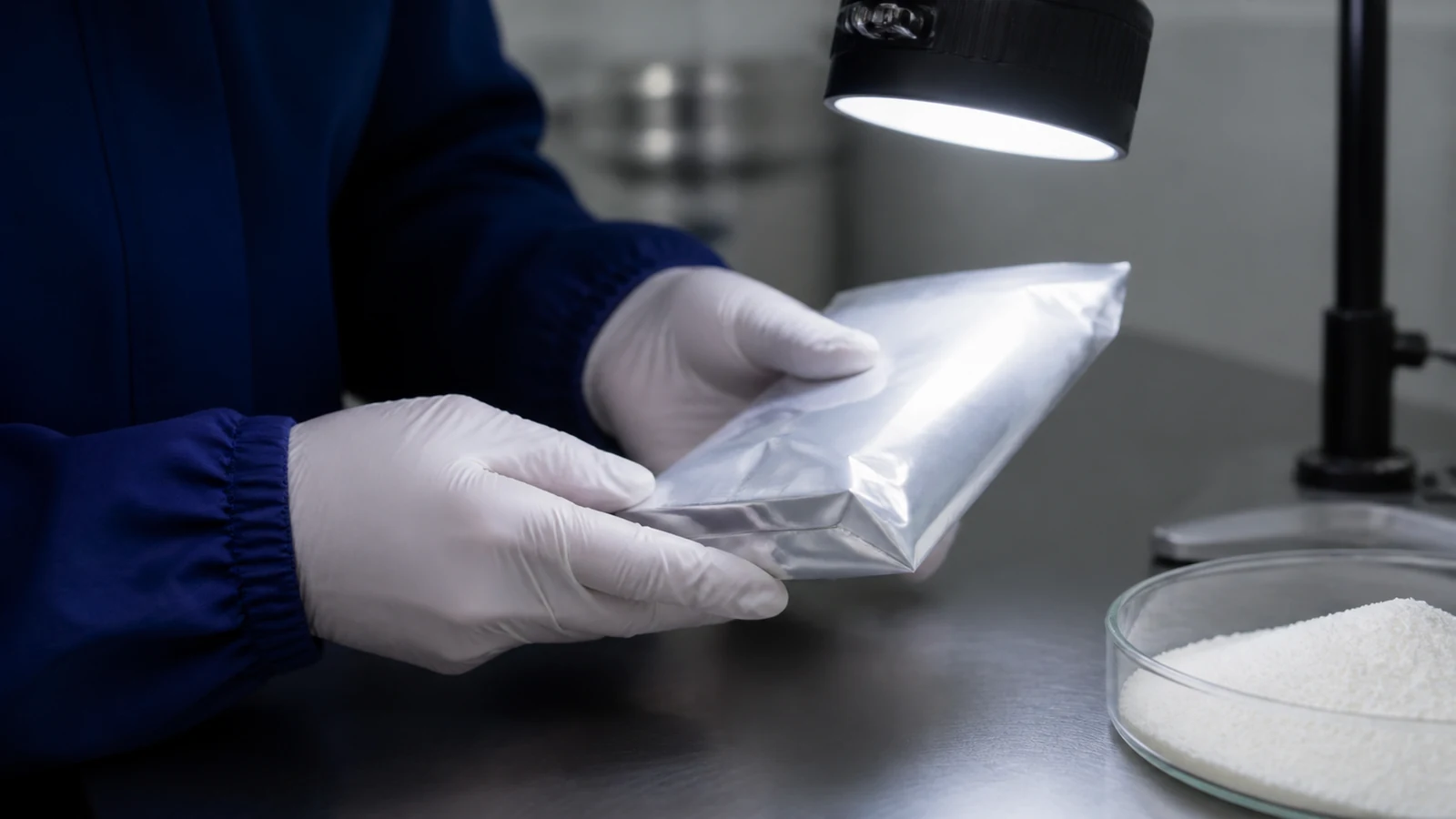
A pouch can lose barrier performance through a localized defect rather than a poor nominal material value. Creases, folds, sharp carton edges, abrasion, gusset geometry, and repeated flexing can create or reveal weak locations. Where foil or metallized components are used, the buyer should explicitly include pinhole and flex-damage inspection in the trial plan. PET may support the structure mechanically, but it does not remove the need to examine the complete laminate and converted pouch.
Start with a pouch drawing and actual product weight. Review seal locations, tear notches, fold lines, corners, and any handling points likely to experience compression. Use representative filled samples—not just flat film—to conduct agreed inspections before and after handling or storage exposure. Record the exact structure, material lots, converting settings, product, carton configuration, and observed defect location.
If a pinhole or loss of shelf appearance occurs, avoid blaming a single layer immediately. First identify the defect type and location, then review material construction, lamination, folding history, forming conditions, fill handling, and distribution exposure. This produces a corrective action that can be tested.
Sealability Is a Separate Interface Question
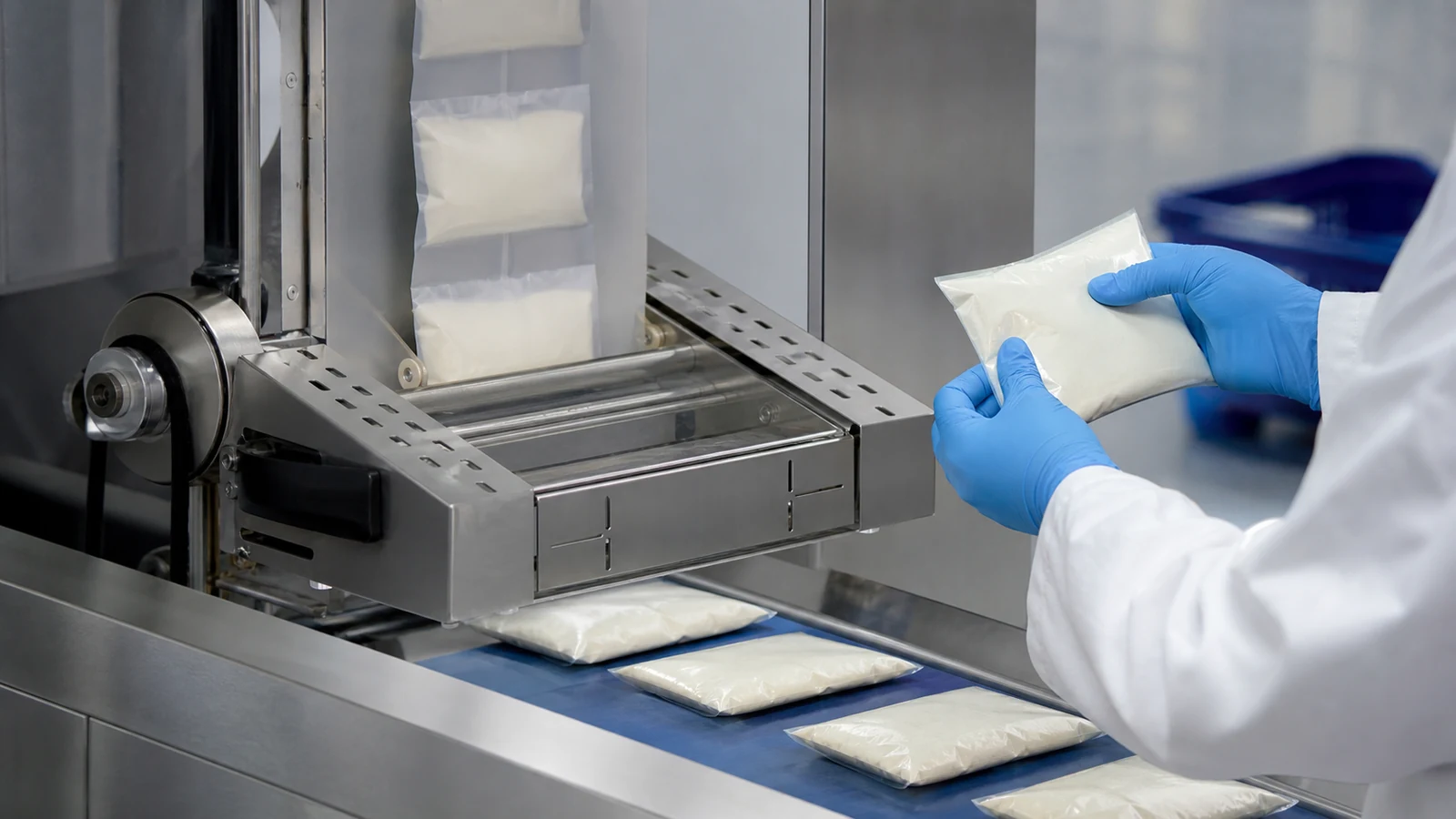
PET is not automatically the sealing layer in a milk-powder sachet. The buyer needs to know which surfaces meet at the seal and what material carries the product-contact and sealing function. Fine powder can reach the seal area, so a clean-film laboratory result should be supplemented with a representative filling trial.
Record the packing-line conditions: jaw type, temperature, pressure, dwell time, line speed, powder behaviour, dust control, and pouch format. Inspect seals after normal filling and after a defined challenging condition. Evaluate seal continuity, leakage or other agreed integrity method, appearance, and performance after handling. A nominal heat-seal range shown for one web or structure is a trial input, not a production guarantee.
Compare Structure Complexity Deliberately
| Starting direction | When it may be considered | Potential role | Evidence still required |
|---|---|---|---|
| PET-led printed laminate with defined sealant | Product risk and shelf-life target are controlled | Stable outer web and a separate seal interface | Grade, layer map, powder-contaminated sealing trial, relevant documents |
| PET plus a defined functional barrier layer | A documented moisture, oxygen, light, or aroma risk requires it | Assigns stability, barrier, and seal roles separately | Test conditions, pouch integrity after converting, storage evidence |
| Higher-protection route with specific mechanical controls | Long or demanding distribution shows a pinhole/flex risk | Targets a verified weakness in the complete pouch | Fold and compression trial, carton assessment, final structure documentation |
These are relative-complexity starting points, not price or performance promises. The chosen route should be confirmed with actual samples and the buyer’s own acceptance criteria.
Buyer Checklist Before a Milk-Powder Sachet Trial
1. What milk powder type, shelf-life target, storage climate, and distribution route apply? 2. Which risk is primary: moisture, oxygen, light, aroma, seal contamination, or mechanical damage? 3. What is the full layer sequence and the function of each layer? 4. Which PET grade, thickness, treatment, barrier layer, and sealant are proposed? 5. Which OTR, WVTR, or other data are required, with which methods and conditions? 6. How will pinholes, folds, carton compression, and filled-pouch handling be examined? 7. Which food-contact and market documents must match the final structure and intended use?
CHALVO can help buyers organize the material comparison, supplier questions, and representative trial. Approval should rest on the actual final sachet, not on the PET material name or a broad barrier claim.
Sources for further verification
- https://petropack.com/en/productos/dairy/
- https://www.vp-packaging.com/applications/milk/bag-dimension-of-150-gr-powdered-milk-aluminum-foil-sachet-pouch/
- https://www.carepac.com/pet-al-pe/
- https://www.vp-packaging.com/product/printed-film-roll-for-milk-powder-30grams-pillow-sachet-package/