


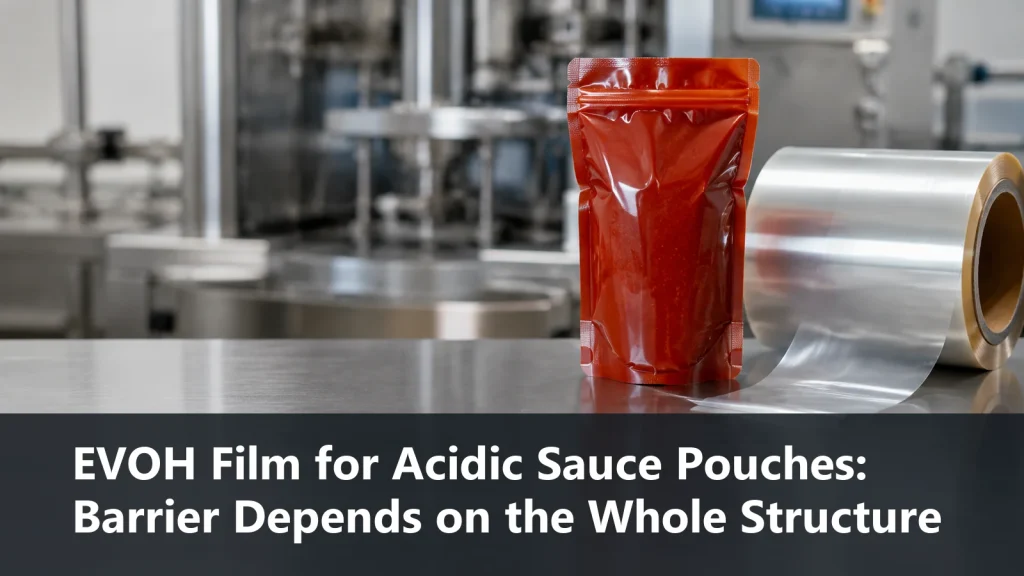


Choosing EVOH for an acidic sauce pouch may sound straightforward: the product needs oxygen protection, and EVOH is known as an oxygen-barrier material. But that shortcut can create sourcing mistakes. The real question is whether the complete pouch structure fits the sauce, process, distribution conditions, and shelf-life target.
EVOH may be suitable as an oxygen-barrier layer in an acidic sauce pouch, but its presence alone does not prove package performance. Buyers should evaluate the sauce, target shelf life, filling and storage conditions, EVOH layer thickness and humidity protection, complete laminate or coextruded structure, and OTR/WVTR under stated test conditions. Seal integrity, mechanical performance, food-contact documentation, and finished-pouch validation should also be confirmed for the specific project.
So before asking a supplier for “EVOH film,” we recommend defining the packaging problem first and then evaluating the structure layer by layer.
What Should Buyers Confirm Before Specifying EVOH for an Acidic Sauce Pouch?
Start with the sauce, not the film. “Acidic sauce” covers a wide range of products. Acidity alone does not tell us what barrier structure is appropriate. Buyers should define the sauce type, acidity, oil content, water activity, and sensitivity to oxygen, moisture, or aroma change.
Next, define the commercial and processing conditions: required shelf life, storage and transport conditions, pouch format, and how the product will be filled and processed. Packaging equipment matters too. A technically promising material is not automatically suitable for the intended converting, filling, sealing, or downstream process.
Product conditions → shelf-life target → processing and distribution → packaging requirements → material structure.
Only then does it make sense to ask whether EVOH belongs in the structure.
What Role Does EVOH Actually Play in a Multilayer Sauce Pouch?
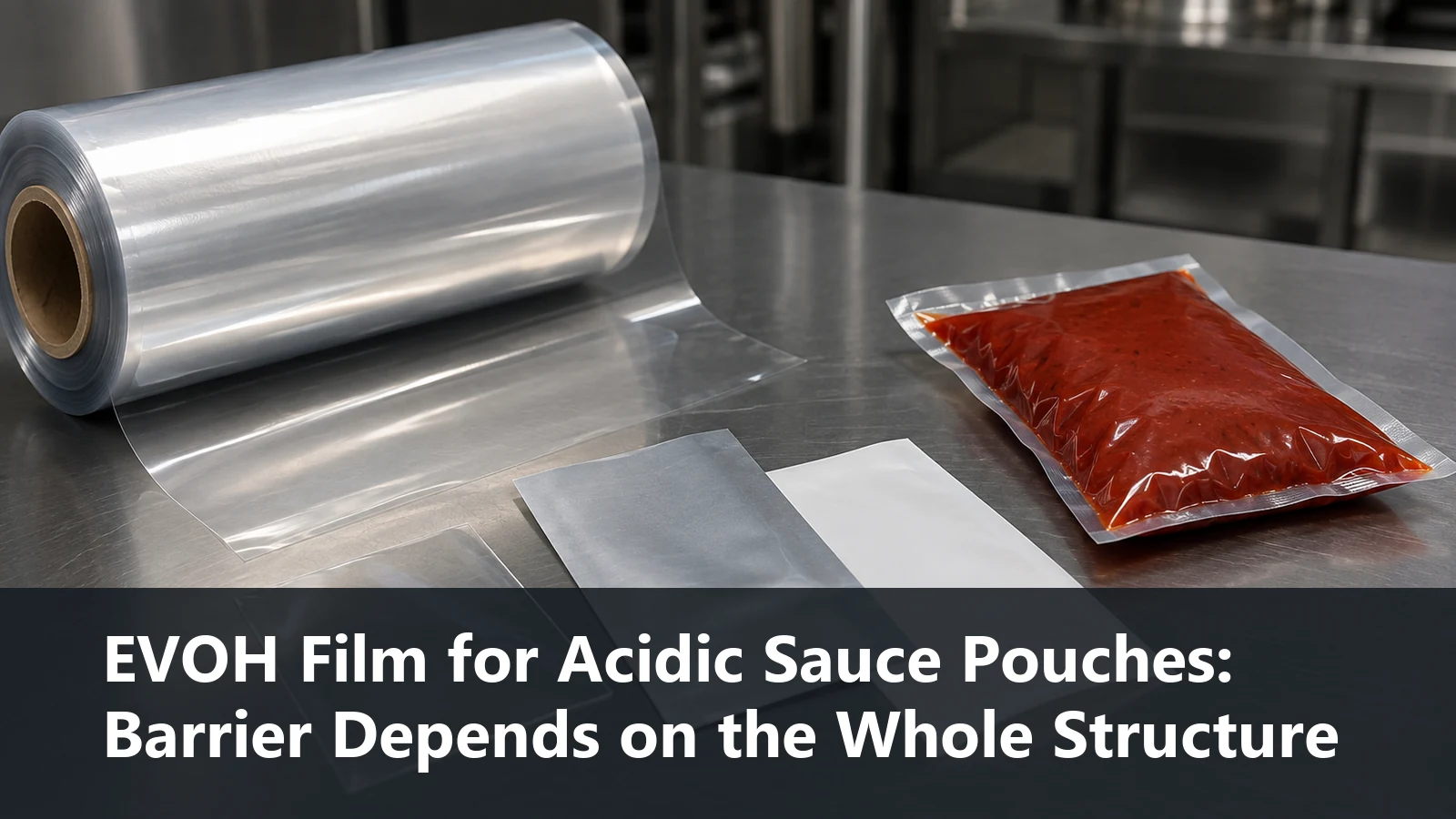
EVOH, or ethylene vinyl alcohol copolymer, is commonly discussed in food packaging for its oxygen-barrier function. In a pouch, however, EVOH is normally only one part of a multilayer system.
A sealant/contact layer may provide sealing functionality. Another layer may provide mechanical support or puncture resistance. A printable outer layer may support graphics and handling. Depending on the construction, tie or adhesive layers may also be necessary to keep dissimilar materials together.
This distinction matters during sourcing because a good barrier layer does not automatically provide good sealing, printability, mechanical strength, or complete package protection. Buyers should request a structure diagram and an explanation of what each layer is intended to do, rather than evaluating the pouch from the word “EVOH” alone.
Why Does Humidity Matter to EVOH Oxygen-Barrier Performance?
Humidity is one reason EVOH should be evaluated as part of a complete structure. The P8 research card retains a Washington State University research record on EVOH-containing multilayer films under thermal processing; it is a research lead, not a specification for this pouch. For this project, barrier behavior must be confirmed with the proposed grade and complete structure at the stated temperature and relative humidity.
For an acidic sauce project, this raises practical questions: Where is the EVOH layer located? Which surrounding layers help protect it from moisture? What relative humidity was used when the reported OTR was measured? Does the tested specimen represent the proposed commercial structure?
The answer should come from the proposed material structure and supporting test data—not from a generic EVOH value found online. This is also why unrelated EVOH thickness or permeability figures should not be copied into a purchasing specification without understanding their test conditions.
Why Should OTR and WVTR Be Evaluated Separately?
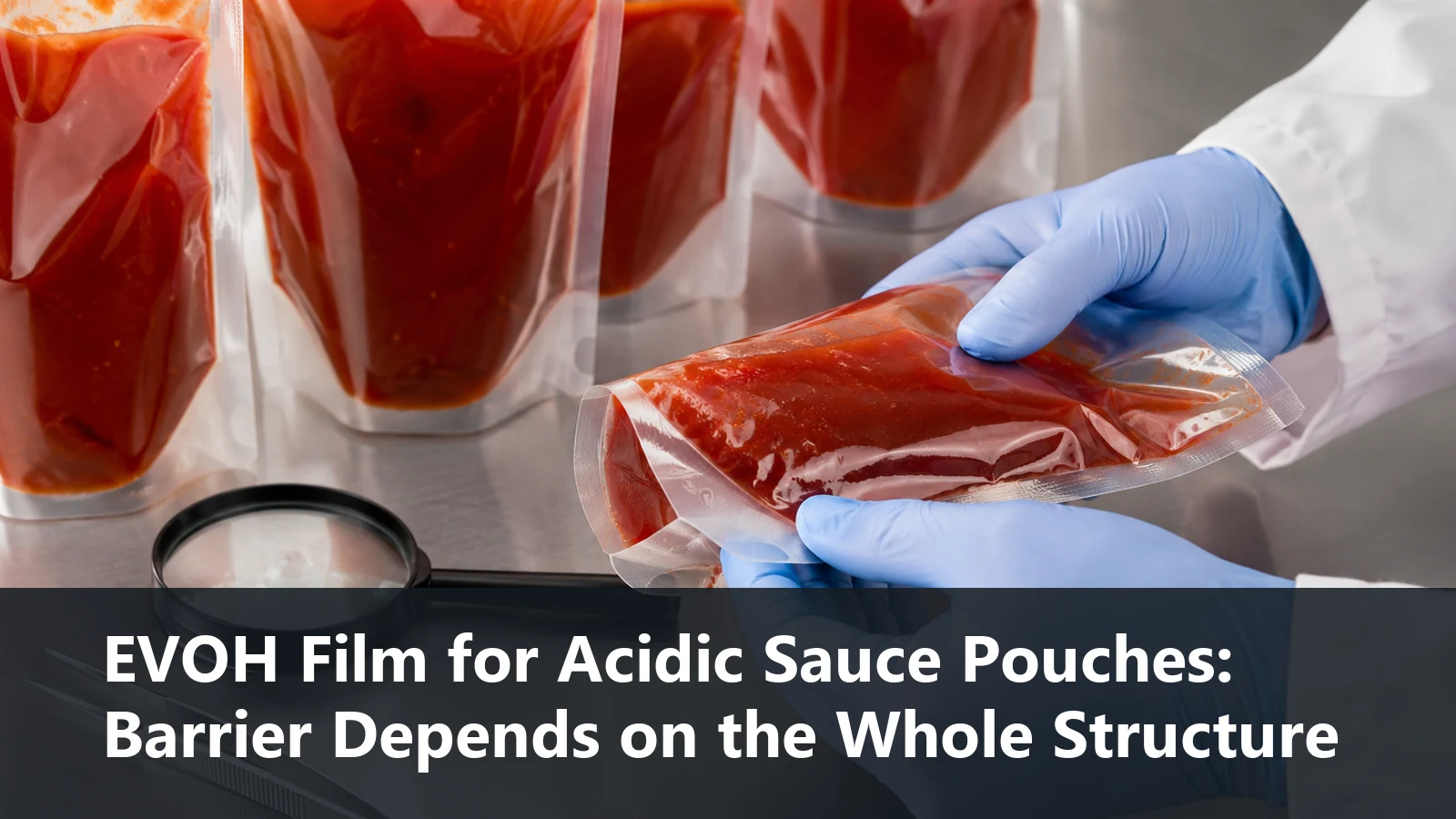
OTR and WVTR answer different questions. OTR (Oxygen Transmission Rate) describes oxygen transmission through a specified specimen under stated conditions. WVTR (Water Vapor Transmission Rate) describes water-vapor transmission. Their relevance depends on the product's defined failure mode.
A structure with an appropriate oxygen barrier does not automatically meet a project's moisture-barrier requirement. Buyers should therefore establish OTR and WVTR requirements separately when both are relevant.
Before comparing values, confirm the unit, test method, temperature, relative humidity, specimen thickness, and specimen structure. Do not set a generic OTR or WVTR target from this article. The target must be set against the actual product, shelf-life objective, process, pouch format, and distribution conditions.
Why Can’t Buyers Compare EVOH Barrier Numbers Without Test Conditions?
Imagine receiving two technical sheets. Both suppliers describe their products as having an excellent oxygen barrier, and both provide an OTR number. The smaller number may appear to be the obvious winner.
But first ask: Were the specimens tested at the same temperature and relative humidity? Are the units the same? Is the thickness comparable? Was one result measured on an EVOH-containing film while the other was measured on a complete laminate?
Also check whether the number is a typical value, individual test result, specification limit, or guaranteed requirement. Without this information, ranking two structures solely by the headline OTR value can be misleading. Request enough test information to make an apples-to-apples comparison—or acknowledge where direct comparison is not possible.
Film Barrier vs. Laminate Barrier vs. Finished Pouch Performance: What Is the Difference?
Film Barrier ≠ Laminate Barrier ≠ Finished Pouch Performance.
Film-Level Data
Film data describe the tested specimen under defined laboratory conditions. They are valuable for screening and material comparison, provided the conditions are known.
Laminate or Coextruded Structure
Once EVOH becomes part of a laminate or coextruded film, consider the entire construction: barrier protection, sealing layer, mechanical layers, interfaces, thicknesses, and intended converting process.
Finished Pouch
The finished pouch adds seals, pouch geometry, converting quality, handling, closures or fitments where applicable, and possible defects. An excellent EVOH-layer result cannot, by itself, prove the performance of the commercial pouch.
How Do Filling and Thermal-Processing Conditions Change the Structure Decision?
Do not assume every acidic sauce follows the same filling process. Some projects may involve elevated filling temperatures or additional thermal treatment; others may use different processing routes. The required structure should reflect what the package will actually experience.
Before selecting materials, confirm filling temperature, post-fill treatment, thermal exposure, process duration, cooling conditions, and equipment requirements where applicable. These conditions can affect more than the barrier layer: sealant selection, adhesives or tie layers, dimensional stability, mechanical performance, and package integrity may also need consideration.
Neither a hot-fill nor a retort structure should be specified simply because the product is an acidic sauce. The actual process must be defined and the proposed structure validated for it.
Why Does Seal Contamination Matter for Sauce Pouches?
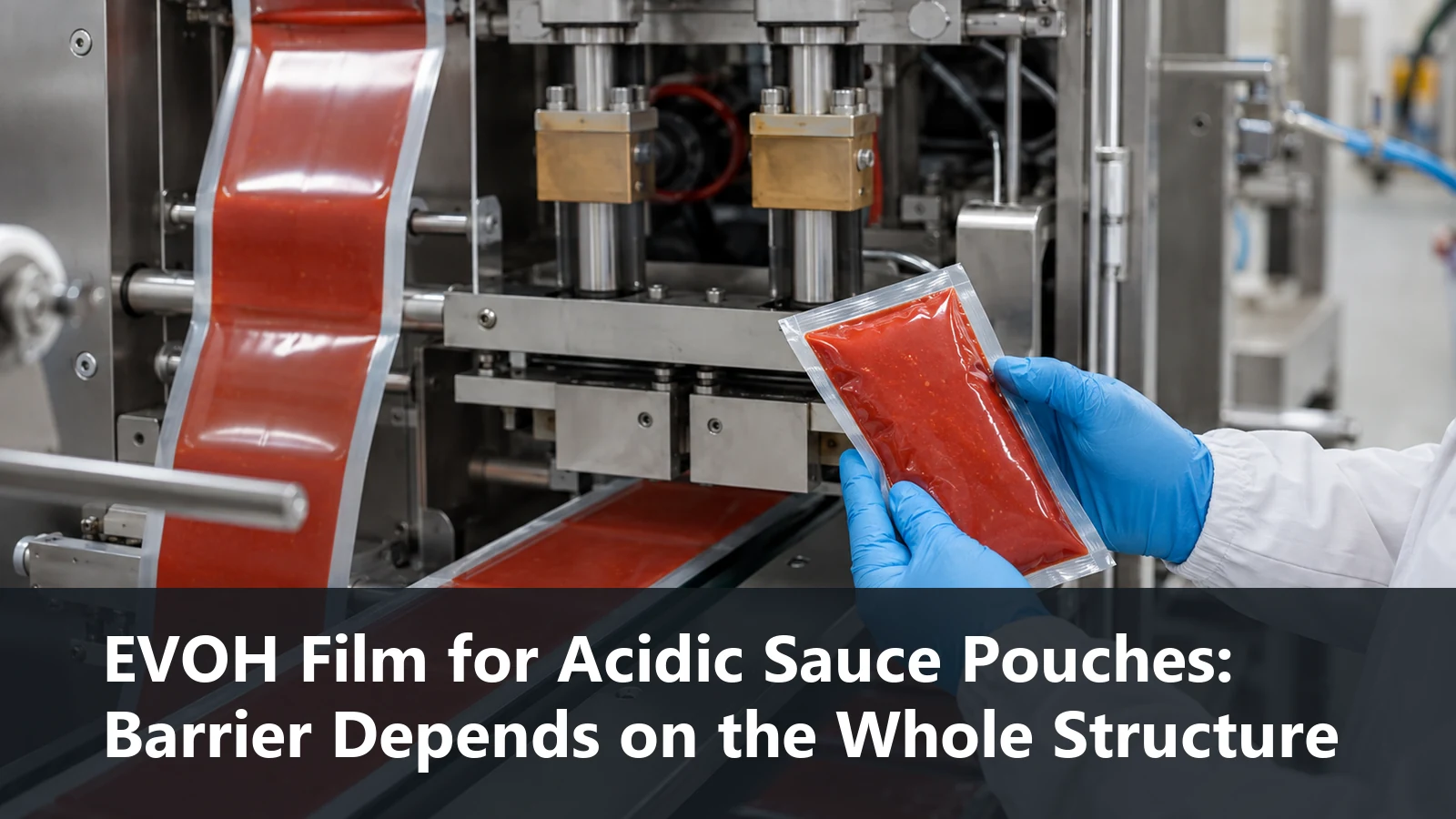
Barrier performance cannot compensate for a poor seal. With sauces and other flowable products, product in the seal area can interfere with sealing. This article does not claim a contamination tolerance for any film. That tolerance must be established on the intended filling line and finished pouch.
For buyers, the practical questions include: Is the sealant layer suitable for the intended process? What sealing window is expected? How does the packaging line control the seal area? How will seal integrity be checked after filling? The answers require trials on the actual package and equipment rather than assumptions based on EVOH barrier data.
What Other Risks Should Be Validated Besides Oxygen Barrier?
A commercial sauce pouch has to survive more than a permeability test. Depending on the application, buyers may need to evaluate puncture and handling performance, seal integrity, laminate durability, filling compatibility, transportation stresses, and finished-package integrity. Select the relevant tests for the specific project.
This prevents a common sourcing mistake: optimizing one attractive specification while overlooking another failure mode that matters more in actual distribution.
What Food-Contact and Migration Documents Should Buyers Request?
Material names do not prove regulatory compliance. Instead of assuming an EVOH-containing structure is “FDA approved,” “EU compliant,” or suitable for every food-contact application, review documentation for the specific materials or grades, intended use, complete structure where relevant, and target market.
Depending on the project and destination market, appropriate supplier declarations, food-contact documentation, migration information, or other supporting records may be required. No market-specific compliance claim is made here because the destination market, material grade, complete structure, intended food-contact conditions, and supporting declaration have not been supplied.
Review this documentation against the actual application. A statement found for an unrelated EVOH grade or another supplier should never be treated as evidence for the material being purchased.
What Low-, Medium-, and High-Complexity Starting Points Can Buyers Discuss?
It can be useful to organize early supplier discussions by relative solution complexity. Here, complexity means material and converting complexity only. It does not indicate price, MOQ, lead time, or guaranteed performance.
A lower-complexity starting point may be appropriate when the product, process, barrier requirement, and pouch design can be addressed with a relatively straightforward construction. Buyers still need to validate barrier, sealing, mechanical performance, and food-contact requirements.
A medium-complexity starting point may be worth discussing when the package needs a more deliberate balance of oxygen barrier, moisture protection, sealing, printing, and mechanical functions.
A higher-complexity starting point may be considered when demanding barrier targets, processing conditions, distribution risks, shelf-life requirements, or multiple functional requirements must be managed together. More complex does not mean better. The objective is to use a structure that addresses the defined requirements without adding layers or specifications that the project cannot justify.
What Should Buyers Ask an EVOH Packaging Supplier Before Requesting a Quote?
A useful RFQ should contain more than dimensions and quantity. Request a complete structure diagram, the function of each material layer, relevant EVOH-layer information, and OTR/WVTR data with test conditions. Ask for the TDS and relevant test reports, and clarify which values are typical and which are actual purchasing specifications.
Where required, request appropriate target-market food-contact documentation. Then move beyond paperwork: ask for samples and define how the material will be evaluated through converting or pouch trials, package-integrity checks, and product validation.
How Should Buyers Validate an EVOH Sauce-Pouch Structure Before Commercial Approval?
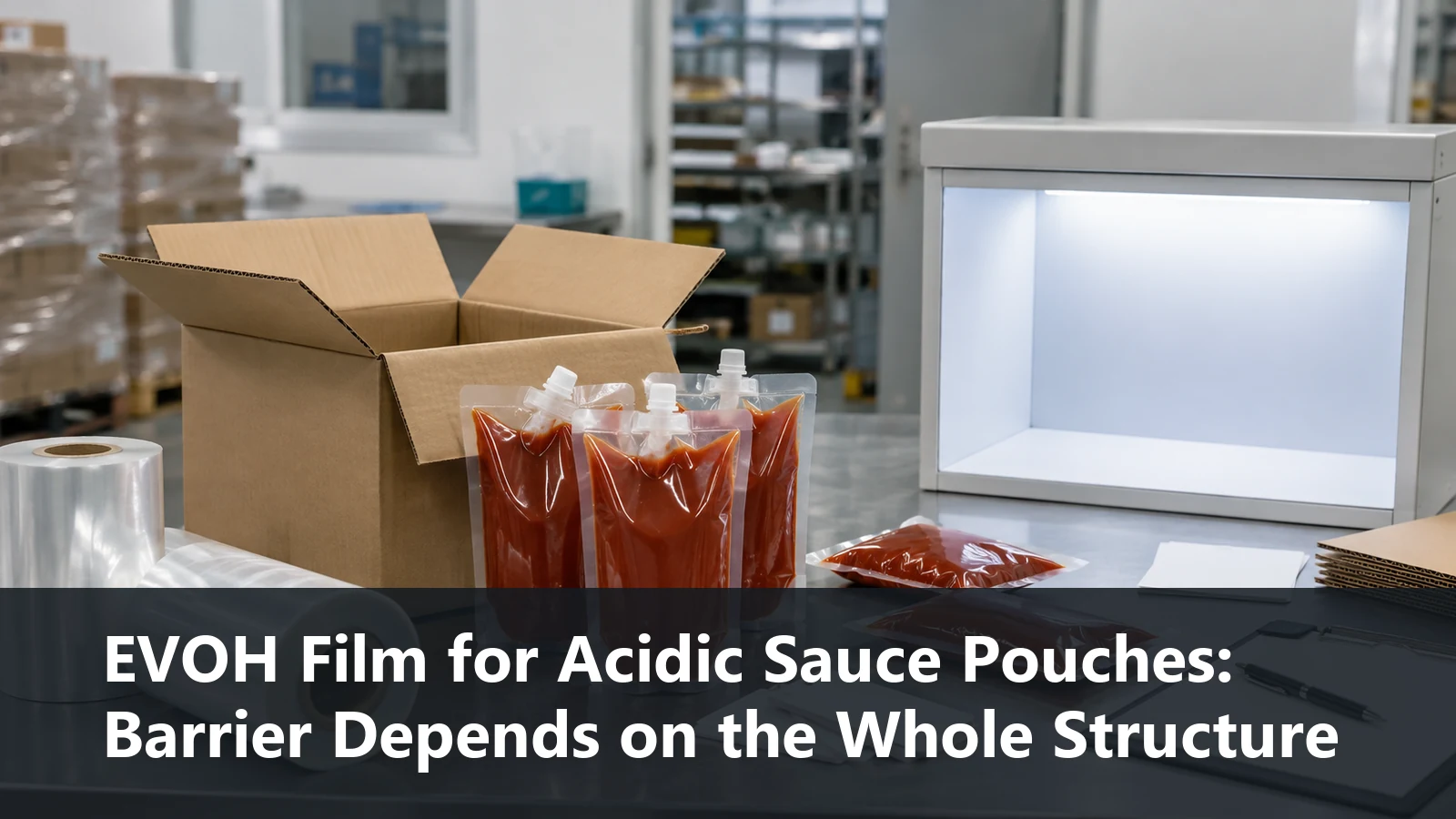
Define Sauce → Define Shelf-Life Target → Define Filling and Distribution Conditions → Set Packaging Requirements → Review Structure → Review OTR/WVTR Evidence → Review Documentation → Obtain Samples → Run Pouch Trials → Check Package Integrity → Validate Product and Shelf Life → Commercial Approval
This process separates a promising material concept from a validated packaging solution. Do not convert an OTR result directly into a claim that the sauce will achieve a specific shelf life. Product shelf life should be validated using the actual product, package structure, process, and relevant storage conditions.
Where Does CHALVO Fit Into the Sourcing Process?
CHALVO is a China-based packaging-film sourcing and customization partner. For an EVOH sauce-pouch project, the most useful starting point is not simply requesting “EVOH film,” but sharing the application requirements that define the sourcing task.
Buyers can provide the sauce and pouch application, target barrier requirements, proposed or existing structure, filling conditions, destination market, and validation needs. These details create a clearer basis for discussing suitable sourcing and customization directions and identifying what technical evidence should be requested before approval.
Summary
EVOH can be a useful oxygen-barrier layer, but an acidic sauce pouch should be approved as a complete packaging system. Define the sauce and process first, compare OTR/WVTR under stated conditions, review every layer’s function, and validate the finished pouch before making a commercial decision.
Sources for further verification
- https://rex.libraries.wsu.edu/esploro/outputs/doctoral/Barrier-properties-of-ethylene-vinyl-alcohol/99901055021101842
- https://www.glenroy.com/blog/barrier-film-laminations-explained-food-pharma-and-pets
- https://blog.impactplastics.co/blog/what-is-evoh-and-how-is-it-used-in-food-packaging
Technical questions still requiring project evidence
- What are the sauce formulation, fill temperature, post-fill thermal exposure, target shelf life, storage profile, and destination market?
- Which EVOH grade, layer thickness, surrounding layers, adhesive or tie layers, and finished-pouch construction are proposed?
- Which OTR and WVTR methods, units, temperatures, relative humidities, and specimen thicknesses apply to the proposed complete structure?
- What food-contact and migration records apply to that specific structure and target market?
- What finished-pouch trial, seal-integrity, distribution, and shelf-life evidence supports commercial approval?