


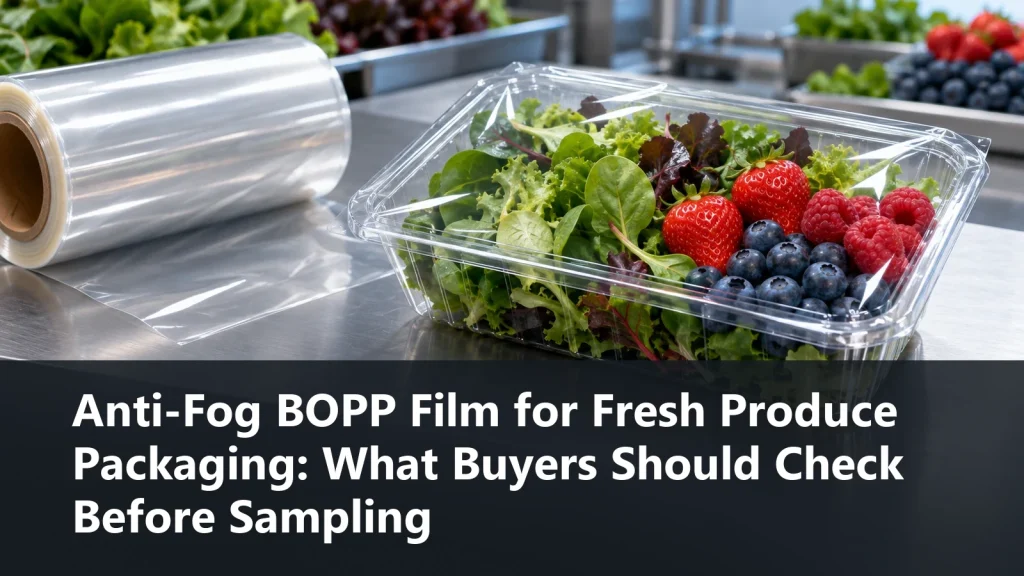

Fogging complaints often start with a simple request: “Please send us a 30-micron anti-fog BOPP sample.” But thickness and an anti-fog label are not enough. If the application, functional sides, roll format, sealing requirements and cold-chain conditions are unclear, even a successful-looking sample may tell you very little.
Before sampling anti-fog BOPP film for fresh produce packaging, buyers should confirm the produce and pack format, exact film role and grade, thickness and roll dimensions, anti-fog and corona sides, sealing or easy-peel requirements, printing or lamination interface, machine conditions and cold-chain route. The trial method and acceptance criteria should also be agreed in advance. Any technical values should come from the latest grade-specific TDS or sample data under stated test conditions.
In other words, qualify the application first and sample second. That turns a roll of film into a controlled trial instead of an expensive guessing exercise.
What Does Anti-Fog BOPP Actually Do?
Fresh produce can release moisture, while changes in temperature can cause water vapor to condense on the inner surface of a package.
On an untreated surface, condensation may form many small droplets. Those droplets scatter light, making an otherwise transparent pack look cloudy or “fogged.”
An anti-fog surface changes how condensed water wets the film. Instead of remaining as many scattered droplets, the moisture is encouraged to spread into a more continuous layer, helping maintain visibility through the package.
That basic principle matters when specifying the film. The functional anti-fog surface normally needs to be positioned toward the environment where condensation occurs. In a fresh-produce pack, that is typically the produce-facing side. Buyers should confirm the intended functional-side orientation for the exact grade rather than assuming it from the product name.
Why Does Condensation Form Inside Fresh-Produce Packaging?
Condensation is strongly influenced by moisture and temperature.
Washed leafy vegetables, fresh-cut produce, mushrooms and similar products can create a humid package environment. Moving a pack from production through refrigerated storage, transport and retail display can expose it to changing temperatures.
This is why an anti-fog result observed under one condition does not automatically predict performance throughout a commercial cold chain.
Anti-fog should also not be confused with moisture-barrier performance. It manages how condensation behaves on a surface; it does not, by itself, solve the moisture balance of the package.
When Does Anti-Fog BOPP Fit a Fresh-Produce Pack?


Anti-fog BOPP can be considered when a BOPP web is appropriate for the package and clear product visibility is important under condensation-prone conditions.
Potential applications include:
- Salad greens and leafy vegetables
- Herbs
- Mushrooms
- Fresh-cut fruit and vegetables
- Vegetable pouches
- Flow-wrap applications
- Tray-lidding structures
- Printed bags with clear product windows
However, “used for vegetables” is not a complete specification.
A film running as a mono web on a flow-wrapper has different requirements from BOPP intended as a layer in a BOPP/nylon laminated structure. A double-sided heat-sealable film may have different functional-surface requirements from a heat-sealable easy-peel grade intended for tray lidding.
Before discussing a sample, define what job the BOPP layer actually performs.
Before Sampling, Define What the Film Must Actually Do
Start With Produce, Pack Format and Film Role
First describe the product, not the film.
Is the produce whole, cut or washed? Is it packed wet or relatively dry? Is the film forming a vegetable pouch, running through flow wrap, becoming tray lidding, or entering a printed laminate?
Then identify whether the BOPP is the complete packaging web or one component of a laminate.
These questions help narrow the grade before anyone cuts a sample roll.
Read the TDS by Grade, Not by Product Name
“Anti-fog BOPP” describes a function, not a complete technical specification.
Ask for the latest grade-specific technical data sheet (TDS) and identify which reported properties matter to your process. Depending on the grade and application, these may include haze, light transmission, coefficient of friction (COF), heat-seal behavior and anti-fog test results.
Do not fill missing values with assumptions from another supplier, another thickness or a generic BOPP data sheet.
Where a value matters to qualification, request the actual value together with its test method and test conditions.
| Evidence | What it can help verify | What it does not prove by itself |
|---|---|---|
| Grade-specific TDS | Declared properties and applicable test methods for a particular grade | Performance on your exact packaging line |
| COA | Reported characteristics of a supplied lot | Universal suitability for every anti-fog application |
| Food-contact documents | Applicable compliance information for a stated material and market | Machine performance or cold-chain anti-fog results |
| Sample/trial data | Performance under the stated trial conditions | Performance under different products, temperatures or converting conditions |
A document is useful only when you understand what question it answers.
Confirm the Exact Anti-Fog Grade and Functional Side

Buyers may request single-sided or double-sided anti-fog treatment. That distinction must be confirmed before sampling.
Some inquiries also specify anti-fog grades using A/B/C-style or ASTM-style ratings. A letter alone should not be treated as a universal performance guarantee. Ask which method, conditions and grading system produced that result, then compare it with your intended trial.
Most importantly, identify the anti-fog side and how the roll must unwind so that the correct surface faces the produce.
Check Heat Seal, Easy Peel, Corona and Anti-Fog Together
This is one of the easiest areas in which to request the wrong sample.
A buyer may need anti-fog functionality, double-sided heat sealing, an easy-peel interface, single- or double-sided corona treatment, printing and lamination in the same project.
Those functions cannot simply be listed independently.
For example, the side needed for anti-fog performance may also be involved in the sealing structure. Printing or laminating on the wrong surface can cover or alter the intended anti-fog interface. A heat-seal layer and anti-fog function may also compete for the same side.
Map the two film surfaces before approving the sample:
Side A: What faces it? Is it printed, laminated, sealed or exposed?
Side B: What faces it? Does it require anti-fog, corona treatment, heat sealing or easy peel?
Have the supplier confirm that the requested combination exists in the proposed grade.
Lock Down Thickness and Roll Geometry

A common inquiry is for 30-micron anti-fog BOPP, but buyers may also discuss 20, 30 or 40 microns, with projects sometimes falling within a broader approximately 20–50 micron discussion range.
These figures should be treated as specification inputs, not universal availability claims.
Roll format matters just as much. Vegetable-pouch inquiries, for example, can involve narrow widths such as 180, 190, 210 or 250 mm.
Confirm:
- Film thickness and width
- 3-inch or 6-inch core requirement
- Required roll length
- Maximum acceptable roll outside diameter (OD)
- Winding direction
- Which functional side faces inward/outward on the roll
A chemically suitable film in the wrong roll configuration may still be unusable on the buyer's machine.
Give the Supplier the Actual Packaging-Line Inputs
Provide the machine type, operating route and relevant converting conditions before sampling.
Include expected machine speed and sealing requirements. If you have an established sealing window, share it. If you do not, request the grade-specific information available from the supplier rather than assuming a temperature from another BOPP film.
For custom printing, specify whether clear windows are required and provide artwork, Pantone references and ink-system requirements, such as water-based ink where applicable.
For laminated structures, state the complete proposed construction rather than requesting “anti-fog BOPP for lamination” without explaining which side will be laminated.
Why Cold-Chain Conditions Must Be Part of the Sample Specification

A fresh-produce package rarely stays at one temperature.
Its route might include packing, pre-cooling or refrigerated storage, transport, distribution and retail display. Temperature changes can change the condensation challenge, so fog may disappear under one condition and return after another transition.
That makes cold-chain information part of the film specification.
Tell the supplier the expected refrigerated or cold-chain storage temperature and, where known, the significant temperature transitions in the real route.
Design the Trial Before the Sample Arrives
Decide what a successful sample means before testing it.
Define the test method, observation points and acceptance criteria. Where practical, keep variables controlled and change one relevant variable at a time. Comparing several films while simultaneously changing sealing conditions, package design and storage route can make the result difficult to interpret.
When the sample arrives, record its grade, roll ID, lot identification and conditioning information available to you.
Then document what happened during converting, packing, cold storage and temperature transitions. Photographs taken at predefined observation points can make comparisons more useful.
This turns “it looked foggy” into trial evidence that can support the next qualification decision.
What Anti-Fog BOPP Cannot Fix
Anti-fog film has a specific job. Giving it responsibility for unrelated packaging functions creates unrealistic expectations.
Anti-fog treatment is not automatically:
- A moisture-barrier solution
- A produce-respiration control system
- A substitute for perforation or modified-atmosphere packaging (MAP) design
- A solution for poor seal integrity
- A shelf-life guarantee
Produce physiology, gas exchange, moisture, temperature, package construction and distribution conditions can interact.
If shelf life, respiration management or gas transmission is critical to the project, those requirements need their own packaging evaluation. Do not infer them from an anti-fog claim.
What Failure Symptoms Can Tell You
When a trial fails, avoid jumping immediately to “the anti-fog film doesn't work.”
Fogging across the complete window could point to unsuitable performance under the tested conditions, but it could also justify checking orientation and whether the intended anti-fog surface actually faces the package interior.
Localized fogging may justify reviewing product contact, moisture distribution and temperature differences.
Unexpected sealing behavior should trigger a check of the grade, seal interface and machine settings. A problem appearing only after printing or lamination should trigger a review of which functional surface was converted.
If clarity is acceptable initially but fog returns after temperature cycling, document exactly when the change occurs.
The symptom begins troubleshooting. It is not the conclusion.
Pre-Sampling Checklist for Anti-Fog BOPP Buyers
Use this information to create a sample request that can actually be evaluated.
| Check | Information to send or confirm |
|---|---|
| Produce | Product type; whole/cut/washed; relevant moisture condition |
| Pack | Pouch, flow wrap, tray lidding, printed bag or other format |
| Film role | Mono web or layer within a specified laminate |
| Film dimensions | Thickness and width |
| Roll | Core, roll length, maximum OD and winding direction |
| Anti-fog | Required side(s), functional orientation and requested rating/test method |
| Sealing | Seal sides, heat-seal requirements and easy-peel interface if needed |
| Corona | Required treated side(s) |
| Printing | Artwork, Pantone references, ink requirements and clear windows |
| Machine | Machine type, speed and relevant sealing conditions |
| Cold chain | Packing/storage/display temperatures and important transitions |
| Documents | Destination market and required food-contact documentation |
| Trial | Method, control/comparison, acceptance criteria and observations to record |
Commercial information also helps suppliers plan the correct sample and potential supply route. A buyer might discuss 5 tons per month, 300 tons per year or future 40HQ container orders, for example.
Likewise, buyers may target a lead time around one to two weeks.
These should remain inquiry parameters, not assumptions. MOQ, production availability, sample timing, lead time and container planning need confirmation for the selected grade and order conditions.
The same principle applies to documentation. If the process is to share a TDS after specifications are confirmed, make sure the document subsequently supplied corresponds to the actual candidate grade.
How CHALVO Supports Pre-Sampling Qualification
CHALVO (Hangzhou Chalvo New Material Co., Ltd.) works as a packaging-film export and supply-chain integration company.
For anti-fog BOPP inquiries, CHALVO's role can include helping buyers organize application requirements, identify candidate grades through its supplier network, coordinate available grade-specific TDS/COA and applicable food-contact documents, define sample scope and support communication during the trial process.
The goal is not to promise performance before testing.
It is to reduce ambiguity before the sample is selected, so the buyer and supplier know what is being tested and why.
Final suitability still depends on the selected grade, actual package construction, converting process, product and trial conditions. When technical evidence is missing, buyers should request the latest grade-specific TDS or sample data rather than rely on a generic claim.
FAQ: Anti-Fog BOPP Film for Fresh Produce
Is 30-micron anti-fog BOPP automatically suitable for vegetable packaging?
No. Thirty microns describes thickness, not complete application suitability.
You still need to confirm the exact grade, produce and pack format, functional sides, sealing requirements, roll configuration, converting process and cold-chain conditions. Use the latest grade-specific TDS and controlled sample results for technical qualification.
Does anti-fog coating actually work in refrigerated packaging?
Anti-fog technology is designed to change how condensation wets the film surface, which can help maintain visibility. However, actual performance depends on the film grade and conditions.
For refrigerated packaging, request grade-specific evidence with the test method and conditions, then test the film through a cold-chain route representative of your application.
Which side of anti-fog BOPP should face the produce?
The intended anti-fog surface generally needs to face the condensation-prone package interior and therefore the produce side in these applications.
Do not identify that side by guesswork. Confirm the functional-side specification and winding orientation for the exact grade before running the sample.
Can anti-fog BOPP be printed or laminated?
Potentially, but the surface configuration needs to be designed correctly.
Confirm which side is anti-fog treated, corona treated, printable, sealable or intended for lamination. Printing or laminating the wrong surface may interfere with the intended anti-fog function. For a BOPP/nylon or other laminate, provide the complete proposed structure.
What should I send before requesting an anti-fog BOPP sample?
At minimum, send the produce type, pack format, film role, thickness, roll dimensions, required functional sides, sealing requirements, printing or lamination requirements, machine route and cold-chain conditions.
Also state the destination market, required food-contact documentation and how you intend to judge the sample.
Summary
Anti-fog BOPP qualification should begin before the sample roll is shipped. Define the produce, structure, functional sides, roll format, machine and cold-chain route; verify grade-specific evidence; then establish trial criteria. A controlled sample can answer a purchasing question. An undefined sample often creates another one.
CTA
Planning an anti-fog BOPP trial? Send CHALVO your produce type, pack format, film role, machine route, cold-chain route and current fogging issue. Add your target thickness, roll dimensions, sealing, printing or lamination requirements where available. CHALVO can use those inputs to help clarify candidate grade and sample scope and coordinate available grade-specific documentation through its supplier network before the trial begins.
Sources for further verification
- Jindal Poly Films, flexible packaging applications – supplier application context for anti-fog BOPP used with fruit and vegetable packs; not a CHALVO product specification.
- Cosmo Films, transparent anti-fog packaging films – supplier application context for visibility-oriented food packaging; not a performance guarantee.
- U.S. FDA, food packaging and other substances that come into contact with food – food-contact regulatory context for the destination-market review.
- Commission Regulation (EU) No 10/2011 – EU plastic food-contact regulatory context where applicable.